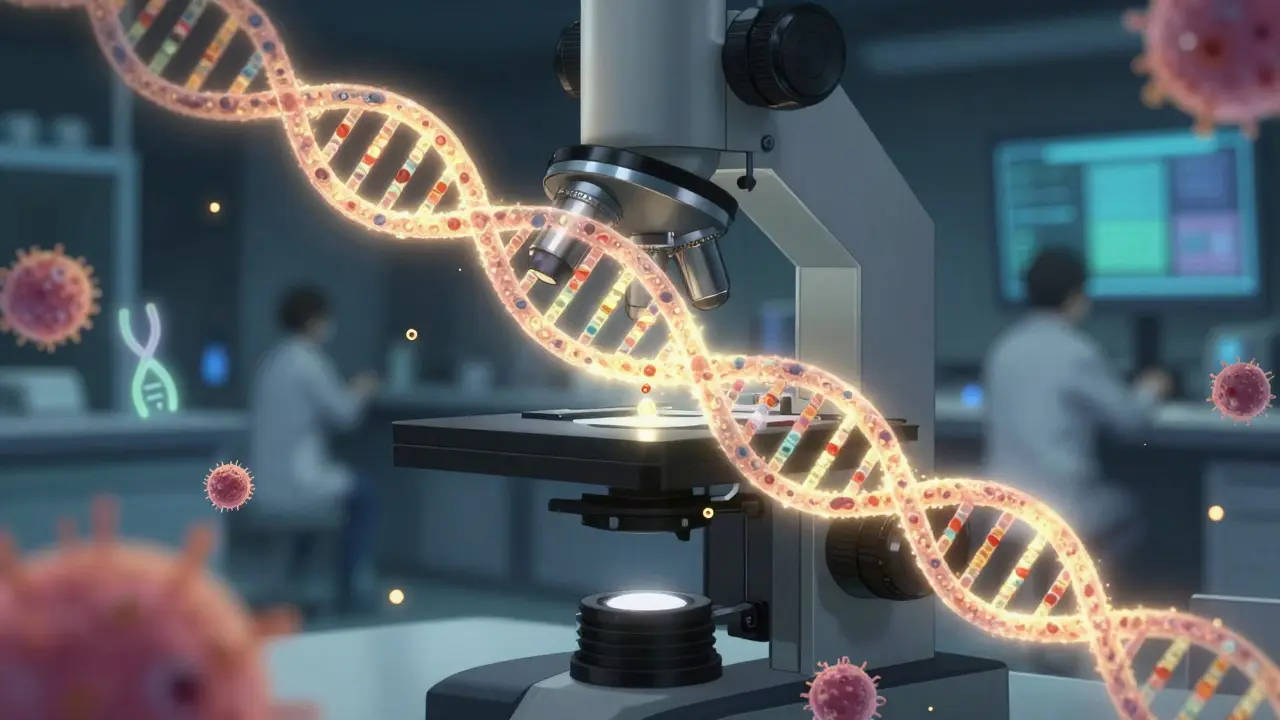
Imagine knowing if your cancer treatment is working before your next scan shows any change. No needles into your lung. No surgery to pull out tissue. Just a simple blood draw that tells you if the tumor is shrinking, growing, or hiding mutations that make drugs useless. This isn’t science fiction. It’s happening right now in clinics-from Sydney to San Francisco-using something called circulating tumor DNA, or ctDNA.
What Is Liquid Biopsy, Really?
A liquid biopsy isn’t a biopsy in the traditional sense. You don’t cut into anything. Instead, it’s a blood test that looks for tiny fragments of DNA shed by cancer cells into your bloodstream. These fragments are called circulating tumor DNA, or ctDNA. When cancer cells die, they break apart and release pieces of their DNA into the blood. Scientists can now fish out these pieces, read their genetic code, and learn what’s happening inside the tumor-even if it’s deep in the liver, lung, or bone. This approach started gaining real traction around 2019, but the idea of finding cancer clues in blood goes back decades. Early research looked for whole cancer cells floating in blood, but those are rare. ctDNA, on the other hand, is more abundant and easier to detect with modern tools. Today, liquid biopsy doesn’t just look at ctDNA. It also checks for tumor-derived RNA, proteins, and even changes in how DNA is packaged (methylation patterns). But ctDNA remains the star of the show.Why It Beats Traditional Biopsies
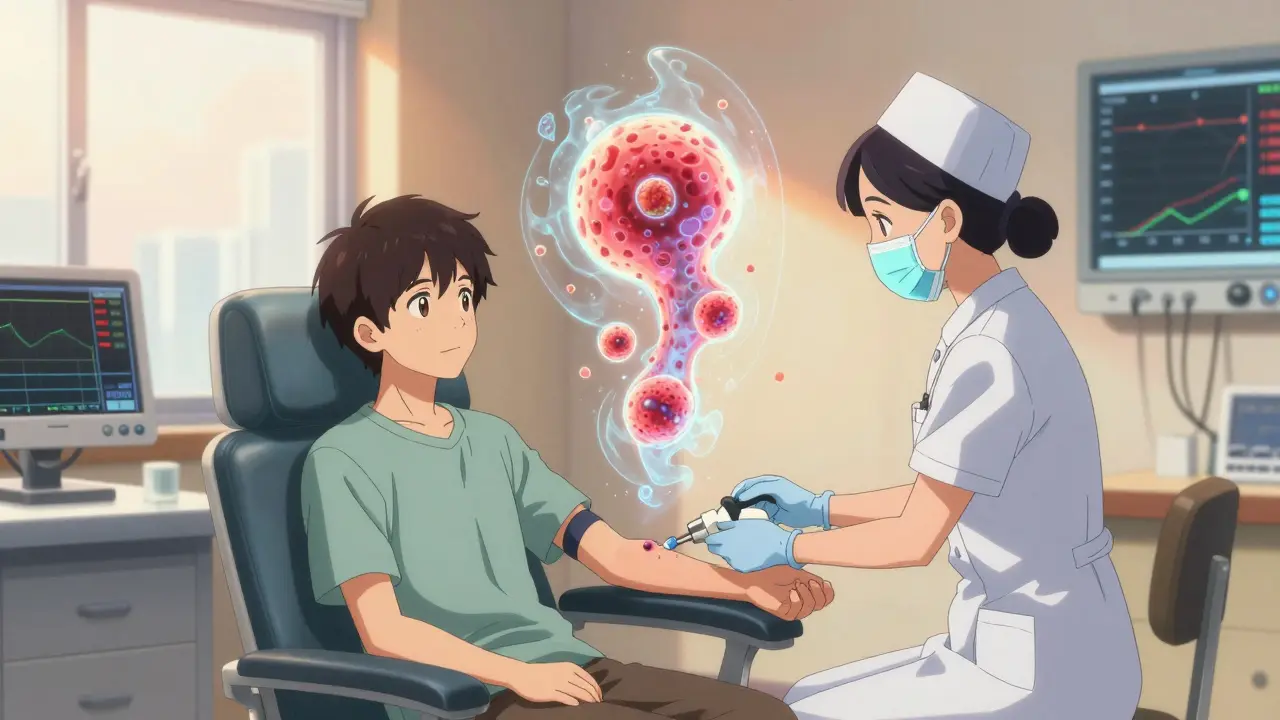
Traditional tissue biopsies are painful, risky, and often impossible. Needing to get a sample from a tumor near the spine? That’s a dangerous procedure. A tumor in the pancreas? Hard to reach. And even if you get a sample, it’s just one piece of the tumor. Cancer isn’t uniform-it changes across different parts of the body. A biopsy from one spot might miss the most dangerous mutation hiding elsewhere. Liquid biopsy fixes this. A single blood draw captures DNA from tumors all over the body. It gives a full picture, not a snapshot. Studies show single-site biopsies miss up to 30% of key mutations because of this spatial variation. Liquid biopsy catches them. It’s also repeatable. You can’t do a tissue biopsy every month. But you can draw blood every 4 to 8 weeks during treatment. That means doctors can see if a drug is working within weeks-not months. If resistance is building, they can switch therapies before the cancer spreads further. In lung cancer, ctDNA testing has found targetable EGFR mutations in 92% of cases where tissue was too small or damaged to test. That’s life-changing.How It Works: The Science Behind the Blood Test
Not all blood tests are created equal. Detecting ctDNA is like finding one wrong letter in a library of books. The cancer DNA makes up less than 0.1% of all free DNA in your blood. To find it, labs use ultra-sensitive tools. The most common methods are:- Digital droplet PCR (ddPCR): Splits blood into thousands of tiny droplets and counts mutant DNA molecules. Can detect one cancer mutation in 10,000 normal ones.
- Next-generation sequencing (NGS): Reads millions of DNA fragments at once. Can screen for dozens of cancer genes at the same time.
- Methylation analysis: Looks at chemical tags on DNA that turn genes on or off. Cancer DNA has abnormal methylation patterns-even before mutations appear. Adding this boosts detection by 20-30%.
Where It’s Making the Biggest Difference
Liquid biopsy isn’t useful for every cancer. It shines where tumors shed lots of DNA.- Non-small cell lung cancer: NCCN guidelines now say liquid biopsy is an option for first-line EGFR, ALK, ROS1 testing when tissue is limited. About 35% of metastatic lung cancer patients get tested this way.
- Colorectal cancer: ctDNA can detect recurrence after surgery with 85-90% accuracy-up to 11 months before scans show anything.
- Breast cancer: Used to monitor treatment response and spot ESR1 mutations that make hormone therapy fail.
- Melanoma and ovarian cancer: Tracking BRAF or BRCA mutations in real time helps adjust targeted therapies.
The Limits: When It Falls Short
It’s not magic. Liquid biopsy has blind spots.- Early-stage cancers: Only 50-70% of stage I tumors shed enough ctDNA to be detected. That’s why it’s not yet used for screening healthy people.
- Brain tumors: The blood-brain barrier traps most ctDNA. Detection rates can be under 40%.
- Slow-growing cancers: Like some prostate or thyroid cancers, they release little DNA. Blood tests often come back negative even when the tumor is active.
- Clonal hematopoiesis: As we age, blood cells pick up random mutations. These aren’t cancer-but they can look like it. About 10-15% of patients over 65 have this, and labs must filter it out.
- Variants of unknown significance: About 15-20% of reports find genetic changes that doctors don’t yet understand. This creates anxiety and confusion.
Real Impact: What It’s Doing in Clinics Today
At MD Anderson, liquid biopsies are now part of 35-40% of phase I clinical trials. Oncologists use them to:- Confirm minimal residual disease after surgery-meaning no cancer left behind.
- Spot resistance mutations months before tumors grow on a CT scan.
- Identify pseudo-progression: when immunotherapy makes tumors look bigger on scans, but they’re actually dying. ctDNA drops in these cases, confirming the treatment is working.
The Future: What’s Coming Next
The next five years will change everything.- Multi-analyte tests: Combining ctDNA, methylation, fragment size, and RNA into one test. Early results show sensitivity for stage I cancers rising to over 95%.
- AI-powered analysis: Machine learning is being trained to spot cancer patterns in DNA fragmentation. At MD Anderson, AI boosted diagnostic accuracy by 15-20% in early trials.
- Tumor-agnostic screening: Tests that don’t need to know where the cancer started. Just detect cancer, then figure out the source.
- Lower detection limits: Labs are pushing to find one cancer molecule in 100,000 normal ones-enough to catch recurrence even earlier.
What This Means for You
If you or someone you know has advanced cancer, ask your oncologist: “Can we use a liquid biopsy to monitor treatment?” It’s not a replacement for imaging or tissue diagnosis-but it’s a powerful companion. It gives you faster answers, fewer invasive tests, and the chance to switch therapies before it’s too late. It won’t replace mammograms or colonoscopies for screening. But for monitoring, it’s already the future. And in five years, it may be the standard.Is liquid biopsy better than a tissue biopsy?
It’s not better-it’s different. Tissue biopsies are still needed for initial diagnosis and to confirm cancer type. But for monitoring, liquid biopsy wins. It’s less risky, gives a full picture of the tumor’s genetics, and can be done repeatedly. Think of it as a real-time update, while tissue biopsy is the original report.
Can liquid biopsy detect cancer early?
For early-stage cancers, sensitivity is still limited-around 50-70% for stage I. It’s not reliable enough for population-wide screening yet. But for high-risk people-like those with BRCA mutations or a strong family history-it’s being tested in trials. Methylation-based tests show the most promise here, possibly catching cancer before it’s visible on scans.
How often should liquid biopsy be done?
During active treatment, every 4-8 weeks is common. After treatment ends, every 3-6 months for surveillance. But it depends on the cancer type. Lung cancer patients may be tested monthly during chemo. Someone with slow-growing prostate cancer might only get tested once a year. Your doctor will decide based on your risk and treatment plan.
Does insurance cover liquid biopsy?
In many countries, including Australia and the U.S., insurance covers liquid biopsy for advanced cancers when tissue isn’t available or for monitoring treatment response. Medicare and private insurers typically cover FDA-approved tests like Guardant360 or FoundationOne Liquid CDx. But coverage varies-always check with your provider and oncologist.
What if my liquid biopsy result is positive but my scan is normal?
This happens. ctDNA can detect cancer cells before they form visible tumors. A positive result with a normal scan might mean minimal residual disease-tiny amounts of cancer left after treatment. In that case, your doctor may recommend earlier or more aggressive therapy. It’s not a false alarm-it’s an early warning. Follow up with your oncologist to understand the next steps.
Can liquid biopsy replace imaging like CT or PET scans?
No-not yet. Imaging shows where the cancer is and how big it is. Liquid biopsy tells you what’s happening genetically. You need both. But liquid biopsy can reduce how often you need scans. If ctDNA stays low, you might skip a scan. If it spikes, your doctor knows to scan immediately. Together, they give a fuller picture.
Sangeeta Isaac
January 20, 2026 AT 11:58so like… you’re telling me we can now just poke a vein and see if the cancer’s throwing a rave inside my body? wild. i mean, i’d rather have a blood test than another needle in my lung, honestly. also, who knew my blood could be this dramatic? it’s basically the gossip column of my tumor.
Dee Monroe
January 21, 2026 AT 10:17It’s funny how we’ve spent decades trying to cut into people’s bodies to find out what’s wrong, when the answer was floating in their veins the whole time. This isn’t just a medical breakthrough-it’s a philosophical shift. We’re moving from invasive interrogation to gentle conversation with our own biology. The body doesn’t lie, but it used to whisper. Now it’s speaking clearly, in code we’re finally learning to read. And honestly? That’s kind of beautiful. We’re not just treating disease anymore; we’re listening to it. Every fragment of ctDNA is a story-of mutation, of resistance, of survival. We used to fear the unknown. Now we’re decoding it, one drop at a time.
Ben McKibbin
January 21, 2026 AT 20:47For years, oncologists were flying blind with tissue biopsies-grabbing one snapshot from a warzone where the enemy keeps moving. Liquid biopsy is like putting a drone overhead: real-time intel from every front. And the methylation stuff? Genius. Cancer doesn’t just mutate; it rearranges its furniture. The way DNA folds, the chemical tags it slaps on itself-that’s the real fingerprint. We’re not just reading genes anymore; we’re reading context. That’s how you catch the silent killers-the ones hiding in plain sight until it’s too late.
Philip Williams
January 22, 2026 AT 18:41While the promise of liquid biopsy is undeniable, it is imperative to acknowledge the significant heterogeneity in analytical validation across laboratories. The 25% inter-laboratory discordance rate reported in the 2023 multicenter study remains a critical barrier to clinical adoption. Standardization of pre-analytical variables, bioinformatic pipelines, and reporting thresholds must be prioritized by regulatory bodies and professional societies before widespread implementation.
Melanie Pearson
January 24, 2026 AT 13:40Let’s be honest-this is just another profit-driven gimmick disguised as science. Big Pharma and biotech firms are cashing in on the hype. You think these tests are affordable? They’re not. And who gets left behind? The uninsured, the rural, the elderly. Meanwhile, doctors are being pushed to use these expensive tools instead of listening to patients. This isn’t progress-it’s commodification of suffering. And don’t even get me started on the false positives. People are getting terrified over noise in their blood. This is medicine becoming a casino.
Alex Carletti Gouvea
January 26, 2026 AT 12:06Why are we letting foreign labs and tech companies control this? We’ve got the best scientists in the world right here in America. Why are we importing these tests from Europe and Israel? If this is the future of cancer care, it should be made in the USA. Invest in domestic biotech, fund American labs, stop outsourcing our health to global corporations. This isn’t just medicine-it’s national security.
Samuel Mendoza
January 26, 2026 AT 19:25It’s not magic. It’s just expensive guesswork with extra steps.
Steve Hesketh
January 28, 2026 AT 15:56I’ve watched my sister go through this-stage IV lung cancer, chemo, scans, the whole rollercoaster. When they did her first liquid biopsy and saw the ctDNA drop after just two weeks? She cried. Not because she was cured-but because for the first time, she felt *seen*. No more waiting months to know if the drugs were working. Just a vial of blood, and suddenly, the doctors weren’t guessing anymore. They were listening. That’s the real gift here-not the tech, but the humanity it brings back to care. We’re not just treating tumors. We’re honoring the person inside them.
shubham rathee
January 30, 2026 AT 04:08you know what they dont tell you? this tech was originally developed by the military to track enemy bioweapons and now its being sold to hospitals for 5k a pop. who really owns the data? is your dna being sold to insurance companies? i saw a leak on dark web once where a lab was selling ctDNA profiles to pharma. its all connected. they want to predict your cancer before you even know you have it… so they can charge you more to fix it
MAHENDRA MEGHWAL
January 31, 2026 AT 06:11While the clinical utility of circulating tumor DNA analysis has been demonstrated in multiple cohorts, the ethical implications of detecting variants of unknown significance (VUS) in asymptomatic individuals require careful consideration. The psychological burden of ambiguous results, coupled with the lack of actionable pathways, may lead to iatrogenic harm. Institutional review boards must establish clear protocols for VUS disclosure and counseling prior to widespread implementation.
Dee Monroe
January 31, 2026 AT 23:24And you know what’s most profound? This isn’t just changing cancer care-it’s changing how we think about time itself. Before, medicine operated on the clock of scans: every three months, every six. Now, it operates on the rhythm of biology. A drop in ctDNA? That’s not a number-it’s a heartbeat. A spike? That’s not noise-it’s a warning cry. We’re moving from calendar-based medicine to biology-based medicine. And in that shift, we’re giving patients back something they lost: agency. No longer passive recipients of waiting rooms and grim prognoses, they’re co-pilots in their own survival. That’s not just science. That’s dignity.