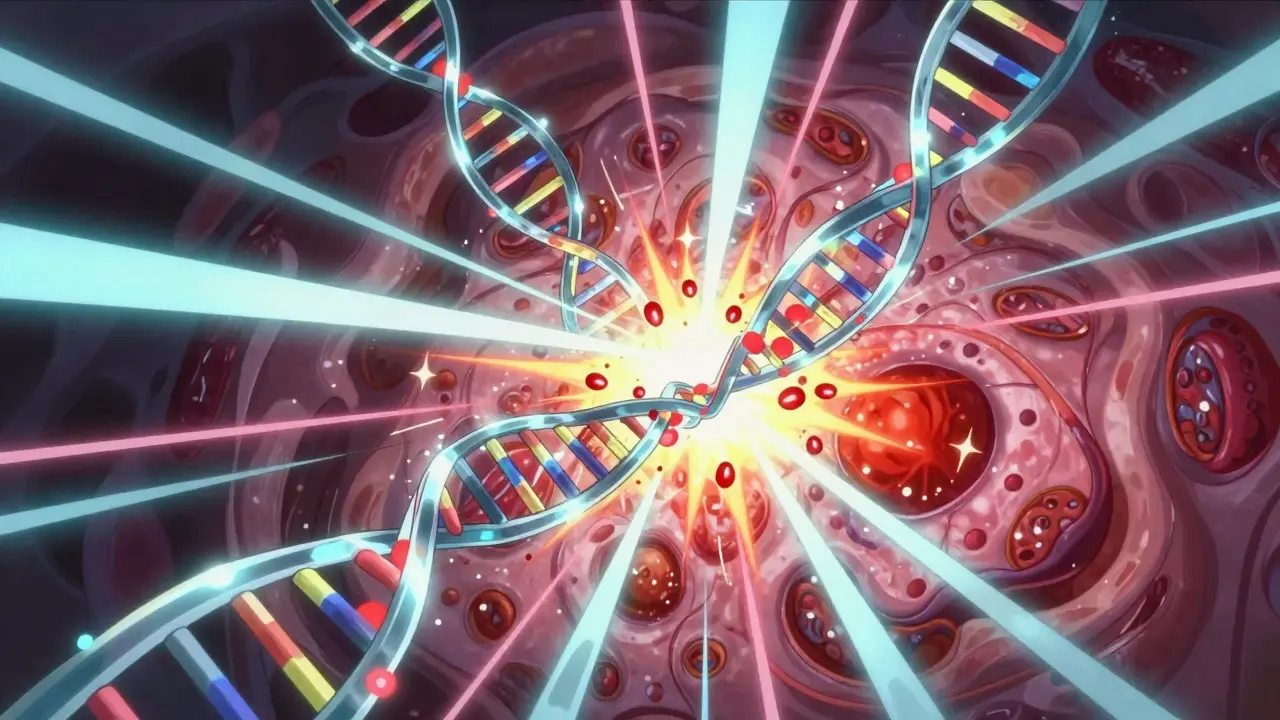
Radiation therapy is one of the most common ways to treat cancer-and it works by breaking apart the DNA inside tumor cells. It’s not magic. It’s physics and biology working together to stop cancer from growing. Every year, more than half of all cancer patients receive some form of radiation treatment. But how does it actually kill cancer cells? And why does it sometimes work better than other times?
How Radiation Breaks DNA
Radiation therapy uses high-energy particles or waves-like X-rays, gamma rays, or protons-to target tumors. These rays are called "ionizing radiation" because they knock electrons out of atoms, turning them into charged particles. This process doesn’t just nudge the DNA-it shatters it.The worst kind of damage is a double-strand break. Think of DNA like a twisted ladder. Each strand is one side of the ladder. When radiation hits, it can snap both strands at the same time. Cells can handle a single broken strand. But two breaks? That’s a disaster. The cell’s repair systems get overwhelmed. And when they fail, the cell can’t divide anymore. It dies.
This isn’t random. Radiation doesn’t just blast everything in its path. Modern machines like linear accelerators focus beams with sub-millimeter precision. Techniques like IMRT and SBRT shape the radiation to match the tumor’s exact outline. That means healthy tissue gets spared-most of the time.
More Than Just Broken DNA
It’s not just about the physical break. Radiation also creates reactive oxygen species-tiny, aggressive molecules that attack everything nearby. They chew through cell membranes, mess with proteins, and make DNA damage even worse. This oxidative stress pushes the cell toward death.There’s also the ceramide pathway. When radiation hits the cell’s outer membrane, it triggers an enzyme called acid sphingomyelinase. This enzyme turns sphingomyelin into ceramide. Ceramide isn’t just a building block-it’s a signal. It tells the cell: "You’re done." It kicks off apoptosis, the body’s clean, controlled way of killing off damaged cells.
And then there’s the blood supply. High-dose radiation, like in SBRT, doesn’t just kill tumor cells directly. It damages the tiny blood vessels feeding the tumor. Without oxygen and nutrients, cancer cells starve and die days after treatment. This is called vascular-mediated death-and it’s why some tumors shrink slowly, even when the radiation is done.
How Cells Try to Survive
Cancer cells aren’t helpless. They have repair crews. Two main teams show up after radiation: NHEJ and HR.NHEJ is the quick fix. It’s sloppy. It just glues the broken ends back together, even if it’s not perfect. It works fast, but it’s error-prone. HR is the precision team. It uses a healthy copy of DNA as a template to fix the break correctly. But HR needs a sister chromosome nearby-and that only happens during certain parts of the cell cycle.
Here’s the twist: the way a cancer cell repairs its DNA determines whether it dies quietly-or screams for help.
Research from the CMRI in Sydney found that cells using HR to fix damage die silently during cell division. No alarm. No immune response. Just gone.
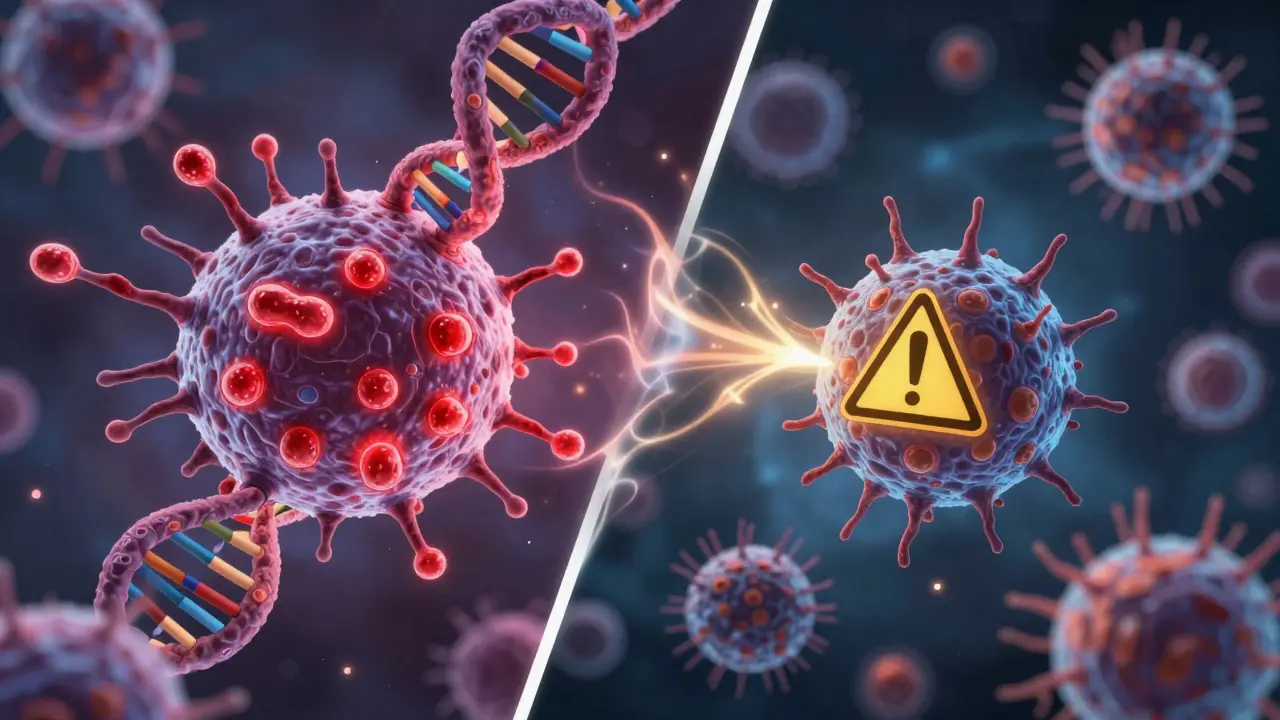
But cells that use NHEJ-or can’t repair at all-release signals. They act like they’re infected. They put up warning flags that attract immune cells. That’s huge. It means radiation doesn’t just kill on its own. It can turn the body’s own defenses against the cancer.
The BRCA Connection
About 5 to 10 percent of breast cancers and 15 to 20 percent of ovarian cancers have mutations in the BRCA1 or BRCA2 genes. These genes are essential for HR repair. So when radiation hits a BRCA-mutated tumor, it can’t fix the damage properly. The cell dies-and it dies loudly, triggering an immune response.This isn’t just theory. It’s changing treatment. Doctors are now combining radiation with immunotherapy drugs like pembrolizumab. In one trial, the response rate jumped from 22% to 36% in lung cancer patients when radiation was added to immunotherapy. The idea? Break the cancer’s DNA, then let the immune system finish the job.
Why Some Tumors Don’t Respond
Not all tumors fall apart under radiation. About 30 to 40 percent become resistant. Why?One big reason: hypoxia. Tumors often grow so fast that their blood supply can’t keep up. That means parts of the tumor are low on oxygen. Radiation needs oxygen to work well. Without it, cells need 2.5 to 3 times more radiation to die. That’s a huge problem.
Another reason: repair proteins. Some tumors overproduce proteins like 53BP1, which help them patch up DNA damage. A study of head and neck cancer patients found those with high 53BP1 levels had lower survival rates. Their cells were just too good at fixing the damage.
And then there’s the tumor environment. Fibroblasts and immune cells around the tumor can shield it. They create a protective bubble, blocking radiation and suppressing immune attacks.
The Future: Faster, Smarter, Stronger
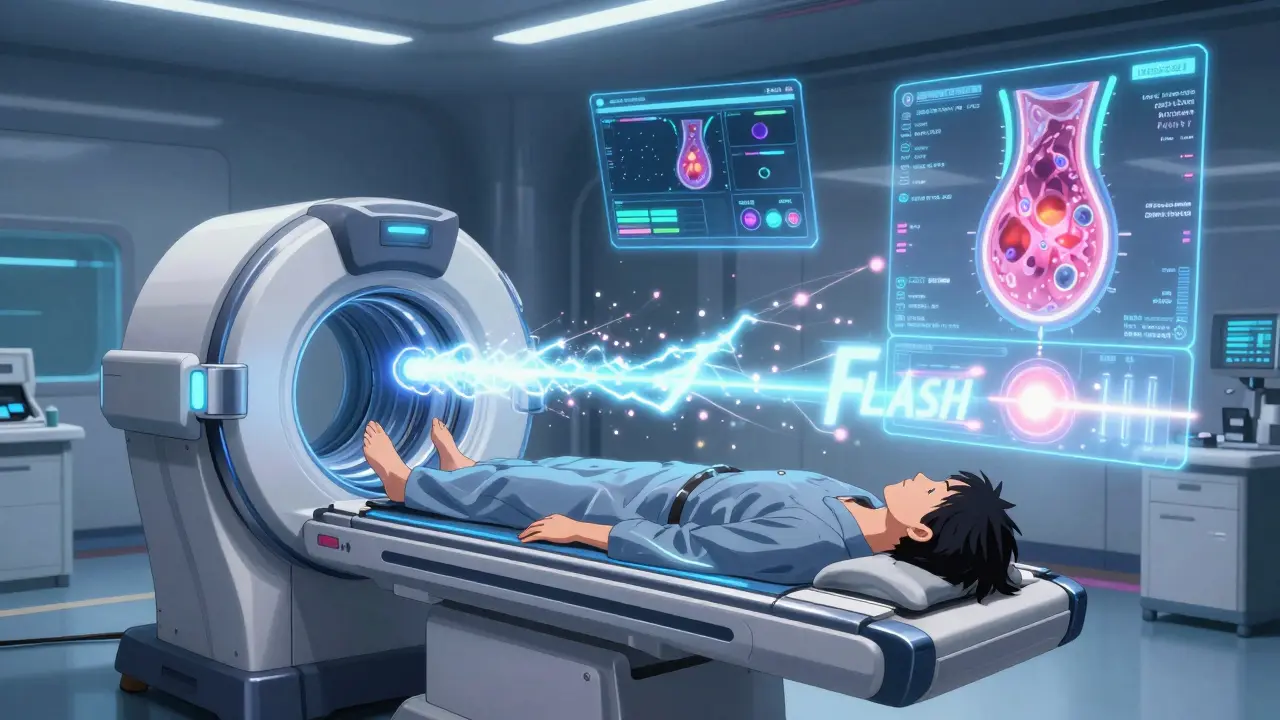
New tools are changing the game. FLASH radiotherapy delivers the full dose in less than a second-at speeds over 40 gray per second. Early tests show it kills tumors just as well but causes less damage to healthy tissue. Human trials started in 2020 and are expanding.AI is also stepping in. What used to take hours to plan-a custom radiation map for each patient-now takes under 10 minutes. Deep learning models predict how a tumor will respond, helping doctors adjust doses before treatment even begins.
And drugs like PARP inhibitors, which block DNA repair, are being tested with radiation. For patients with BRCA mutations, olaparib has shown promise in making tumors more sensitive to radiation.
The big shift? We’re no longer just thinking about killing cells. We’re thinking about how to make them scream for help-and how to help the immune system hear them.
What This Means for Patients
If you’re getting radiation, know this: it’s not just about the machine or the dose. It’s about your tumor’s biology. Your DNA repair tools. Your oxygen levels. Your immune system.Doctors are starting to test tumors before treatment-not just to stage them, but to see how they might respond. Are you BRCA-positive? Is your tumor hypoxic? Are your repair proteins overactive? These answers help decide if you need extra drugs, higher doses, or a combo with immunotherapy.
Radiation therapy isn’t a one-size-fits-all tool anymore. It’s becoming personalized. And that’s making it more effective than ever.
Does radiation therapy hurt?
No, the treatment itself doesn’t hurt. You won’t feel the radiation as it’s delivered. Some people feel tired or have skin irritation later, similar to a sunburn, but the actual beam is painless. Any discomfort comes from side effects, not the radiation itself.
Can radiation therapy cure cancer?
Yes, in many cases. For early-stage cancers like prostate, cervical, or skin cancer, radiation can be curative on its own. Even in advanced cases, it can shrink tumors, relieve pain, and extend life. It’s often used with surgery or chemo to improve outcomes.
Why do some people need more radiation sessions than others?
It depends on the cancer type, location, size, and how sensitive it is to radiation. Conventional treatment usually means daily sessions over several weeks-this lets healthy tissue recover between doses. High-dose treatments like SBRT use fewer, stronger sessions because they’re more targeted and precise.
Does radiation make you radioactive?
No. External beam radiation doesn’t make you radioactive. The radiation passes through your body and stops. You’re safe to be around others. The only exception is internal radiation (brachytherapy), where a radioactive source is placed inside the body temporarily. Even then, safety rules are clear and short-term.
Can radiation therapy cause another cancer?
It’s possible, but rare. The risk is very low-less than 1 in 1000 over 10 years-and only applies to people who live many years after treatment. For most, the benefit of killing the current cancer far outweighs this small risk. Modern techniques reduce exposure to healthy tissue, lowering this risk even further.
How long does it take for radiation to kill cancer cells?
It doesn’t happen right away. Cells may die during treatment, but many die days or weeks later as they try to divide. That’s why scans weeks after treatment often show continued shrinkage. The process is gradual-like a plant dying after its roots are cut, not from being pulled up.
What’s the difference between radiation and chemotherapy?
Radiation is local-it targets one area, like a tumor. Chemo is systemic-it travels through your whole body. Radiation works by breaking DNA directly. Chemo uses chemicals to stop cells from dividing. They’re often used together because they attack cancer in different ways.
Can you get radiation therapy more than once?
Yes, but it’s carefully planned. Healthy tissue can only handle so much radiation over a lifetime. If cancer returns in the same area, doctors check how much radiation was used before and use advanced techniques to avoid overexposing normal tissue. It’s possible, but not common.
What’s Next?
The future of radiation therapy isn’t just about stronger beams. It’s about smarter combinations. Pairing it with drugs that block DNA repair. Boosting immune signals after treatment. Using AI to predict who will respond best.For patients, this means more options. More hope. And better outcomes. Radiation isn’t just a tool anymore-it’s part of a team. And that team is getting stronger every year.
Trevor Davis
January 12, 2026 AT 19:40Man, I never realized radiation was basically a DNA wrecking ball. I thought it was just zapping stuff like a sci-fi ray gun. Turns out it’s way more elegant-like nature’s way of saying, ‘You’re done.’ The part about ceramide signaling was wild. Feels like the cell has its own suicide hotline.
Also, the fact that it can wake up the immune system? That’s next-level. Like, the treatment doesn’t just kill-it recruits backup.
Lethabo Phalafala
January 14, 2026 AT 16:11Oh my GOD. I just read this whole thing and I’m crying. Not because it’s sad-because it’s beautiful. Like, cancer cells are trying to survive, but the body? The body has this whole symphony of death signals. Ceramide, oxidative stress, vascular collapse-it’s like a biological opera. And then the immune system shows up like a superhero in a lab coat.
I’m not even sick and I feel like I’ve been given a gift. Thank you for writing this. Someone needs to turn this into a documentary.
Lance Nickie
January 14, 2026 AT 19:43radiation dont kill cancer its just makes it mad so it kills itself lmao
Milla Masliy
January 15, 2026 AT 09:42As someone who grew up in a household where my mom had radiation for breast cancer, this hits different. I remember her saying the machine sounded like a washing machine on spin cycle. No pain, just this quiet hum.
But what blew my mind was the part about BRCA and immunotherapy combo. In India, we have this saying: ‘The enemy of my enemy is my friend.’ Turns out, your own body’s immune system is the ultimate ally. This isn’t just science-it’s poetry with a stethoscope.
Damario Brown
January 17, 2026 AT 08:57Okay but let’s be real-this whole ‘radiation wakes up the immune system’ thing is just hype. You’re telling me a bunch of broken DNA just magically screams ‘HELP’? Nah. Most tumors just chill and ignore it. The 30-40% resistance rate? That’s the real story. And don’t even get me started on hypoxia. You think your tumor’s getting blasted? Half of it’s just chilling in a low-oxygen basement like it’s in a spa.
Also, FLASH radiotherapy? Cool gimmick. But if your tumor’s got 53BP1 overexpressed, you’re still screwed. Stop selling magic bullets. This ain’t a Marvel movie.
Clay .Haeber
January 17, 2026 AT 17:18Oh wow. So radiation doesn’t just kill cancer-it *dramatically* triggers a molecular existential crisis, then the immune system shows up like a concerned neighbor with a casserole? How quaint.
Meanwhile, I’m over here trying to explain to my cat why I’m suddenly watching PBS documentaries instead of Netflix. ‘Honey, it’s not that I’m dying-it’s that my tumor’s using NHEJ instead of HR, and now I’m basically a walking TED Talk.’
And yes, I’m aware I just used ‘NHEJ’ in casual conversation. I’m not sorry.
Priyanka Kumari
January 19, 2026 AT 16:27This is one of the most beautifully written explanations of cancer treatment I’ve ever read. As someone from India, where access to advanced radiotherapy is still limited in rural areas, this gives me hope. The personalization angle? That’s the future.
Imagine if every clinic could test for BRCA status, hypoxia markers, and repair protein levels before treatment. We’d save so many lives. This isn’t just science-it’s justice. Thank you for sharing this with clarity and heart.
Avneet Singh
January 21, 2026 AT 07:05Interesting, but the entire piece reads like a pharmaceutical whitepaper with a thesaurus. ‘Ceramide pathway’? ‘Vascular-mediated death’? Please. If you’re going to write about biology, at least explain it without sounding like you’re trying to impress a grant committee. The real takeaway? Radiation works when it works. The rest is jargon.
Nelly Oruko
January 22, 2026 AT 21:44There is a profound metaphysical truth here: destruction, when applied with precision, becomes creation. The cell’s death is not an end-it is a catalyst for systemic awakening. We do not merely treat disease; we orchestrate cellular revelation.
And yet-how fragile is this balance? One misstep in dosing, one undetected hypoxic pocket, and the symphony collapses into silence. This is not medicine. This is alchemy.