
Thyroid Medication Timing Calculator
Correct Timing Calculator
Calculate if your thyroid medication and magnesium timing is correct to avoid absorption interference.
If you're taking levothyroxine for hypothyroidism and also using magnesium supplements, you might be wondering why your TSH levels keep creeping up-even when you're doing everything else right. Or maybe you’ve been prescribed an antibiotic like doxycycline or ciprofloxacin and noticed your symptoms aren’t improving. The problem might not be your dose. It might be magnesium.
Why Magnesium Interferes with Thyroid Medication
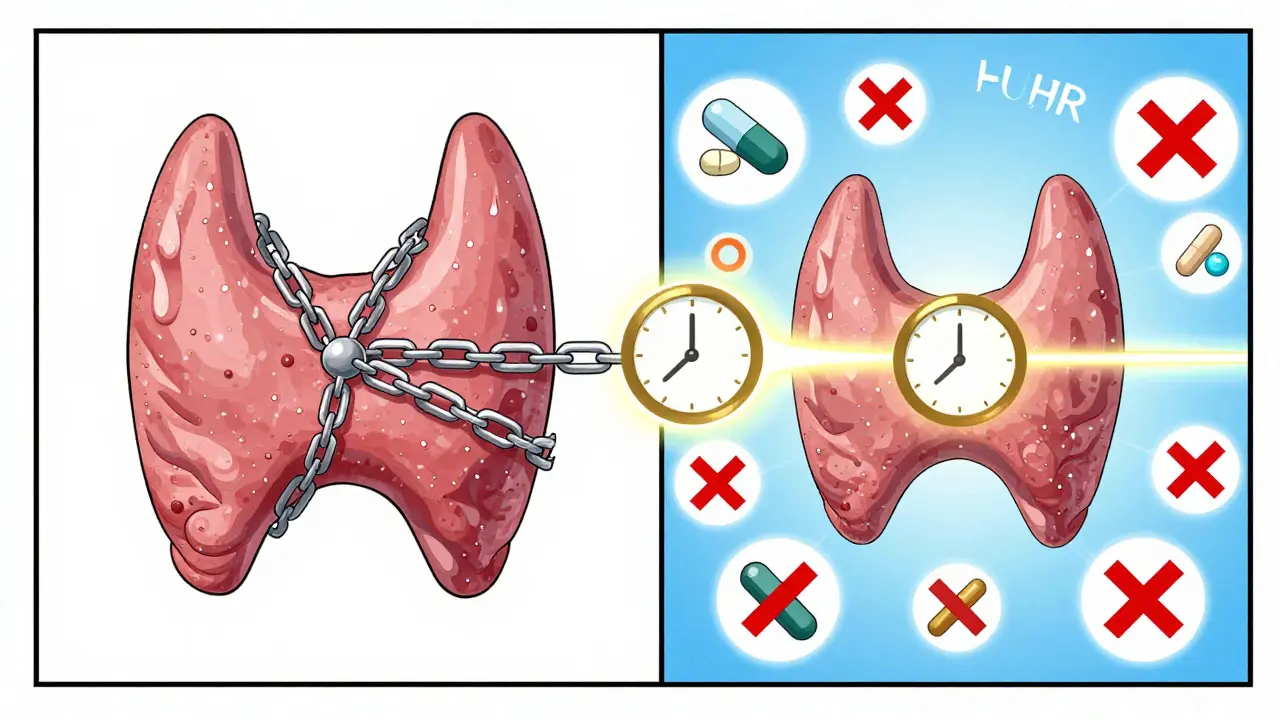
Levothyroxine, the most common thyroid hormone replacement, needs to be absorbed in your small intestine to work. But magnesium doesn’t just sit there quietly. It binds to the hormone in your gut, forming a complex your body can’t absorb. Think of it like two magnets sticking together-you can’t use either one properly once they’re stuck. Research from the Journal of Clinical Endocrinology & Metabolism (2021) shows that when magnesium and levothyroxine are taken together, absorption drops by 25% to 35%. That’s enough to push your TSH levels from a normal 2.0 up to 6.0 or higher, triggering fatigue, weight gain, brain fog, and cold intolerance-all the symptoms you thought you’d left behind. Not all magnesium forms are the same. Magnesium hydroxide (found in antacids like Mylanta) and magnesium carbonate bind strongly to levothyroxine, cutting absorption by 40-60%. Magnesium oxide? It’s less reactive-only about 10% interference in lab tests. But here’s the catch: even if your supplement says “magnesium oxide,” your body might still react differently. Individual variation is huge. One person might take it together and be fine. Another sees their TSH spike in weeks.What the Experts Say About Timing
The American Thyroid Association, the Endocrine Society, and the American Association of Clinical Endocrinologists all agree: spacing matters. And it’s not just a suggestion-it’s a medical requirement. The standard rule? Take your levothyroxine first thing in the morning on an empty stomach with a full glass of water. Wait at least 45 to 60 minutes before eating or drinking anything else. Then, wait at least 4 hours before taking any magnesium supplement. Why 4 hours? That’s how long it typically takes for your stomach to empty and for the drug to move past the absorption zone in your upper intestine. Taking magnesium at bedtime-after dinner-is the most common and effective solution. It’s also easier to remember than trying to squeeze it in midday. A 2023 study in the Journal of Managed Care & Specialty Pharmacy found that patients using a simple pill organizer with AM/PM compartments had an 89% adherence rate to proper timing. Those without a system? Only 47% got it right. If you’re struggling, get a pill box. Label it. Stick to it.Liquid Thyroid Meds: A Better Option?
If you’ve tried spacing and still see weird TSH swings, you might want to talk to your doctor about switching from a tablet to a liquid form. Tirosint and Unithroid are softgel or liquid versions of levothyroxine that bypass many of the gut-binding issues. Studies show these formulations reduce magnesium interference to just 8-12%, compared to 25-35% with traditional tablets. That’s not a cure, but it’s a big improvement. And if you’re someone who takes multiple supplements or has digestive issues, it could be worth the switch.Magnesium and Antibiotics: Another Hidden Conflict
Magnesium doesn’t just mess with thyroid meds-it can also knock out antibiotics. Tetracyclines (like doxycycline and minocycline) and fluoroquinolones (like ciprofloxacin and levofloxacin) bind to magnesium just like levothyroxine does. The result? Your antibiotic might not reach the bloodstream at all. The FDA’s labeling for ciprofloxacin says magnesium can cut its absorption by up to 50%. That’s not a small drop. That’s treatment failure. A 2021 study in Antimicrobial Agents and Chemotherapy showed that a single 500 mg dose of magnesium citrate reduced levofloxacin’s peak blood levels by 37% and overall exposure by 29%. So if you’re on antibiotics, don’t take magnesium at the same time. The rule here is simpler: take magnesium at least 2 hours before or 6 hours after the antibiotic. If you take your antibiotic in the morning, hold off on magnesium until dinner or bedtime. If you take it at night, take magnesium in the morning-after your thyroid med and your breakfast wait.
What About Other Magnesium Types?
Not all magnesium supplements are created equal. Here’s what you need to know:- Magnesium oxide: Cheap, common in laxatives, but poorly absorbed. Low interaction risk with levothyroxine, but may not help your actual magnesium levels.
- Magnesium glycinate: Gentle on the stomach, well-absorbed, low risk of GI upset. Preferred for long-term use. Still needs 4-hour spacing.
- Magnesium citrate: Good for constipation, but higher interaction risk with antibiotics. Avoid if you’re on ciprofloxacin or doxycycline.
- Magnesium malate: Often used for fatigue and muscle pain. Lower binding potential than citrate or hydroxide.
- Magnesium hydroxide: Found in antacids. Strongest binder. Avoid unless absolutely necessary. If you must use it, wait 4+ hours after levothyroxine.
Real Stories: What Happens When You Don’t Space
One Reddit user from Sydney took 300 mg of magnesium glycinate with her Synthroid every morning because she “forgot” to separate them. Within 10 weeks, her TSH jumped from 1.8 to 14.2. She felt exhausted, gained 8 kilos, and her hair started falling out. She didn’t realize the supplement was the issue until her endocrinologist asked about it. Another man in Melbourne took magnesium oxide for constipation while on levothyroxine. His doctor kept increasing his Synthroid dose-first 75 mcg, then 100, then 125. His TSH kept climbing. Only when he switched to taking magnesium at bedtime did his levels normalize in 6 weeks. He didn’t need a higher dose. He just needed better timing. A 2023 Drugs.com analysis of 1,247 users showed that 78% who spaced magnesium by 4+ hours reported stable thyroid levels. Only 34% of those who took it together did.What to Do If You’re on Multiple Supplements
If you’re also taking calcium, iron, or zinc, things get more complicated. These minerals all bind to levothyroxine too. Here’s a simple daily schedule that works for most people:- 6:30 AM: Take levothyroxine with water. No food, coffee, or other meds.
- 7:30 AM: Eat breakfast.
- 10:30 AM: Take iron supplement (if prescribed).
- 12:30 PM: Take calcium supplement with lunch.
- 6:30 PM: Take magnesium supplement with dinner.
- 10:00 PM: Take antibiotics (if needed)-but only if spaced 6+ hours from magnesium.
Why Doctors Don’t Always Tell You
A 2023 survey of 2,500 U.S. primary care doctors found that 74% now routinely ask about supplement use during medication reviews-up from 42% in 2020. That’s progress. But many patients still say their doctors never mentioned the interaction. Why? Time. Overworked clinics don’t always have the bandwidth to go through every supplement. And not all pharmacists flag it either-though CVS and Walgreens now hand out “Thyroid Medication Timing Cards” to patients, and 92% of pharmacists say it’s helped. If your doctor doesn’t bring it up, ask. Say: “I’m taking magnesium. Does that interfere with my thyroid med?” It’s that simple.What’s Changing in 2026?
New formulations are coming. Chronocell’s LevoThyrin, a time-release levothyroxine, is in Phase 3 trials and shows no TSH variation when taken with magnesium. That could change everything. Also, pharmacogenomics is starting to show promise. Early research from Mayo Clinic (2023) found genetic variants that predict who’s more likely to have absorption issues. In the future, your DNA might tell you whether you need 2 hours or 6. But for now? Stick to the 4-hour rule. It’s proven. It’s simple. And it works.Final Tips to Get It Right
- Always take levothyroxine on an empty stomach with water.
- Wait 60 minutes before eating or drinking anything else.
- Take magnesium at least 4 hours later-ideally at bedtime.
- If you’re on antibiotics, space magnesium by 2 hours before or 6 hours after.
- Use a pill organizer with labeled compartments.
- Get your TSH checked 6-8 weeks after changing your timing.
- If your levels still don’t stabilize, ask about switching to Tirosint or Unithroid.
Can I take magnesium at the same time as my thyroid medication if I wait 2 hours?
No. Even 2 hours isn’t enough for most people. Levothyroxine absorption peaks in the first 1-2 hours after taking it, and magnesium can still bind to it during that window. Research shows 4 hours is the minimum safe gap to avoid significant drops in hormone absorption. Some people might get lucky with 2 hours, but most won’t. Don’t gamble with your thyroid levels.
Does magnesium glycinate interact less than other forms?
Yes, magnesium glycinate has a lower tendency to bind with levothyroxine compared to magnesium hydroxide or citrate. Some early studies suggest it may be safe with a 2-hour gap, but the official guidelines still recommend 4 hours because of individual differences. Until more data is available, stick to the 4-hour rule to be safe.
What if I forget and take them together? Should I take another dose?
No. Don’t double up on your thyroid med. Taking an extra dose can cause heart palpitations, anxiety, or even atrial fibrillation. Just skip the magnesium that day and go back to your regular schedule tomorrow. One mistake won’t wreck your progress, but repeated ones will. Keep track of slips so you can spot patterns.
Can I take magnesium with food instead of on an empty stomach?
Yes, and you should. Magnesium is better absorbed with food and is less likely to cause diarrhea or stomach upset when taken with a meal. The key is timing: take it with dinner or at bedtime, at least 4 hours after your thyroid med. Don’t take it with breakfast or lunch if you’re on levothyroxine.
Do all antibiotics interact with magnesium?
No. Only tetracyclines (doxycycline, minocycline) and fluoroquinolones (ciprofloxacin, levofloxacin) have strong interactions. Penicillin, amoxicillin, azithromycin, and cephalosporins do not interfere with magnesium. Always check the label or ask your pharmacist if you’re unsure.
How long does it take for TSH to stabilize after fixing the timing?
Most people see improvement in 4-6 weeks, with full stabilization by 8-12 weeks. Thyroid hormone levels change slowly. If you’ve been taking magnesium with your levothyroxine for months, your body needs time to reset. Don’t panic if your TSH doesn’t drop right away. Just stay consistent and get retested in 8 weeks.




Ashley Karanja
January 25, 2026 AT 10:16Okay, I’ve been taking magnesium glycinate at night with my levothyroxine for like 14 months and my TSH was hovering at 8.5. I thought it was stress, or my diet, or maybe my thyroid was just ‘done’… until I read this. 🤯 I switched to taking it at 10 PM and my med at 6:30 AM. Six weeks later, my TSH dropped to 2.1. I cried. Not because I was sad-because I finally felt like me again. No brain fog, no 3 p.m. naps, no weight gain. It’s wild how something so simple can be so overlooked. 🙏
Ashley Porter
January 25, 2026 AT 22:56So magnesium oxide = bad. Magnesium glycinate = less bad. But still needs 4 hours. Got it. I was gonna buy the cheap stuff from Amazon. Not anymore. 🧠
Peter Sharplin
January 27, 2026 AT 21:12As a pharmacist, I see this every week. Patients think ‘natural’ means ‘safe with everything.’ Nope. Magnesium’s a mineral chelator-it binds to metals and ions like levothyroxine and ciprofloxacin. It’s chemistry, not magic. The 4-hour rule isn’t arbitrary-it’s pharmacokinetic. If you’re on antibiotics AND thyroid meds, use a pill organizer. Label it. Set phone alarms. Your body will thank you. And yes, Tirosint is worth the extra cost if you’re struggling.
Allie Lehto
January 28, 2026 AT 06:02Y’all are so obsessed with timing… but what if the real problem is that thyroid meds are synthetic garbage? 🤔 Like, why are we even taking a lab-made hormone instead of healing the root cause? I went keto + adrenal support + iodine + selenium and my TSH normalized in 3 months WITHOUT meds. The system doesn’t want you to know this. Pharma makes billions off your dependency. 😔
Henry Jenkins
January 29, 2026 AT 07:29I appreciate the science here, but I’m curious-how much of this is based on population averages vs. individual variability? I’ve got a friend who takes magnesium at the same time as Synthroid and her TSH is rock-solid at 1.9. Meanwhile, I space everything perfectly and still fluctuate. Is it gut flora? Genetic SNPs? The fact that I take my med with sparkling water? There’s a lot we don’t know. I get the 4-hour rule as a blanket recommendation, but I wonder if we’re missing personalized biomarkers. Maybe in 2026 with Chronocell’s time-release, we’ll stop treating everyone like a lab rat.
Renia Pyles
January 30, 2026 AT 19:45Oh wow, so now I’m supposed to be a time-management ninja just to take my vitamins? 🙄 I have a 2-year-old, a full-time job, and I’m barely surviving. You want me to wait 4 hours after my thyroid med to take magnesium? What if I’m traveling? What if I forget? What if I’m on vacation and my pill organizer is in the suitcase? This is ridiculous. I’m just gonna take my meds and my magnesium together and deal with the consequences. Life’s too short for this.
Nicholas Miter
January 31, 2026 AT 02:26Been on levothyroxine for 12 years. Took magnesium with it for 8 of them. Didn’t know it was an issue. My TSH was always ‘borderline’ so my doc kept bumping my dose. Last year I switched to bedtime magnesium and dropped my dose by 25 mcg. No symptoms. No drama. Just… better. If you’re struggling, don’t overthink it. Try the 4-hour rule. Use a cheap pill box. Write it on your bathroom mirror. It’s not complicated. Just hard to remember. Consistency > perfection.
Suresh Kumar Govindan
January 31, 2026 AT 09:57While the pharmacokinetic data presented is statistically significant, it remains empirically limited to Western populations with homogeneous genetic backgrounds. In contrast, Indian subcontinental cohorts exhibit markedly different intestinal pH profiles and microbiome diversity, which may attenuate chelation effects. Moreover, the assertion that magnesium hydroxide exhibits 40–60% binding interference is derived from in vitro models that do not account for enterohepatic recirculation. One must question whether these guidelines are universally applicable-or merely a product of Anglo-American clinical hegemony.
Karen Droege
January 31, 2026 AT 22:36OMG I JUST REALIZED I’VE BEEN DOING THIS WRONG FOR 3 YEARS. 😭 I took my magnesium with my dinner at 6 PM and my Synthroid at 7 AM… that’s only 11 hours apart. But wait-what if I took my med at 7 AM, ate at 8, then took magnesium at 11 PM? That’s 16 hours! 🤯 I’m switching to that. I’m getting a fancy pill organizer with color-coded slots. I’m buying Tirosint. I’m telling my whole family. I’m posting this on my Instagram story. I’m crying happy tears. This changed everything. I feel like I’ve been walking through fog and now… I can see. Thank you. 🙌💜