When your liver is scarred from cirrhosis, the risk of developing liver cancer doesn’t just go up-it skyrockets. Hepatocellular carcinoma (HCC) is the most common type of liver cancer, and over 80% of cases happen in people who already have cirrhosis. That’s why surveillance isn’t optional-it’s lifesaving. Yet, in the U.S., only about half of people with cirrhosis get the recommended screenings. Many don’t even know they’re at risk. The good news? Catching HCC early can mean the difference between a simple treatment and a life-or-death emergency.
Why Surveillance Matters: The Numbers Don’t Lie
Without screening, most HCC cases are found too late. The average 5-year survival rate for untreated HCC is between 10% and 20%. But when tumors are caught early through regular surveillance, survival jumps to 50-70%. That’s not a guess. It’s backed by data from over 15,000 patients in multiple studies. The reason? Early tumors are small, confined, and often treatable with surgery, ablation, or transplant. Late-stage tumors have spread, or the liver is too damaged to handle aggressive treatment.
Surveillance isn’t just about finding cancer. It’s about catching it before symptoms appear. Most people with early HCC feel fine. No pain. No jaundice. No weight loss. That’s why waiting for symptoms is a deadly mistake. Regular checks every six months catch 70% of tumors at the earliest stage (BCLC stage 0 or A), compared to just 30% in unscreened patients.
Who Needs Surveillance? It’s Not Just Everyone With Cirrhosis
Not all cirrhosis is the same. The guidelines used to say: if you have cirrhosis, get screened. But that’s changing. The European Association for the Study of the Liver (EASL) now recommends a risk-based approach. They divide patients into three groups:
- High-risk (over 2.5% annual risk): People with hepatitis B, heavy alcohol use, or advanced fibrosis. These patients need ultrasound every 6 months-or possibly MRI.
- Medium-risk (1.5-2.5% annual risk): Most common group. Includes people with NAFLD (fatty liver) after viral cure, or mild-moderate alcohol-related cirrhosis. Standard 6-month ultrasound.
- Low-risk (under 1.5% annual risk): Rare, but some patients with stable cirrhosis from early-stage viral hepatitis or autoimmune disease may fall here. Surveillance may not be needed.
The American Association for the Study of Liver Diseases (AASLD) still recommends screening everyone with Child-Turcotte-Pugh (CTP) Class A or B cirrhosis. But they’re updating their guidelines in late 2024, and risk stratification is expected to become standard.
One big exception: CTP Class C cirrhosis. These patients have severe liver failure. Their life expectancy is often under two years. Screening them rarely helps-they’re better off being evaluated for transplant. Screening them just adds stress and cost without benefit.
What’s Actually Done During Surveillance?
Two tools are used: ultrasound and a blood test.
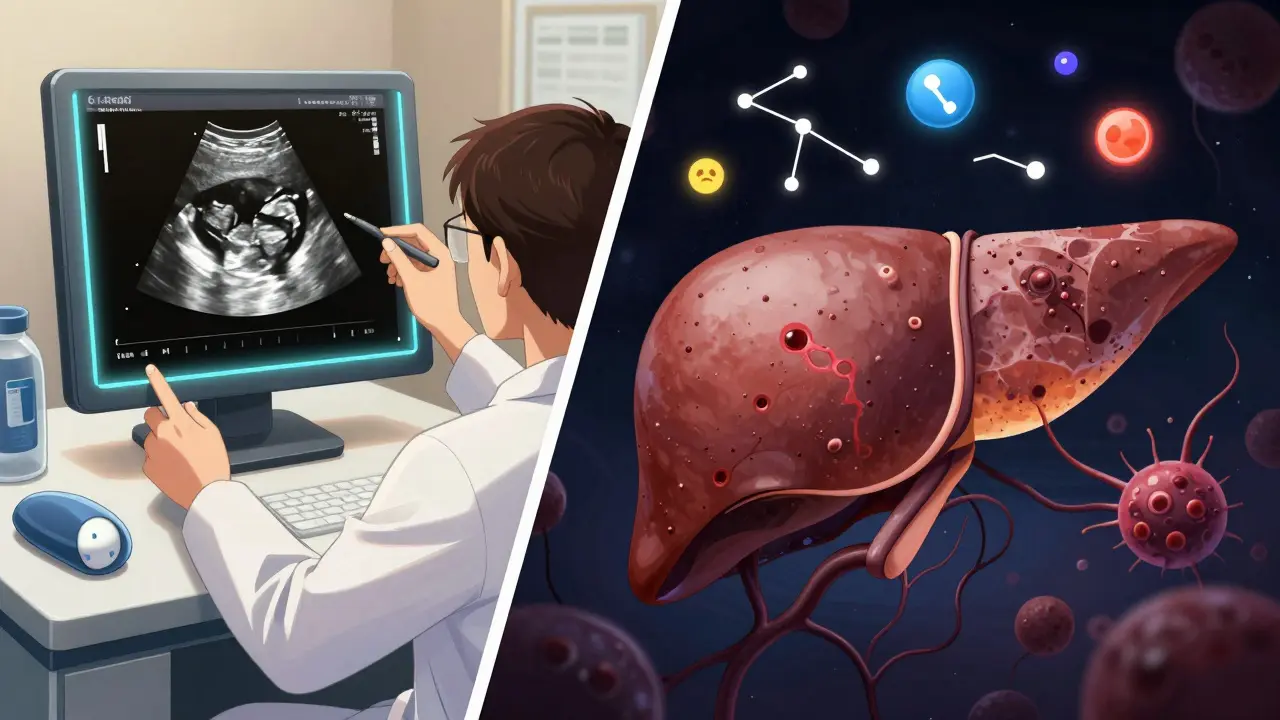
Ultrasound is the gold standard. It’s non-invasive, cheap, and widely available. A 3-5 MHz curvilinear probe is used to scan the liver. Technicians look for masses, changes in liver texture, or abnormal blood flow. The key? It must be done every 6 months. Why? HCC tumors in cirrhotic livers grow about 1-2 cm in that time. Miss a scan, and a small spot can become a large tumor.
Alpha-fetoprotein (AFP) is a blood marker. It’s not perfect. Some cancers don’t produce it. Some non-cancer conditions (like hepatitis flare-ups) raise it. But when AFP is over 20 ng/mL (or 20 μg/L), it’s a red flag. The AASLD says it’s optional. The EASL says it’s not strong enough to rely on alone. Still, many clinics use it as a backup. It’s cheap. It’s easy. And when combined with ultrasound, it improves detection.
Here’s what happens if something shows up:
- If ultrasound finds a mass over 1 cm → get a contrast CT or MRI.
- If AFP is high (>20 ng/mL) → get a contrast CT or MRI, even if ultrasound looks normal.
- Imaging results are scored using LI-RADS (Liver Imaging Reporting and Data System). This tells doctors whether it’s likely benign, probably cancer, or definitely cancer.
LI-RADS has cut down misdiagnoses. In 2011, radiologists disagreed on 55% of cases. By 2022, after LI-RADS was updated, agreement jumped to 78%. That’s huge.
What Happens If Cancer Is Found?
Treatment depends on three things: tumor size, liver function, and whether cancer has spread.
Stage 0 or A (early): The goal is cure.
- Resection: Surgery to remove the tumor. Only if the liver is still working well (CTP Class A).
- Ablation: Heat (radiofrequency) or cold (cryoablation) destroys the tumor. Done through the skin. No big incision. Works best for tumors under 3 cm.
- Transplant: Best option if the tumor is small (single tumor under 5 cm, or up to 3 tumors under 3 cm) and the liver is failing. Removes both cancer and the diseased liver.
Stage B (intermediate): Tumors are larger or more numerous. Surgery isn’t an option.
- TACE (Transarterial Chemoembolization): Chemo is injected directly into the artery feeding the tumor, then blocked. Starves the cancer.
Stage C (advanced): Cancer has spread to blood vessels or outside the liver.
- Targeted drugs: Sorafenib, lenvatinib, or regorafenib slow growth.
- Immunotherapy: Pembrolizumab or nivolumab + ipilimumab help the immune system attack cancer.
Stage D (end-stage): The liver is failing. Treatment focuses on comfort.
Transplant is the only cure for advanced cirrhosis + early HCC. But demand far outpaces supply. In the U.S., about 10,000 liver transplants happen each year. Over 15,000 people are on the waiting list. That’s why early detection matters so much-it keeps you eligible.
Why So Many People Miss Surveillance
Guidelines are clear. But in practice, only 30-50% of eligible patients get screened. Why?
- No reminders: Only 35% of clinics have automated EHR alerts when a patient is diagnosed with cirrhosis.
- Poor follow-up: 25-40% of patients miss their ultrasound appointments. Often, it’s because they feel fine, or they don’t understand the risk.
- Provider confusion: Primary care doctors don’t always know when to refer. Some think only hepatitis patients need screening.
- Cost and access: Ultrasound isn’t free. In rural areas, there may be no qualified technician nearby.
- Disparities: Black patients and Medicaid recipients are half as likely to get screened as white, privately insured patients.
One hospital in Ohio cut missed appointments from 32% to 14% by hiring patient navigators-staff who call, text, and even drive patients to appointments. Another clinic added a pop-up alert in their electronic records. Adherence jumped from 35% to 68%.
The Future: AI, Biomarkers, and Faster Scans
Change is coming fast.
AI tools like Medtronic’s LiverAssist (FDA-cleared in 2022) help ultrasound techs spot tiny tumors they might miss. Studies show they improve detection by 18-22%.
New blood tests are in the works. The GALAD score (gender, age, AFP-L3, AFP, DCP) detects early HCC with 85% accuracy. The aMAP score (age, gender, albumin, bilirubin, platelets) is already being used in Asia and may soon be adopted in the U.S.
And MRI? It’s getting cheaper. GE and Siemens now offer abbreviated liver MRI scans that take just 5-7 minutes and cost $350-$400. By 2027, 30-40% of high-risk patients may get MRI instead of ultrasound-it’s more sensitive.
The SURVIVE trial, enrolling 10,000 patients, will compare standard screening with risk-based screening. Results are due late 2025. If it proves better, the whole world will change how we screen for liver cancer.
What You Should Do Now
If you have cirrhosis:
- Ask your doctor: "Am I on the surveillance list?"
- Make sure you get an ultrasound every 6 months-no exceptions.
- If your AFP is checked, ask what the result means.
- If you’re told you don’t need screening, ask why. Request a risk assessment.
- Don’t wait for symptoms. If you feel fine, that’s exactly why you need screening.
If you’re a caregiver or family member:
- Help set reminders.
- Go with them to appointments.
- Ask questions. Don’t assume they understand.
If you’re a doctor or nurse:
- Set up EHR alerts for cirrhosis patients.
- Train staff on LI-RADS and surveillance protocols.
- Use patient navigators. It works.
Do all people with cirrhosis need liver cancer screening?
Not everyone. Most guidelines recommend screening for those with Child-Turcotte-Pugh Class A or B cirrhosis. But newer risk-based models (like EASL 2023) suggest screening only if the annual HCC risk is 1.5% or higher. Patients with advanced liver failure (CTP Class C) usually don’t benefit from screening unless they’re on a transplant waitlist.
What’s the best test for liver cancer screening?
Ultrasound every 6 months is the standard. It’s affordable, widely available, and effective. Some high-risk patients may be moved to MRI, which detects smaller tumors. Alpha-fetoprotein (AFP) blood tests are sometimes used alongside ultrasound, but they’re not reliable enough on their own. The combination improves detection slightly, but ultrasound remains the cornerstone.
Can liver cancer be cured if caught early?
Yes. When detected early (Stage 0 or A), HCC can often be cured. Treatments like surgical removal, radiofrequency ablation, or liver transplant can eliminate the cancer. Survival rates jump from under 20% to over 70% when tumors are small and the liver still functions well. That’s why regular screening is critical.
Why do some people miss their screening appointments?
Many patients feel fine and don’t realize they’re at risk. Others can’t afford the test, live far from a clinic, or don’t get reminders. Studies show 25-40% of patients miss appointments. Simple fixes-like automated text reminders, patient navigators, or scheduling the next appointment before leaving-can cut no-show rates by more than half.
Is liver cancer screening covered by insurance?
In the U.S., Medicare and most private insurers cover biannual ultrasound for patients with cirrhosis, especially if they have hepatitis B, C, or other high-risk causes. However, coverage varies by plan. Always check with your provider. Some plans may require a referral from a specialist. Out-of-pocket costs for ultrasound alone are typically under $200.
What happens if a tumor is found during screening?
If a mass larger than 1 cm is seen on ultrasound-or if AFP is over 20 ng/mL-you’ll be referred for a contrast-enhanced CT or MRI. These scans use dye to show blood flow and help determine if the mass is cancer. Results are scored using LI-RADS, which classifies lesions as benign, probably cancer, or definitely cancer. If cancer is confirmed, treatment options are reviewed based on tumor size, liver function, and overall health.
Alex Ogle
February 11, 2026 AT 05:23So many people think if they don't feel sick, they're fine. But cirrhosis doesn't yell-it whispers. And by the time it screams, it's too late. I've seen it. A buddy of mine, 52, never missed a beer Friday, got diagnosed with cirrhosis, shrugged, and said 'I'm fine.' Two years later, he was on the transplant list with a tumor the size of a lemon. Surveillance isn't paranoia-it's patience with a purpose.
Ultrasound every six months? Yeah, it's boring. But so is dying. The real tragedy isn't the cost or the inconvenience-it's the silence. People don't know they're at risk because no one told them. Not their doctor. Not their family. Just… silence.
I get why clinics don't automate alerts. EHRs are a mess. But if we can track your Netflix binges, why can't we track your liver? We need systems that don't rely on patients remembering. We need systems that remember for them.
And don't get me started on the disparities. Black patients? Medicaid recipients? Half as likely to get screened? That's not a healthcare gap. That's a moral failure dressed in bureaucracy.
The Ohio hospital that hired navigators? That's the future. Not AI. Not fancy scans. Just someone who calls. Who texts. Who shows up with a ride. That’s care. That’s humanity.
I’m not saying every cirrhosis patient needs screening. But if your risk is over 1.5%, you’re not 'fine.' You’re a ticking clock. And the only way to defuse it is to show up, every six months, like clockwork.
They say early detection saves lives. I say early detection saves dignity. Because you don’t want to spend your last months in a hospital wondering if you’d have lived if you’d just gone for a 20-minute scan.
Don’t wait for symptoms. If you’ve got cirrhosis, you already have the symptom: the disease.
Tatiana Barbosa
February 11, 2026 AT 12:42Let me tell you something-surveillance isn’t just medical, it’s emotional armor.
My mom had NAFLD after her Hep C cure. She thought she was ‘in the clear.’ Until I dug into the guidelines and found she was medium-risk. She cried. Not from fear-from relief. Relief that someone finally said: ‘You’re not fine, but you’re not doomed.’
Ultrasound + AFP? Cheap. Non-invasive. Easy. Why are we overcomplicating it? We have tools. We have data. We have LI-RADS. We just need to stop treating prevention like an optional bonus.
And yes, transplant is the holy grail-but it’s not a magic wand. It’s a lottery with a 15K-person waiting list. That’s why catching it early isn’t just smart-it’s survival math.
If you’re on the fence: go. Get scanned. Bring a notebook. Write down the radiologist’s name. Ask for a copy of the report. Be your own advocate. You’ve got this.
PS: If your doc says ‘you don’t need it’-ask for the risk score. Demand it. You’re not being difficult. You’re being alive.
Simon Critchley
February 12, 2026 AT 16:44Oh for fuck’s sake, another ‘screening saves lives’ sermon. Let’s be real-ultrasound is a glorified flashlight. It misses 30% of early tumors. And AFP? A junk metric. I’ve seen hepatitis flares spike it like a stock market crash. False positives? They lead to biopsies. Biopsies lead to infections. Infections lead to hospitalizations. So now you’re ‘saved’ from cancer… by sepsis.
And don’t get me started on LI-RADS. It’s a 7-tiered alphabet soup that even radiologists argue about. In 2022, agreement was 78%? That means 1 in 4 cases are still misclassified. That’s not progress-that’s gambling with your liver.
AI tools? Cool. But they’re trained on biased datasets. Most are built on data from academic hospitals in Chicago. What about rural Arkansas? Or Navajo Nation? You think the AI knows your liver looks different because you’re 6’4” and eat frybread daily?
Transplant? Ha. You need a private insurance plan, a 10-year sobriety record, and a therapist’s note. Meanwhile, your cousin with cirrhosis from alcoholism gets told to ‘wait until he’s ready.’ Like liver cancer gives a damn about your readiness.
Real solution? Stop screening. Start treating cirrhosis. Stop letting people get to cirrhosis in the first place. Alcohol, NAFLD, obesity-these are social problems. Not medical ones.
And yes, I know I’m being contrarian. But someone’s gotta say it.
Karianne Jackson
February 12, 2026 AT 19:23I cried reading this. My dad died of liver cancer. He never got screened. He said, 'I'm not sick.' He was wrong.
Andy Cortez
February 14, 2026 AT 18:49So let me get this straight-your liver’s scarred, so you need to get a scan every 6 months? That’s like saying if your car has a dent, you gotta get it washed weekly. What if I don’t wanna? What if I’m broke? What if I’m scared?
And why are we even doing this? So we can give people false hope? 'Oh, it’s early!' Then what? You get a biopsy? A CT? A transplant? Good luck getting one. The waitlist is longer than the line at Apple Store.
Also, who decided ultrasound is the gold standard? Who made that rule? Some guy in a lab coat in 1998? I’ve seen ultrasounds where the tech couldn’t find the gallbladder. How’s he gonna spot a tumor?
And AFP? That’s a blood test that gets elevated when you sneeze too hard. It’s not a biomarker-it’s a guess.
Real talk? We’re scaring people into tests that don’t work, then blaming them when they don’t show up. Meanwhile, Big Pharma is selling sorafenib for $15K a month. Someone’s making money here. And it ain’t you.
My uncle had cirrhosis. Got screened. Got a nodule. Got a biopsy. Got infection. Got sepsis. Died 3 months later. Cancer never touched him.
Screening isn’t saving lives. It’s just moving the death date.
Jessica Klaar
February 16, 2026 AT 01:50I work in a community clinic in Texas. We had a 30% no-show rate for ultrasounds. Then we started texting reminders. Then we added a $25 gas card for people who showed up. Then we had a nurse walk them to the van. Now we’re at 82% adherence.
It’s not about knowledge. It’s about access. It’s about dignity.
One woman came in last week. She’d been cirrhotic for 8 years. Never screened. Said, 'I didn’t think they cared.' I cried. She’s getting her scan tomorrow.
Screening isn’t just medicine. It’s saying: 'You matter.'
And yeah, maybe not everyone needs it. But for the ones who do? It’s everything.
Patrick Jarillon
February 16, 2026 AT 03:17Who funded this article? Pharma? Big Radiology? The transplant industrial complex?
Let’s be real-HCC screening exists because it’s profitable. Ultrasounds. MRIs. Biopsies. TACE. Sorafenib. Each step is a bill. Each step is revenue.
Meanwhile, the real cause-poverty, food deserts, alcohol access, lack of mental health care-is ignored.
And what about the 40% of patients who get false positives? They get anxiety. They get surgeries. They get scared. They lose jobs. They lose insurance.
AI? It’s trained on data from white, middle-class patients. What if your liver looks different because you’re Black? Indigenous? Poor?
Transplant? Only for the privileged. The rest get palliative care. Or worse-ignored.
This isn’t healthcare. It’s a revenue model disguised as prevention.
Stop screening. Start fixing society.
John Watts
February 16, 2026 AT 23:34Just wanted to say thank you for writing this. As a nurse in a rural clinic, I see the gaps every day.
One patient, 68, had cirrhosis from HCV. Never told she needed screening. We found a 1.2 cm nodule on ultrasound. She cried. Said she thought she was 'just old.' We got her MRI. Confirmed HCC. She got ablation. Now she’s back, volunteering at our clinic.
It’s not about perfection. It’s about presence.
If you’re reading this and you have cirrhosis-go. Get scanned. You’re not a burden. You’re a person who deserves a shot.
And if you’re a provider-set the alert. Call the patient. Drive them if you have to. This isn’t just medicine. It’s love in action.
Randy Harkins
February 18, 2026 AT 12:48❤️ This is why I do what I do. Every 6-month ultrasound is a chance. Not a chore. Not a burden. A gift.
My sister got screened. Found a 7mm nodule. Ablated. No chemo. No transplant. Just a 30-minute procedure. She’s back hiking. She’s alive.
Screening isn’t fear. It’s freedom.
Thank you for the clarity. For the data. For the humanity.