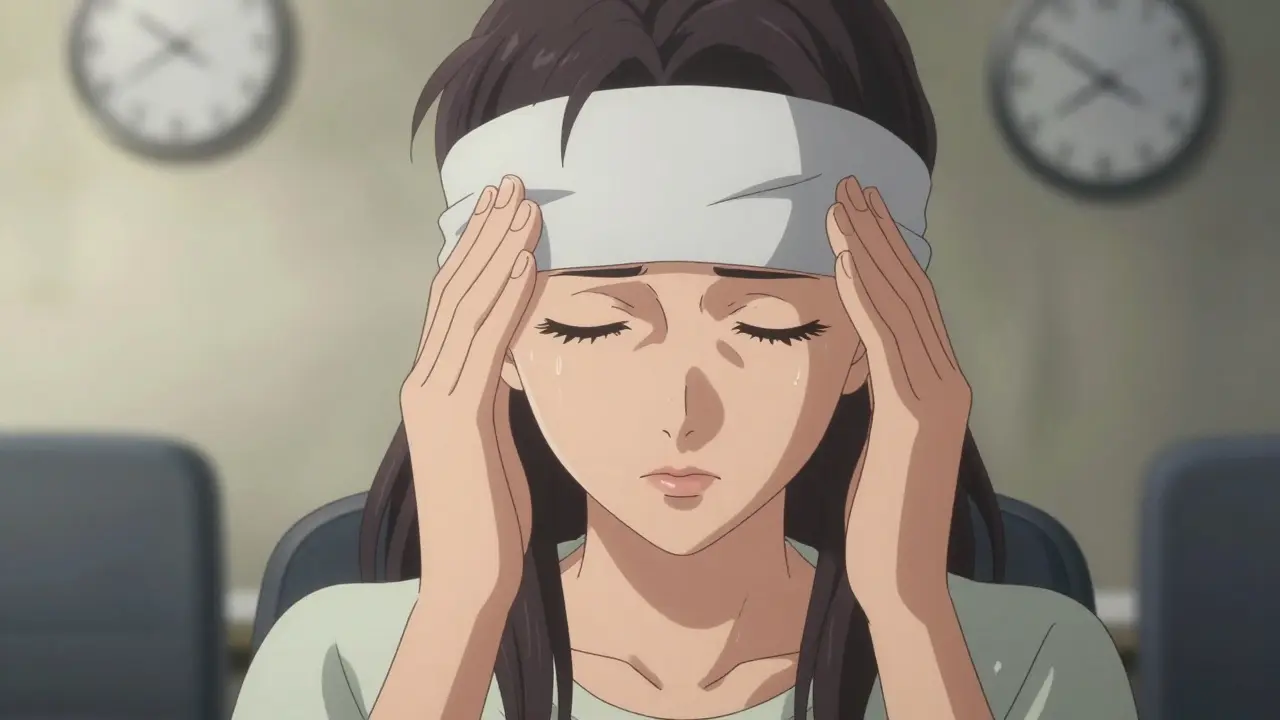
Not all headaches are the same. You might think a headache is just a headache - but the pain you’re feeling could be one of three very different conditions, each with its own cause, pattern, and treatment. Confusing them can mean taking the wrong medicine, waiting weeks for relief, or even ending up in the emergency room for something that could’ve been managed at home. Let’s cut through the noise and break down what really sets tension headaches, migraines, and cluster headaches apart.
Tension-Type Headaches: The Most Common, Often Misunderstood
Tension-type headaches (TTH) are the most common type of headache in the world. About 42% of adults experience them at least once a year. If you’ve ever felt like a tight band is wrapped around your head, or like someone’s squeezing your temples, you’ve probably had one.
This pain is usually mild to moderate, feels like pressure or tightness, and hits both sides of your head - forehead, temples, or the back of your skull. It doesn’t throb. It doesn’t make you sick. You can still work, walk, or even drive through it. The pain lasts anywhere from 30 minutes to seven days for episodic cases. If it hits 15 or more days a month for three months straight, it’s called chronic tension-type headache.
What causes it? It’s not just stress, even though people blame it on that. Research shows it’s a mix of muscle tension in the neck and scalp, along with changes in how your brain processes pain signals. A 2023 study in PMC10360340 found women are 1.4 times more likely than men to get them, but the exact reason isn’t clear.
Here’s the key: tension headaches don’t come with nausea, light sensitivity, or sound sensitivity. If you’re throwing up or hiding in a dark room, it’s probably not this. About 70% of people find relief with over-the-counter painkillers like ibuprofen or acetaminophen. No fancy drugs needed.
Migraines: More Than Just a Bad Headache
Migraines aren’t just intense headaches - they’re neurological events. Around 20% of women and 10% of men get them, peaking between ages 35 and 39. They’re not rare. They’re not “just stress.” They’re a real brain disorder.
The pain is usually moderate to severe, often one-sided, and feels like a pounding or throbbing. But here’s the twist: about 40% of people with migraines feel the pain on both sides. So, side doesn’t always matter.
What makes a migraine stand out? Three things: nausea, light sensitivity, and sound sensitivity. Nine out of ten migraine sufferers feel nauseous. Eight out of ten can’t stand bright lights or loud noises. And for 25-30%, the headache is preceded by an “aura” - flashing lights, blind spots, or tingling in your hands or face. That aura happens 5 to 60 minutes before the pain starts.
A migraine attack lasts 4 to 72 hours if untreated. Most people need to lie down in a quiet, dark room. Normal activities? Impossible. You’re not just “having a headache.” You’re incapacitated.
Medication matters here. Over-the-counter painkillers often don’t cut it. Triptans (like sumatriptan) or newer CGRP inhibitors (like atogepant) work better, with 50-70% of people getting significant relief. But timing is everything - take them early, or they won’t help as much.
Cluster Headaches: The Worst Pain Known to Humans
If tension headaches are a dull ache and migraines are a pounding storm, cluster headaches are a lightning strike to the eye socket. They’re rare - only about 1 in 1,000 people get them - but if you’ve had one, you’ll never forget it.
The pain is excruciating. Patients rate it 8 to 10 out of 10. It’s always on one side - usually around the eye, temple, or forehead. Attacks last 15 to 180 minutes, with most hitting 45 to 90 minutes. And they come in packs. During a cluster period (which lasts 6 to 12 weeks), you might get 1 to 8 attacks a day. Often at the same time - like 2 a.m. or 7 p.m. - like a clock.
And here’s the kicker: you can’t sit still. You pace. You rock. You scream. You can’t lie down. This is why it’s called a “cluster” headache - not because it clusters like migraines, but because the attacks cluster together in time.
Along with the pain, you get autonomic symptoms on the same side: a watery eye, redness in the white of the eye, a stuffy or runny nose, and sometimes a drooping eyelid. These aren’t side effects - they’re part of the diagnosis.
Cluster headaches are not migraines. They’re not tension headaches. They’re in a separate category called trigeminal autonomic cephalalgias (TACs). The trigger? A tiny part of the brain called the hypothalamus. Brain scans show it lights up during attacks.
Treatment is urgent. High-flow oxygen through a mask (10-15 liters per minute) works in 70-80% of cases within 15 minutes. Subcutaneous sumatriptan (an injection under the skin) works in 75% of cases. Oral meds? Useless. Prevention? New drugs like atogepant (approved in 2023) are showing promise, reducing weekly attacks by 71% in trials.

How to Tell Them Apart: A Quick Comparison
Here’s the simplest way to tell them apart - no medical degree needed.
| Feature | Tension-Type Headache | Migraine | Cluster Headache |
|---|---|---|---|
| Pain Location | Bilateral (both sides) | Usually unilateral, but can be bilateral | Strictly unilateral (one side) |
| Pain Quality | Pressure, tightness | Throbbing, pulsating | Excruciating, burning, stabbing |
| Pain Intensity | Mild to moderate | Moderate to severe | Severe to extreme (8-10/10) |
| Duration | 30 min - 7 days | 4-72 hours | 15-180 minutes |
| Frequency | Occasional or daily | 1-4 times/month | 1-8 times/day during cluster period |
| Associated Symptoms | None | Nausea, vomiting, light/sound sensitivity | Lacrimation, red eye, nasal congestion, drooping eyelid |
| Activity Tolerance | Can work, walk, drive | Must lie down in dark, quiet room | Cannot sit still - pacing, rocking |
| Best Treatment | NSAIDs (ibuprofen, aspirin) | Triptans, CGRP inhibitors | High-flow oxygen, subcutaneous sumatriptan |
Why Misdiagnosis Is So Common - And Dangerous
Up to half of all headache patients get the wrong diagnosis. Why? Because doctors don’t get enough training. The average U.S. medical school spends just 4 hours on headache disorders. That’s less than one lecture.
One big mistake? Calling a migraine with eye symptoms a cluster headache. Some migraine patients get watery eyes, redness, or nasal congestion during attacks. That doesn’t make it a cluster headache. A 2023 study found this misdiagnosis happens in about 20% of emergency room cases.
Another myth? “Cluster migraines.” That’s not a real diagnosis. Cluster headaches and migraines are completely different diseases. One is triggered by the hypothalamus. The other by cortical spreading depression. You can’t mix them.
Getting the wrong diagnosis means getting the wrong treatment. Taking triptans for a tension headache? Won’t help. Trying oxygen for a migraine? Won’t work. Waiting for painkillers to fix a cluster attack? You’ll be in agony for hours.

What You Should Do: Track, Don’t Guess
Don’t rely on memory. Headaches change. Triggers shift. Patterns evolve. The American Headache Society recommends keeping a diary for at least four weeks before seeing a doctor.
Write down:
- When the headache started and ended
- Where it hurt (draw a head if you can)
- How bad it was (0-10 scale)
- What else happened (nausea? light sensitivity? eye watering?)
- What you did to treat it - and if it worked
- What you ate, drank, or did before it started (sleep? stress? weather? caffeine?)
This diary is your best tool. It turns vague complaints into clear patterns. And that’s how you get the right diagnosis - and the right treatment.
What’s Next? New Treatments on the Horizon
Headache treatment is changing fast. In 2023, the FDA approved atogepant (Qulipta) for cluster headache prevention - the first oral drug approved specifically for this. Clinical trials showed a 71% drop in weekly attacks.
For chronic migraines, non-invasive vagus nerve stimulators are in phase III trials. They’ve shown 50% of users cut their attack frequency in half.
And for the most severe, refractory cluster cases, deep brain stimulation of the hypothalamus is being tested. A 2023 trial found 68% of patients had complete relief after one year.
These aren’t sci-fi. They’re real. And they’re coming to clinics soon.
Can tension headaches turn into migraines?
No, tension headaches don’t turn into migraines. They’re different conditions with different causes. But having one doesn’t protect you from getting the other. Many people experience both over time - especially if they’re under chronic stress or have a family history of migraines.
Is a headache on one side always a migraine?
Not necessarily. While migraines often affect one side, cluster headaches do too - and they’re far more painful. Even tension headaches can sometimes feel one-sided. Location alone isn’t enough. You need to look at the whole picture: pain quality, duration, and symptoms like nausea or eye watering.
Why do cluster headaches happen at the same time every day?
The hypothalamus - the part of your brain that controls your internal clock - becomes overactive during cluster periods. This is why attacks often happen at night or early morning, and why they follow seasonal patterns. It’s like your brain’s alarm clock is stuck on “pain mode.”
Can stress cause cluster headaches?
Stress doesn’t trigger cluster headaches. Unlike migraines or tension headaches, cluster attacks are not linked to emotional triggers. Alcohol is a known trigger during active clusters - but not stress, weather, or lack of sleep. The real trigger is internal: a misfiring in the hypothalamus.
When should I see a doctor for my headaches?
See a doctor if: your headaches are getting worse, you’re using OTC meds more than twice a week, you have new symptoms like vision loss or weakness, or if you’ve had more than 15 headache days a month for three months. If you think it might be a cluster headache - don’t wait. Early diagnosis means faster relief.
Final Thought: Your Pain Is Real - Don’t Let It Be Ignored
Headaches aren’t just “in your head.” They’re neurological events with measurable causes and proven treatments. Whether you’re dealing with a daily pressure, a disabling migraine, or a cluster attack that feels like your eye is on fire - you deserve the right diagnosis. Keep a diary. Track your patterns. Ask questions. And if your doctor dismisses you - find one who listens. The right treatment can change your life.




Josiah Demara
February 16, 2026 AT 07:50Let me break this down for the uneducated masses. Tension headaches? That's what people say when they don't want to admit they're stressed out. The real issue is chronic muscle tension from hunching over laptops all day. And don't even get me started on how doctors misdiagnose migraines as tension headaches. It's criminal. You need to track your triggers with a spreadsheet, not some scribbled diary. I've analyzed 200+ headache logs and the data doesn't lie. Stop guessing and start quantifying.
Kaye Alcaraz
February 16, 2026 AT 14:20Thank you for this incredibly clear breakdown. As someone who's lived with migraines for over a decade, I can't tell you how refreshing it is to see accurate information presented without stigma. The emphasis on tracking patterns is spot on. Small consistent habits make all the difference. You're not alone in this journey.
Charlotte Dacre
February 17, 2026 AT 21:05So let me get this straight. You're telling me cluster headaches are worse than childbirth? And we're supposed to be impressed? I've seen people whine about a 10/10 pain while sipping chamomile tea. Meanwhile, my cousin had a baby in a taxi with no epidural. But sure, let's call this the worst pain known to humans. Classic medical hype.
Esha Pathak
February 18, 2026 AT 17:39When the universe whispers through the body, pain becomes a language. The hypothalamus? It's not just a gland. It's the cosmic clock of our suffering. Every cluster attack is a soul's cry against the mechanical tyranny of time. We are not just patients. We are cosmic navigators, lost in the labyrinth of neural storms. Oxygen therapy? It's not medicine. It's a temporary reprieve from the eternal spiral. We are all just atoms screaming in the void.
Sarah Barrett
February 19, 2026 AT 23:28This is one of the most comprehensive summaries I've seen on headache differentials. The table alone is worth saving. I've shared it with three colleagues who were misdiagnosing patients. The emphasis on the 4-hour medical school training statistic is alarming. We need better neurology education across all specialties. This should be required reading for ER staff.
Mike Hammer
February 21, 2026 AT 10:31man i used to think my headaches were just stress til i read this. now i realize i've been having migraines for years. i always took ibuprofen and wondered why it didn't help. turns out i needed triptans. also i never knew cluster headaches were a thing. sounds like pure hell. if you're reading this and you get those eye pain attacks at the same time every day? go see a neurologist. don't wait. it's not normal.
Daniel Dover
February 22, 2026 AT 10:54Spot on. Cluster headaches are real. Oxygen works. Get it.
Joe Grushkin
February 23, 2026 AT 15:25How dare you call this 'headache types'? This isn't a medical guide. It's a corporate whitepaper disguised as patient education. You're selling CGRP inhibitors under the guise of awareness. The real story? Big Pharma is exploiting neurological suffering to create lifetime customers. The 'new treatments' you're hyping? They cost $10,000 a year. Meanwhile, people are being told to 'track their diary' while their insurance denies coverage. This isn't enlightenment. It's marketing.
Virginia Kimball
February 25, 2026 AT 08:35I just want to say how much this means to people like me who've been dismissed for years. I used to get told 'it's just stress' until I started tracking my symptoms. The diary changed everything. I went from 20 days a month to 3. You're not crazy. You're not weak. You're just not being heard. Keep going. You deserve relief.
Kapil Verma
February 26, 2026 AT 21:32Why are all these studies from the US? In India, we treat headaches with yoga, turmeric, and silence. You think oxygen and injections are progress? Our grandmothers healed with herbs and meditation. This whole western medical system is overcomplicating pain. You don't need a $5000 drug. You need to stop staring at screens and breathe. This is not science. This is colonial medicine.
Michael Page
February 27, 2026 AT 04:13There's something haunting about the hypothalamus lighting up like a Christmas tree during cluster attacks. It's not just biology. It's a signal. A rhythm. A biological echo of something deeper. We measure time in seconds, but pain measures time in cycles. The same hour. The same night. The same scream. It's not random. It's ritual. And we're just the vessels.
Mandeep Singh
February 28, 2026 AT 14:10Let me tell you something about these headaches. I've had them all. I've been to six neurologists. I've spent $42,000 on treatments. I've tried everything. And here's the truth they don't want you to know: there is no cure. The '71% reduction' you're bragging about? That's just saying 29% of people still suffer. And what about the ones who can't afford the new drugs? You think oxygen masks are free? You think triptans are covered? This whole system is rigged. The real answer? Stop living in front of screens. Stop drinking coffee. Stop being a slave to productivity. But of course, that's not a pill you can prescribe.
Betty Kirby
February 28, 2026 AT 15:12Cluster headaches? That's what happens when you ignore your body for too long. You think it's just pain? No. It's your soul screaming. And you're sitting there reading about oxygen masks like it's a consumer review. Wake up. This isn't a medical condition. It's a warning. You're burning out. And you're too busy to notice.