
When you start a new medication, you expect side effects like dry mouth or drowsiness-not sudden, blinding headaches or vision that goes gray for seconds at a time. Yet for thousands of people each year, common drugs like acne treatments, antibiotics, and even steroid withdrawals trigger a dangerous condition called pseudotumor cerebri. It’s not a brain tumor. But it acts like one: pressure builds inside the skull, crushing the optic nerves and causing pain so intense it wakes you up at night. The scary part? Many doctors miss it. They think it’s a migraine. Or sinusitis. By the time it’s caught, permanent vision loss may already be underway.
What Exactly Is Pseudotumor Cerebri?
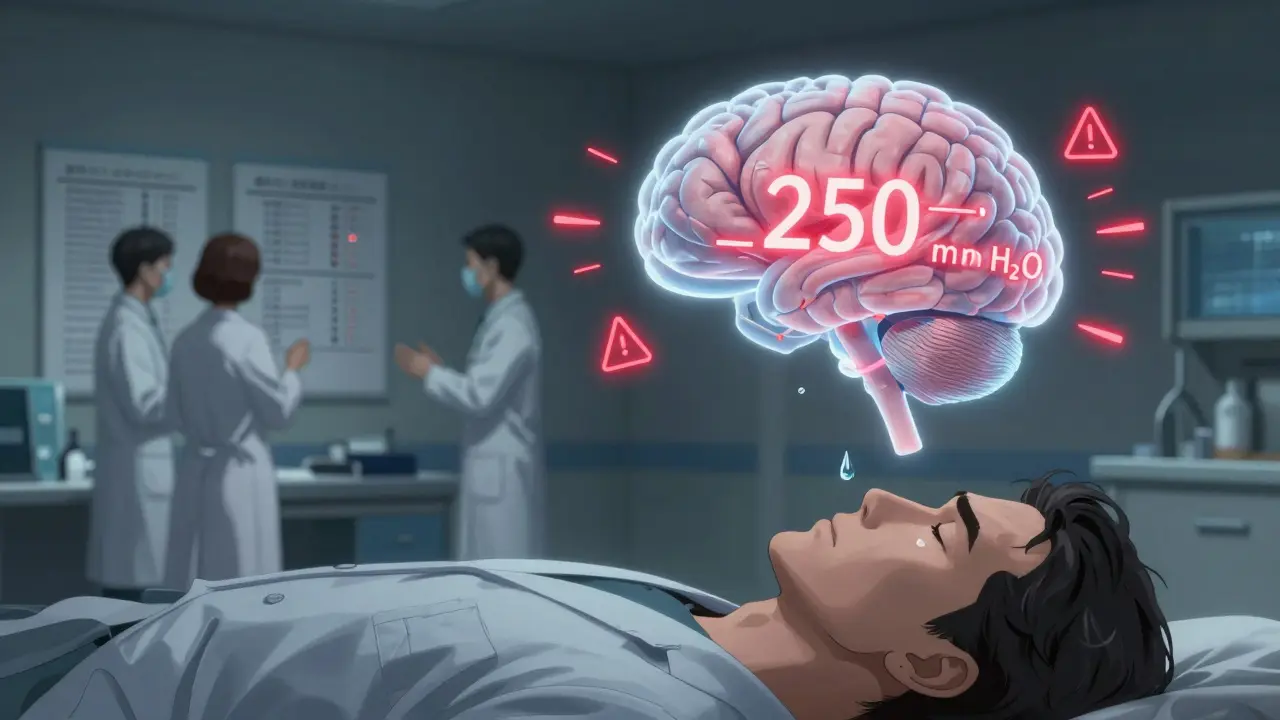
Pseudotumor cerebri, now more accurately called idiopathic intracranial hypertension (IIH), means your brain is under too much pressure-not because of a tumor, but because fluid (cerebrospinal fluid) isn’t draining the way it should. Normal pressure is between 70 and 180 mm H₂O. When it hits 250 or higher, you’re in danger zone territory. Symptoms are brutal: headaches that feel like a vice tightening around your skull, especially when lying down or bending over. You might notice double vision, ringing in your ears, or brief episodes where your vision dims or goes gray for 5 to 15 seconds. These are called transient visual obscurations. They’re not normal. And they’re not just "stress headaches."
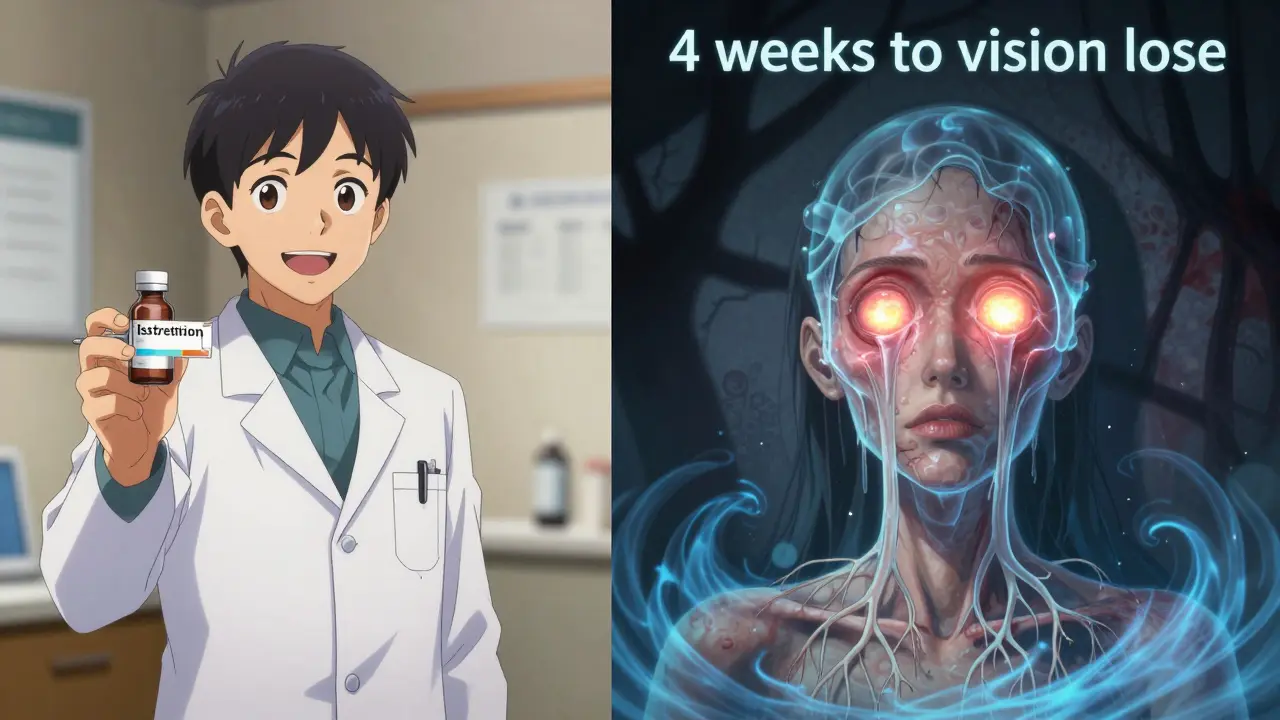
What makes this condition so dangerous is how fast it can destroy vision. In untreated cases, 5 to 10% of people lose sight permanently. And in medication-triggered cases, that risk jumps. A 2023 study from CHOP found that 40% of patients with drug-induced IIH had major vision field loss within just four weeks of symptoms starting. That’s faster than idiopathic IIH, where damage usually creeps in over months.
Which Medications Trigger This?
Not all medications cause this. But some do-and the list is longer than most people realize. The top offenders, backed by clinical data from UVA Health, Penn Medicine, and the IIH Treatment Trial, include:
- Minocycline (a tetracycline antibiotic): The most common drug linked to IIH in young adults. One case occurs for every 7,500 prescriptions. It’s often prescribed for acne or rosacea, and symptoms usually show up 1 to 6 months after starting.
- Isotretinoin (Accutane): Used for severe acne. About 15-20% of medication-induced IIH cases come from this. Vision changes can hit within 4 to 8 weeks. The FDA requires monthly eye exams for anyone on isotretinoin-and for good reason.
- Corticosteroid withdrawal: Stopping prednisone or similar drugs too fast can spike pressure. This group has the highest rate of permanent vision loss (18.3% in one 2019 study). It usually happens 1 to 3 weeks after quitting.
- Growth hormone therapy: Seen mostly in kids. In 22% of pediatric cases, vision loss happens before headaches even appear.
- Excess vitamin A: High-dose supplements or retinoids can trigger it. Not just from pills-some skincare products contain potent retinol derivatives.
Here’s the kicker: taking two of these together multiplies your risk. A 2022 UVA study found that using minocycline and isotretinoin at the same time increases your chance of IIH by 7.3 times. This isn’t rare. It’s happening in teens getting acne treatment from dermatologists while also being treated for skin inflammation by their primary care doctor. No one’s talking to each other.
Why Do These Drugs Cause It?
It’s not random. Each drug interferes with how your body handles fluid in the brain:
- Minocycline may block enzymes that help absorb CSF, causing a backup.
- Isotretinoin alters how fat cells behave around blood vessels in the brain, squeezing veins and slowing drainage.
- Corticosteroid withdrawal causes a rebound effect where fluid production spikes after the drug is gone.
- Growth hormone increases CSF production in children, whose skulls are still developing and can’t handle the pressure.
These aren’t side effects you can just "tough out." They’re biological disruptions that can permanently damage the optic nerve. The nerve doesn’t regenerate. Once it’s crushed by pressure, vision is gone for good.
How Is It Diagnosed?
Doctors don’t diagnose this with an MRI alone. A normal brain scan doesn’t rule it out. The gold standard is a lumbar puncture (spinal tap) to measure CSF pressure. If it’s over 250 mm H₂O, and there’s no tumor, stroke, or infection, it’s IIH.
But here’s the problem: 65-70% of primary care doctors misdiagnose it as migraine or sinusitis. A 2022 Neurology Today study found patients waited 4 to 12 weeks for the right diagnosis. That delay is deadly. By then, the optic nerve may be too damaged.
Early detection tools help:
- Optical coherence tomography (OCT): Measures thickness of the retinal nerve fiber layer. A spike of 15-20 microns in the first week is a red flag.
- Humphrey visual field test: Detects early loss in the upper nasal field-often the first sign before you notice anything.
- Eye exam for papilledema: Swelling of the optic nerve head. It’s visible with a special lens. Yet, many patients report their eye doctor didn’t check for it.
Patients who can describe transient visual obscurations-"my vision goes gray when I stand up"-get diagnosed 94% faster. That’s why knowing your symptoms matters.
Real Stories, Real Consequences
Reddit threads and patient forums tell the same story over and over.
One user, u/MinocyclineSurvivor, stopped the antibiotic after 6 months of daily headaches and "graying out" vision. After 6 weeks of acetazolamide and pressure-lowering treatment, her sight came back. But the headaches? Took four months to fade.
Another, "AcneWarrior" on HealthUnlocked, took isotretinoin for acne. Her doctor missed the swelling on her optic nerve. Three months later, she had permanent peripheral vision loss. "I can’t see cars coming from the side anymore," she wrote. "I drive with my head turned all the time."
A 2022 survey of 318 patients found that 41% were told their symptoms were "stress headaches." Another 33% got labeled as having migraines. No one thought to ask about antibiotics or acne meds.
What Happens After Diagnosis?
The good news? If caught early, medication-induced IIH often reverses. The first step is always stopping the drug. No exceptions.
Then comes treatment:
- Acetazolamide: A diuretic that reduces CSF production. It’s been the standard for decades. Many patients feel better in weeks.
- Venglustat: A new drug approved by the FDA in 2023. In trials, it lowered eye pressure 37% more than acetazolamide. It’s not yet widely available, but it’s coming.
- Lumbar punctures: Repeated spinal taps can temporarily relieve pressure while other treatments kick in.
- Surgery: For severe cases, a shunt may be placed to drain fluid, or optic nerve sheath fenestration is done to relieve pressure on the nerve.
Recovery isn’t instant. Headaches can linger for months. Vision takes time to stabilize. But if you stop the trigger and act fast, most people regain full sight.
How to Protect Yourself
If you’re on any of these drugs:
- Know the warning signs: new headaches that worsen lying down, vision that dims or grays out, ringing in ears, double vision.
- Don’t dismiss "migraines" if they started after a new medication. Ask: "Could this be pressure in my brain?"
- Request an eye exam with a neuro-ophthalmologist if you’ve been on isotretinoin, minocycline, or steroids for more than a month.
- If you’re on two meds that trigger IIH, talk to both your dermatologist and your primary care doctor. They need to know.
- Keep a symptom journal: note when headaches happen, how long vision changes last, if they’re worse at night or after bending over.
And if your doctor says "it’s probably stress"-push back. Bring this information. Ask for a lumbar puncture. Your vision is worth it.
Why This Isn’t Getting More Attention
It’s not rare. The NIH estimates 8,000 to 10,000 new cases of medication-induced IIH happen in the U.S. every year. But because it’s scattered across specialties-dermatology, neurology, endocrinology-no one owns the problem. A teen on isotretinoin sees a dermatologist. A young woman on minocycline sees her PCP. A child on growth hormone sees an endocrinologist. No one connects the dots.
That’s changing. The American Academy of Neurology updated its guidelines in 2022 to specifically include medication-triggered cases. The IIH Registry Project, launched in January 2023, is tracking 500 patients to map exact timelines for each drug. And new research from Johns Hopkins has found three inflammatory biomarkers that appear only in drug-induced IIH-potentially leading to a blood test that could replace lumbar punctures someday.
But until then, awareness is your best defense. If you’re on one of these drugs and you’re having unusual headaches or vision changes, don’t wait. Don’t assume it’s nothing. Ask for help. Your eyesight is one thing you can’t afford to lose.



Cory L
February 23, 2026 AT 01:01Vanessa Drummond
February 23, 2026 AT 06:57lela izzani
February 23, 2026 AT 08:34Joanna Reyes
February 23, 2026 AT 16:58Stephen Archbold
February 25, 2026 AT 15:52Lillian Knezek
February 27, 2026 AT 01:34Anil bhardwaj
February 27, 2026 AT 07:10Joseph Cantu
February 28, 2026 AT 10:59Nerina Devi
March 1, 2026 AT 00:16Southern Indiana Paleontology Institute
March 2, 2026 AT 04:36Kenzie Goode
March 3, 2026 AT 02:46tia novialiswati
March 3, 2026 AT 19:30Dinesh Dawn
March 4, 2026 AT 10:25Lisandra Lautert
March 4, 2026 AT 16:49Sanjaykumar Rabari
March 5, 2026 AT 12:37