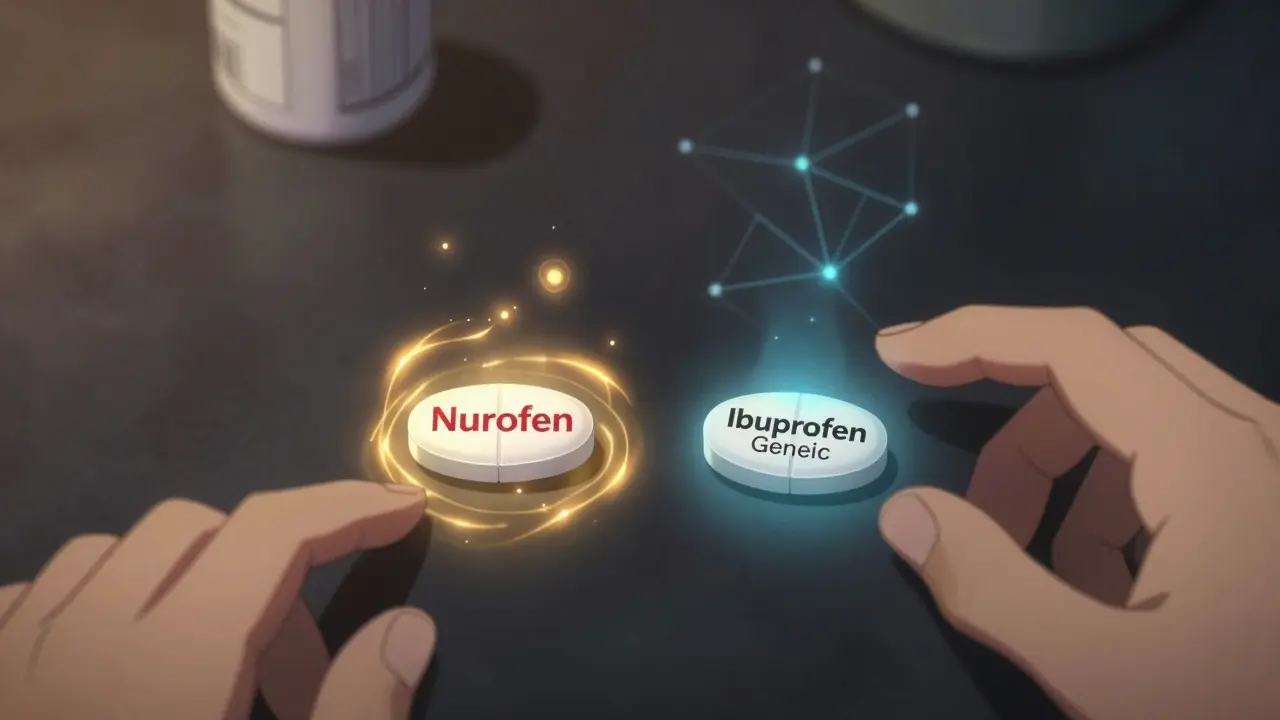
Imagine taking a pill that does nothing-no active ingredients, just sugar and filler. Now imagine that same pill makes your headache disappear. Not because of chemistry, but because you believe it will work. That’s the placebo effect, and it’s stronger than most people think. When it comes to generic medications, your belief about what you’re taking can change how well it works-even if the drug inside is identical to the brand-name version.
Why a Generic Pill Feels Less Effective
A 2016 study by researchers at the University of Sydney and Harvard Medical School showed something startling. Two groups of people with headaches were given identical placebo tablets. One group was told they were taking Nurofen, a well-known brand. The other group was told they were taking generic ibuprofen. The Nurofen group reported pain relief just as strong as if they’d taken real ibuprofen. The generic group? Their pain only dropped by about half as much. This wasn’t a fluke. The same pattern shows up in depression, chronic pain, and even heart conditions. Patients who believe they’re taking a brand-name drug often feel better-even when they’re not. Why? Because your brain doesn’t just respond to chemicals. It responds to expectations. Your brain has learned, over years of advertising, personal experience, and cultural messaging, that expensive, colorful, branded pills are “better.” That belief activates real biological pathways. Brain scans show that when people think they’re taking a brand-name drug, areas linked to expectation and reward light up more strongly. The same area that makes you feel good after a cup of coffee or a good workout also kicks in when you expect a pill to work.The Dark Side: When Belief Makes Things Worse
It’s not just about thinking a pill will help. Sometimes, thinking it will hurt makes you feel worse. This is called the nocebo effect. In one famous study, people taking a placebo pill for high cholesterol were told, “Some users report muscle pain.” Even though the pill had no active ingredient, nearly 20% of them quit the trial because they felt muscle aches. They weren’t imagining it-their brains actually amplified normal sensations into pain because they expected side effects. This happens all the time with generics. Patients hear, “This is cheaper,” or “It’s not the same as the brand,” and suddenly they start noticing side effects they never had before. A 2017 study found that when identical creams were labeled “expensive” versus “generic,” people using the “expensive” one reported less pain-even though both were pure Vaseline. The “generic” group? They felt more pain. Not because the cream was different. Because their minds told them it wouldn’t work.Price Isn’t Just a Number-It’s a Signal
Ever noticed how a $50 bottle of painkiller feels more effective than a $5 one-even if they’re made by the same company? That’s not just psychology. It’s physiology. A 2017 study published in Science showed that when people thought they were using an expensive pain cream, their spinal cords actually sent stronger pain signals to the brain. The cream was identical in both groups. The only difference? The price tag. The brain interpreted “expensive” as “powerful,” and responded accordingly. This has real consequences for generic drugs. If a patient sees a $2 generic instead of a $15 brand, their brain may assume it’s weaker-even if the FDA says it’s identical. And that assumption can cancel out the drug’s real benefits.
What Does the Science Say About Generic Effectiveness?
Let’s cut through the noise. Generics aren’t “weaker.” They’re required by law to have the same active ingredient, in the same amount, absorbed at the same rate as the brand-name version. The FDA tests them. The European Medicines Agency tests them. Australia’s TGA tests them too. In over 90% of cases, generics perform identically to brand-name drugs in clinical trials. For blood pressure meds, antibiotics, and thyroid drugs, there’s no measurable difference in outcomes. Even in depression, where placebo effects are strongest, studies show generics work just as well-if patients believe they will. The problem isn’t the drug. It’s the story we tell ourselves about it.Why Some People Still Doubt Generics
You’ve probably heard someone say, “My generic antidepressant doesn’t work like the brand.” It’s a common complaint. But here’s what’s really happening: when you switch from a brand you’ve used for years to a generic, your brain notices the change. The pill looks different. The name is unfamiliar. Maybe the packaging is simpler. Your mind starts scanning for problems. This is especially true for psychiatric medications. People who’ve been on a brand-name antidepressant for months or years often feel stable. When they switch, even if the drug is identical, they start wondering: “Is this why I feel off?” They notice every slight mood dip, every extra tired day. And they blame the generic. A 2022 Consumer Reports survey found that 63% of Americans believe brand-name drugs are superior. Even though 90% of prescriptions filled in the U.S. are generics, only about 76% of patients stick with them long-term. That’s not because the drugs fail. It’s because the perception fails.How Doctors and Pharmacists Can Help
The good news? You can fix this. It doesn’t take fancy tech or expensive packaging. It takes conversation. A simple 2-minute talk from a doctor or pharmacist can increase adherence to generics by 20%. Here’s what works:- “This generic has the exact same active ingredient as [Brand Name]. The FDA requires it.”
- “Over 90% of prescriptions in Australia are generics. They’re used by millions every day.”
- “The only difference is the color or shape. The medicine inside is the same.”
What You Can Do as a Patient
If you’ve switched to a generic and feel like it’s not working, pause. Ask yourself:- Did anything else change? Sleep? Stress? Diet?
- Am I noticing side effects because I expect them?
- Would I feel this way if I were still on the brand?
The Bigger Picture: Why This Matters
This isn’t just about individual pills. It’s about billions of dollars and millions of lives. In the U.S., poor perception of generics costs the healthcare system $28 billion a year. Why? Because people stop taking their meds. They go back to the doctor. They get unnecessary tests. They switch back to expensive brands. All because they think the cheaper option won’t work. In Australia, where generics are widely used and affordable, we still see the same pattern. Patients on generic blood pressure meds are 27% more likely to stop taking them in the first month if they believe they’re “inferior.” That’s dangerous. Uncontrolled blood pressure leads to strokes, heart attacks, kidney failure. If we can fix perception, we can fix outcomes. And we can save lives.What’s Next?
Pharmaceutical companies are starting to catch on. Some are launching “premium generics”-packaged to look more like brand-name drugs, with better colors, smoother coatings, and clearer labeling. Teva’s “Advil Migraine” generic, for example, looks and feels like the brand, even though it’s the same ibuprofen. It’s not misleading. It’s just designed to reduce doubt. Researchers are also testing personalized approaches. Could we one day test your sensitivity to placebo effects? Maybe use brain scans or questionnaires to predict who’s more likely to respond to branding? That’s still in early stages-but it’s coming. For now, the best tool we have is knowledge. Knowing that your brain shapes your experience with medicine doesn’t make the effect less real. It makes it more powerful. If you’re taking a generic, trust it. The science says it works. Your brain just needs a little nudge to believe it too.Do generic drugs work as well as brand-name drugs?
Yes. By law, generic drugs must contain the same active ingredient, in the same amount, and be absorbed by the body at the same rate as the brand-name version. The FDA, TGA, and European Medicines Agency require strict testing. In over 90% of cases, generics perform identically in clinical use. The only differences are in color, shape, or inactive ingredients-none of which affect how well the drug works.
Why do some people say their generic medication doesn’t work?
It’s often due to the placebo or nocebo effect. When patients switch from a familiar brand to a generic, they may notice differences in appearance or packaging. If they’ve been told generics are “inferior,” their brain may interpret normal sensations as side effects or reduced effectiveness. Studies show that simply explaining how generics work can improve outcomes by up to 22%.
Can the price of a drug affect how well it works?
Yes. Research shows that people who believe they’re taking an expensive medication report better results and fewer side effects-even when the drug is a placebo. Conversely, being told a drug is cheap can increase perceived side effects. This isn’t about the drug itself-it’s about how your brain interprets price as a signal of quality.
Are generic drugs less safe than brand-name drugs?
No. Generic drugs must meet the same safety and quality standards as brand-name drugs. They’re made in the same type of facilities, inspected by the same agencies, and tested for purity and potency. There’s no evidence that generics are less safe. In fact, because they’re used far more often, any safety issues would be detected faster.
Should I avoid switching to a generic drug?
No-unless your doctor advises otherwise. For most medications, switching to a generic is safe and effective. If you’re concerned, talk to your pharmacist or doctor. Ask them to explain why the generic is equivalent. Many patients report better outcomes once they understand the science behind it. The real risk isn’t the generic-it’s stopping your medication because you doubt it.



MARILYN ONEILL
January 22, 2026 AT 07:20This is why I refuse to take generics. I don't care what the FDA says. If it doesn't look like the brand, it doesn't work. My body knows the difference. I've tried it. I felt like garbage for weeks until I went back to the real thing. They're just trying to save money at my expense.
Coral Bosley
January 22, 2026 AT 15:33My brain is a liar and I'm tired of it. I switched to a generic blood pressure med last year. Thought I was fine. Then I started having these weird headaches. Turns out? I was convinced the pill was broken. My mind turned a normal pulse into a crisis. I cried in the pharmacy aisle. It wasn't the drug. It was me. And now I feel stupid.
Alex Carletti Gouvea
January 23, 2026 AT 20:10America's weakness is believing marketing over science. We pay $15 for a pill because it has a cool logo. Meanwhile, other countries get the same medicine for $2 and live longer. This isn't placebo. This is national stupidity.
Ben McKibbin
January 24, 2026 AT 19:18The science here is rock-solid, but the real challenge isn't the drug-it's the narrative we've built around medicine. We've turned pills into status symbols. A branded capsule becomes a ritual. A generic becomes an insult to our intelligence. But the body doesn't care about logos. It cares about molecules. And if the molecule is identical, the outcome should be too. We need to rewire our cultural relationship with health.
Stephen Rock
January 26, 2026 AT 09:09So what you're saying is my migraine is just in my head? Cool. Thanks for that. Now I'll just stop taking the generic and go back to the brand that costs 7x more. Because clearly my pain is a psychological failure. Brilliant. Next you'll tell me my depression is just bad vibes.
Andrew Rinaldi
January 27, 2026 AT 05:44It's fascinating how much of our healing comes from stories we tell ourselves. We think medicine is about chemistry, but it's also about trust. When you hand someone a pill, you're not just giving them a compound-you're giving them a promise. If that promise is broken by a different color or a cheaper price tag, the body feels it. The real tragedy is that we treat biology like it's a machine, when it's more like a poem.
Gerard Jordan
January 28, 2026 AT 14:57Wow this is so real 😭 I switched to a generic antidepressant last year and felt like I was drowning. Turns out I just needed to hear "it's the same medicine" from my pharmacist. Now I take it with a smile. We need more of these conversations. Also, if you're on generics, you're saving money for someone else's insulin. That's powerful 💪💊
Roisin Kelly
January 30, 2026 AT 11:24They're lying. Big Pharma doesn't want you to know this. The generics are made in China. The same factory that made the tainted toys. They test them once a year. The FDA is paid off. My cousin's sister took a generic and her liver failed. It's all connected. Don't be fooled.
lokesh prasanth
January 31, 2026 AT 20:24Placebo is real. But so is profit. Who benefits? Big pharma. They make generics cheap then charge for branding. We are the lab rats. Mind over matter? No. Money over matter.
Glenda Marínez Granados
January 31, 2026 AT 20:27So let me get this straight... I'm supposed to believe that a $2 pill with a weird shape is magically the same as the $15 one that makes me feel like a human again? 😏 Guess I'll just keep paying for the placebo that comes in a fancy bottle. At least the box looks like it cares.
Yuri Hyuga
February 1, 2026 AT 00:19This is one of the most profound public health insights I've read in years. We treat medicine like a product, not a partnership between science and trust. The real innovation isn't in the pill-it's in the conversation. A doctor saying "this is identical" with eye contact and calm tone does more than any clinical trial. We must train clinicians to be healers, not just prescribers.
MAHENDRA MEGHWAL
February 1, 2026 AT 14:28It is a matter of great concern that the perception of pharmaceutical efficacy is influenced by non-pharmaceutical factors. The human psyche, when conditioned by societal norms and commercial branding, may override physiological reality. This phenomenon necessitates a reevaluation of patient education protocols at institutional levels.
Kevin Narvaes
February 2, 2026 AT 16:15bruh i took a generic for anxiety and i swear it made me feel like a zombie. i went back to the brand and boom. i was myself again. so yeah maybe my brain is dumb but it knows what works. dont tell me its all in my head. my head knows better.
Dee Monroe
February 3, 2026 AT 21:37I used to think generics were just a scam to make people feel guilty for spending money. But then I started reading more, and I realized something deeper: we’ve been taught to equate cost with value, and that’s not just wrong-it’s dangerous. What if the real medicine isn’t in the pill at all? What if it’s in the peace of mind that comes from trusting your body, your doctor, and the science? I switched to a generic last month. I didn’t feel any different. But I felt proud. Like I was part of something bigger. Maybe that’s the real placebo effect-the belief that we can do better, together.
Jerry Rodrigues
February 4, 2026 AT 15:31My grandma takes generics. She's 82. Her blood pressure is perfect. She doesn't know what brand it is. She just takes it. Maybe that's the secret.