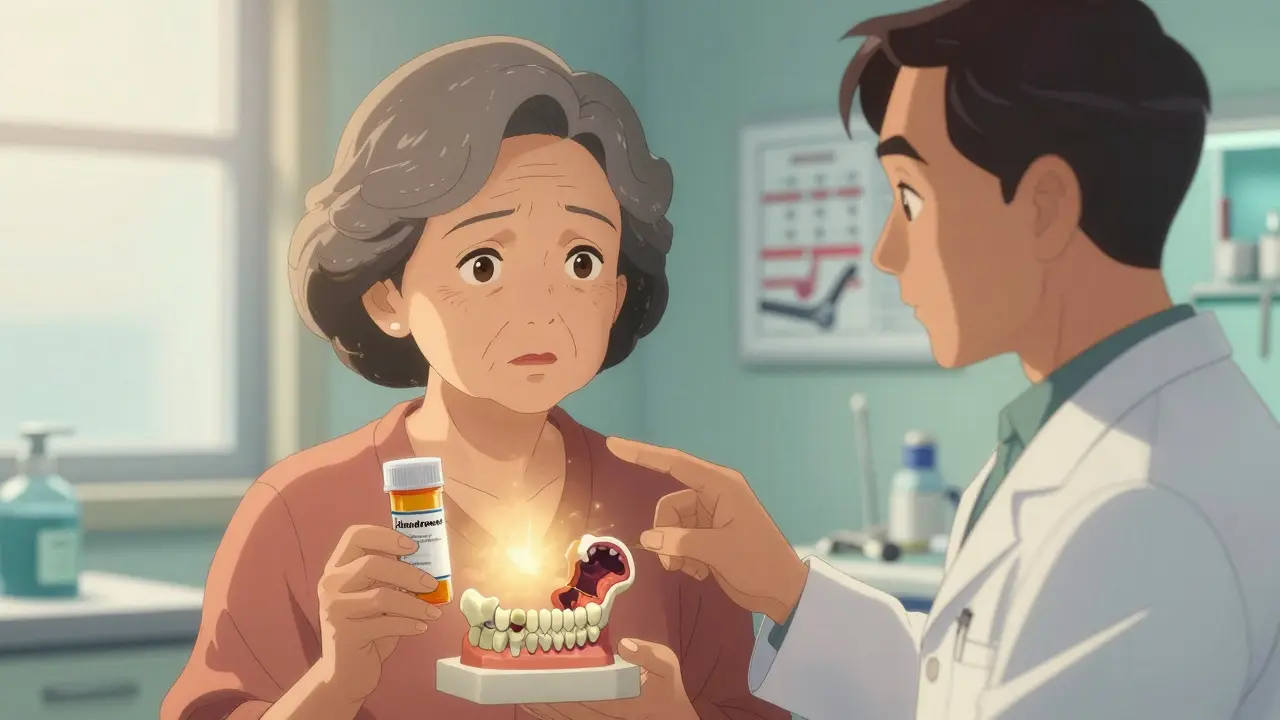
When you’re told you have osteoporosis, the goal is simple: prevent fractures. Your bones are thinning, and a fall could mean a broken hip, a long hospital stay, or even loss of independence. That’s why doctors reach for bisphosphonates - drugs like alendronate (Fosamax), risedronate (Actonel), and zoledronic acid (Reclast). They work. They cut hip fracture risk by over 50% and spine fractures by nearly half. But there’s a quiet, rarely talked-about risk: jaw necrosis.
What Exactly Is Jaw Necrosis?
Medication-related osteonecrosis of the jaw, or MRONJ, happens when bone in your jaw becomes exposed and doesn’t heal. It’s not an infection you can brush off. The bone dies, stays visible for more than eight weeks, and often gets infected. You might feel pain, swelling, or notice a piece of bone sticking out after a tooth extraction. It sounds scary - and it is. But here’s the truth most people don’t hear: this is extremely rare if you’re taking bisphosphonates for osteoporosis.
The condition was first noticed in cancer patients getting high-dose IV drugs. But it showed up in osteoporosis patients too. The jaw is different from other bones. It’s constantly under stress from chewing, has thin gum tissue, and is full of bacteria. When bisphosphonates slow down bone repair, the jaw is the first place it shows up.
How Common Is This Really?
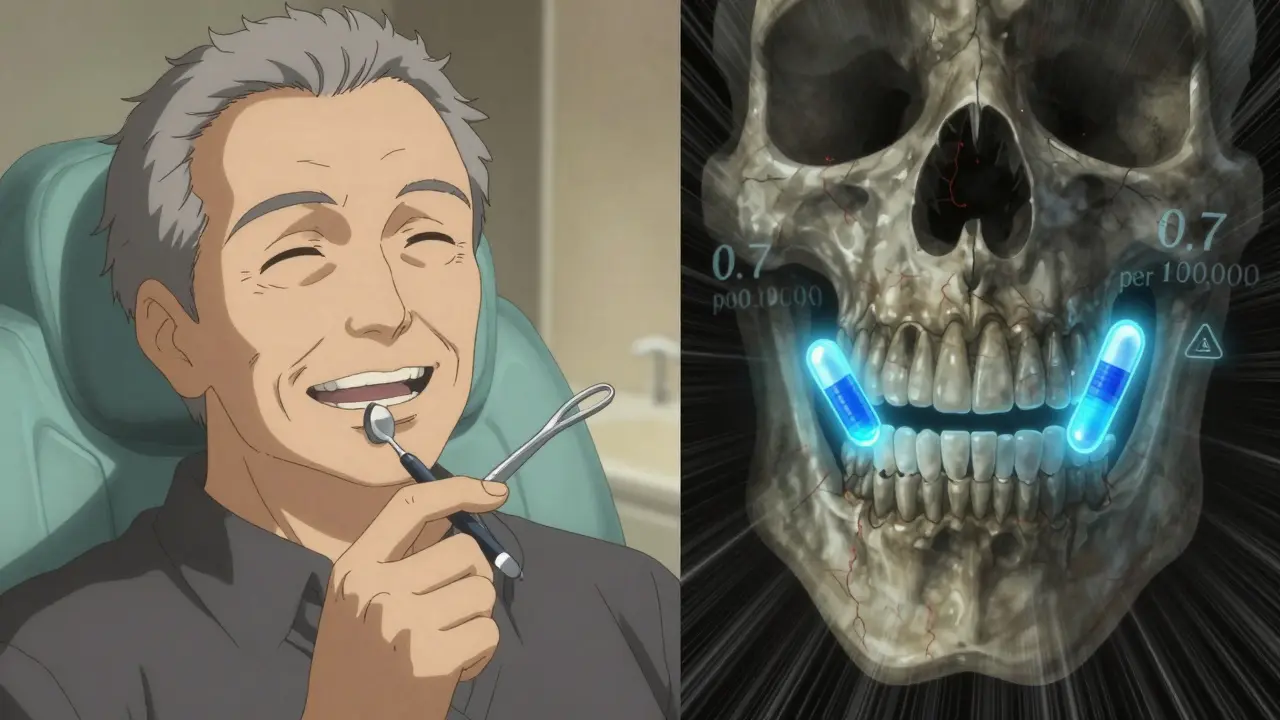
Let’s put numbers to fear. For someone taking oral bisphosphonates like Fosamax for osteoporosis, the risk of MRONJ is about 0.7 in 100,000 people per year. That’s less than one case in a city the size of Adelaide. A major study of 260,000 osteoporosis patients found no higher risk than people not taking these drugs at all. Compare that to cancer patients on IV bisphosphonates - their risk jumps to 1 in 100, or even higher if they’re also on denosumab.
Denosumab (Prolia) is another osteoporosis drug. It works differently - it’s an antibody, not a bisphosphonate. But it carries a higher risk of jaw necrosis. Studies show it’s 1.7 to 2.5 times more likely to cause MRONJ than oral bisphosphonates. Yet, it’s still rare overall. The real danger comes from combining drugs, like switching from bisphosphonates to denosumab. One 2024 study found 16% of cancer patients who did this developed jaw necrosis.
Why Do Bisphosphonates Cause This?
Bisphosphonates stick to bone and stop osteoclasts - the cells that break down old bone so new bone can grow. That’s good for your spine and hip. But your jaw needs constant remodeling. It’s the only bone that’s always in contact with bacteria, saliva, and chewing forces. When bone repair slows down, small injuries from dental work - even a routine cleaning - can’t heal properly.
The nitrogen-containing bisphosphonates (like alendronate and zoledronic acid) are the strongest. They stay in your bones for over 10 years. That’s why MRONJ can show up years after you stop taking the drug. The drug doesn’t vanish; it just sits there, quietly blocking bone repair.
Who’s at Highest Risk?
Not everyone who takes these drugs gets MRONJ. Risk goes up if:
- You’ve had a tooth extraction, dental implant, or major gum surgery after starting treatment
- You have gum disease or poorly fitting dentures
- You smoke or have diabetes
- You’re on IV bisphosphonates (like Reclast), especially for more than 3 years
- You’ve switched from bisphosphonates to denosumab
Most cases happen within 2 years of a dental procedure. But some show up 5 or even 8 years later. That’s why it’s not just about current use - it’s about your history.
What Should You Do Before Starting Treatment?
Before you take your first bisphosphonate pill or IV drip, see your dentist. Get a full exam. Fix cavities. Remove loose teeth. Treat gum disease. Don’t wait. Once you start, your jaw’s healing ability drops. Dental work becomes riskier.
The American Dental Association says this is non-negotiable. If you’re on IV bisphosphonates, your dentist should evaluate you within 30 days of your first dose. If you’re on oral bisphosphonates, get a checkup before you start. It’s not an extra step - it’s your safety net.
What If You’re Already on the Medication?
If you’ve been on alendronate for 5 years and your dentist says you need a tooth pulled, don’t panic. But don’t ignore it either. Talk to both your doctor and dentist. They need to work together.
Some doctors suggest a “drug holiday” - stopping the bisphosphonate for 3 to 6 months before major dental work. But here’s the catch: stopping increases your fracture risk. A 2024 study showed that stopping zoledronic acid for over a year cuts MRONJ risk by 82% - but raises your chance of a new hip or spine fracture by 28%. That’s not a trade-off you make lightly.
For most people on oral bisphosphonates, the risk of jaw necrosis is so low that skipping the drug isn’t worth it. The fracture risk is real. The jaw problem? Almost theoretical.
Signs You Should Watch For
MRONJ doesn’t always hurt. It can start silently. Look for:
- Bone sticking out of your gums after a tooth comes out
- Pain, swelling, or pus in your jaw
- Loose teeth with no obvious cause
- Numbness or heaviness in your jaw
Stage 1 is just exposed bone with no pain. Stage 2 has infection and pain. Stage 3 means the bone breaks, or the infection spreads to your face. Early detection is everything. If you see exposed bone, see your dentist immediately. Don’t wait for it to get worse.
Real Stories, Real Fears
One woman in Sydney, 68, took alendronate for 5 years. Her dentist found exposed bone after a cleaning. It took 18 months of antibiotics and surgery to heal. She’s now off the drug and terrified to go back.
Another man, 72, has been on Fosamax for 22 years. He’s had three extractions and two implants. Zero problems. His dentist says he’s the exception. He’s not. Most people don’t get this. But fear spreads faster than facts.
A survey of over 1,200 osteoporosis patients found 87% were anxious about jaw necrosis before dental work. But only 2.3% actually had it. Dentists are now so scared of MRONJ that some refuse to pull teeth - even when they’re infected and causing pain. That’s worse than the disease.
The Bigger Picture
Over 8 million Americans take bisphosphonates for osteoporosis. About 72% of eligible patients get treatment. But 38% quit within a year - mostly because of stomach upset, not jaw problems. That’s the real tragedy. People are afraid of a 1-in-100,000 risk and walking away from a drug that prevents life-altering fractures.
Denosumab and newer drugs like romosozumab are gaining ground. But they’re not better. Denosumab has a higher MRONJ risk. Romosozumab works fast but needs to be followed by another drug - and its long-term safety is still being studied.
Bisphosphonates are still the gold standard. They’ve been used for 30 years. We know how they work. We know how to prevent complications. And we know the fracture risk they prevent.
What’s Next?
Doctors are starting to personalize treatment. Instead of giving everyone the same drug for 5 years, they’re looking at biomarkers - like urinary NTX levels - to see who’s losing bone fastest. Those at highest fracture risk get longer treatment. Those at low risk might switch to safer options sooner.
By 2025, new guidelines will likely recommend checking your drug holiday timing based on the type of bisphosphonate. For zoledronic acid, stop 12+ months before major dental work. For ibandronate, 3 months may be enough. For oral alendronate? Most experts say: keep taking it.
The future isn’t about avoiding bisphosphonates. It’s about using them smarter - with better screening, better timing, and better communication between doctors and dentists.
Bottom Line: Don’t Let Fear Stop You
Yes, jaw necrosis is real. Yes, it’s serious. But for the vast majority of people with osteoporosis, the risk is microscopic compared to the risk of breaking a bone. You’re not choosing between a drug and a disease. You’re choosing between a tiny chance of a rare complication and a very real chance of losing your mobility, your independence, or your life.
Do this: See your dentist before you start. Keep your gums healthy. Tell your doctor if you need dental work. Don’t skip your meds because of fear. And if you’re worried, ask for a risk assessment - not a scare tactic.
Fractures don’t wait. Your jaw can heal. But a broken hip? That changes everything.

CAROL MUTISO
December 16, 2025 AT 03:17Let’s be real - if your biggest fear after taking Fosamax is your jaw turning into a haunted museum exhibit, you’re probably not the one who’s gonna break a hip. I’ve seen grandmas ride bikes at 80 because they didn’t let fear turn their bones into dust. The real tragedy? People ditching life-saving meds because some Reddit thread called it ‘the jaw death curse.’
Donna Packard
December 17, 2025 AT 05:45I appreciate how calmly this breaks down the numbers. My mom’s on alendronate and I was terrified too - until I saw the stats. 0.7 in 100,000? That’s less likely than getting struck by lightning while winning the lottery. She got her dental checkup, fixed a cavity, and hasn’t looked back.
Jessica Salgado
December 17, 2025 AT 10:12Okay, but why is it always the jaw? Why not the femur? Why not the ribs? Why does the body pick the one bone we use to eat, speak, and smile to betray us? Is it because the jaw’s the most emotionally charged bone? The one that holds our identity - our laugh, our kiss, our scream? Or is it just because it’s exposed, vulnerable, and constantly under siege by bacteria and toothpaste?
I’m not saying don’t take the meds. I’m saying… the universe has a weird sense of irony. We’re told to protect our bones, but the one that gets punished is the one that lets us taste life. Maybe that’s the real lesson here: everything that gives us joy also carries risk.
Chris Van Horn
December 18, 2025 AT 23:34While I appreciate the author’s attempt at demystifying MRONJ, it is imperative to note that the statistical normalization of risk is a fallacy predicated upon the misrepresentation of longitudinal data. The 0.7 per 100,000 figure is derived from a cohort that excludes polypharmaceutical patients - a demographic that constitutes over 62% of osteoporosis sufferers. Furthermore, the exclusion of concomitant corticosteroid use in the cited studies constitutes a significant confounding variable. One must not confuse population-level probabilities with individualized biological vulnerability.
Peter Ronai
December 20, 2025 AT 03:04Oh please. 'Jaw necrosis is rare'? Tell that to the guy in my dentist's waiting room who had to get half his jaw removed. You think your '1 in 100,000' means anything when you're the one left with a hole where your teeth used to be? This is the same logic that told people smoking was 'only risky for some.' Wake up. If your jaw dies, you don't get to say 'but statistically...'
Michael Whitaker
December 21, 2025 AT 10:25As a former pharmaceutical consultant, I must emphasize that the pharmaceutical industry has a vested interest in minimizing the perception of MRONJ risk. The fact that bisphosphonates remain on formularies despite documented cases of delayed-onset osteonecrosis - sometimes appearing 12+ years post-administration - speaks volumes. The real issue isn’t the drug’s efficacy. It’s the systemic suppression of adverse event reporting. Your dentist won’t tell you this, but many of us in the field know: the data is sanitized.
Kent Peterson
December 23, 2025 AT 01:23Let me get this straight - you’re telling me I should risk my jaw for a 50% reduction in hip fractures? But what if I don’t fall? What if I’m active? What if I lift weights and eat calcium? You’re acting like osteoporosis is a death sentence - it’s not! It’s a condition you manage, not a war you surrender to! And who gave you the right to tell people to just take the pill? I’ve seen people lose their jaws and then their dignity - and you’re just shrugging and saying ‘stats’?!?!?!
Evelyn Vélez Mejía
December 24, 2025 AT 02:24The real villain here isn’t bisphosphonates - it’s the medical system’s failure to integrate dental and skeletal care. We treat bones like widgets and teeth like accessories. You wouldn’t give someone a heart stent without checking their arteries. Why do we hand out bisphosphonates without mandating a dental baseline? This isn’t about fear. It’s about negligence dressed up as convenience.
And let’s not pretend denosumab is the ‘safer’ alternative. It’s just a prettier poison with a different expiration date. The real breakthrough? A drug that doesn’t lock your bones in a time capsule. Until then, we’re just playing Russian roulette with our skeletons.
Nishant Desae
December 25, 2025 AT 17:08I am from India and my uncle took Fosamax for 7 years. He had a tooth pulled and nothing happened. He is 78 now, walks every morning, no fractures. I think the fear is bigger than the problem. We must not forget that in many places, people die because they cannot even get calcium or vitamin D. We should not let fear stop us from doing what saves lives. Please, talk to your doctor and dentist together - not alone. That is the key.
Pawan Chaudhary
December 26, 2025 AT 19:39My grandma’s on this stuff and she’s still baking pies at 82. She got her teeth checked, took her pills, and never looked back. Honestly? If you’re scared of your jaw, maybe you’re just scared of getting older. This medicine lets you keep living - not just surviving. Don’t let a 1-in-100k ghost scare you out of your golden years.
Linda Caldwell
December 27, 2025 AT 17:26Just get your teeth checked. Take the pill. Live your life. Stop overthinking it. Your jaw will be fine. Your hip won’t be if you quit.
Anna Giakoumakatou
December 29, 2025 AT 08:40Oh wow, what a beautifully sanitized corporate brochure. ‘Jaw necrosis is rare’ - yes, because the FDA doesn’t require pharmaceutical companies to track it beyond 5 years. And of course, the ‘real tragedy’ is people not taking the drug. What a noble cause - to keep people medicated so the stock price stays up. I’ll pass on my jaw, thanks.
Erik J
December 30, 2025 AT 22:33Is there any data on MRONJ incidence in patients who took bisphosphonates for under 2 years? I’m curious if the risk is truly time-dependent or if it’s just the dental procedure that’s the trigger. Also, what about those who stopped and restarted? I’ve seen conflicting reports.
BETH VON KAUFFMANN
December 31, 2025 AT 09:23Per the 2023 ASBMR guidelines, the term ‘drug holiday’ is misleading. It implies discontinuation equals safety, whereas pharmacokinetic modeling demonstrates that bisphosphonates remain bioavailable in bone matrix for decades. The correct clinical framework is ‘risk stratified monitoring,’ not cessation. Furthermore, the notion that oral bisphosphonates are ‘low risk’ is a category error - the absolute risk is low, but the relative risk increase post-dental extraction is 37x. That’s not negligible. It’s pharmacovigilance 101.