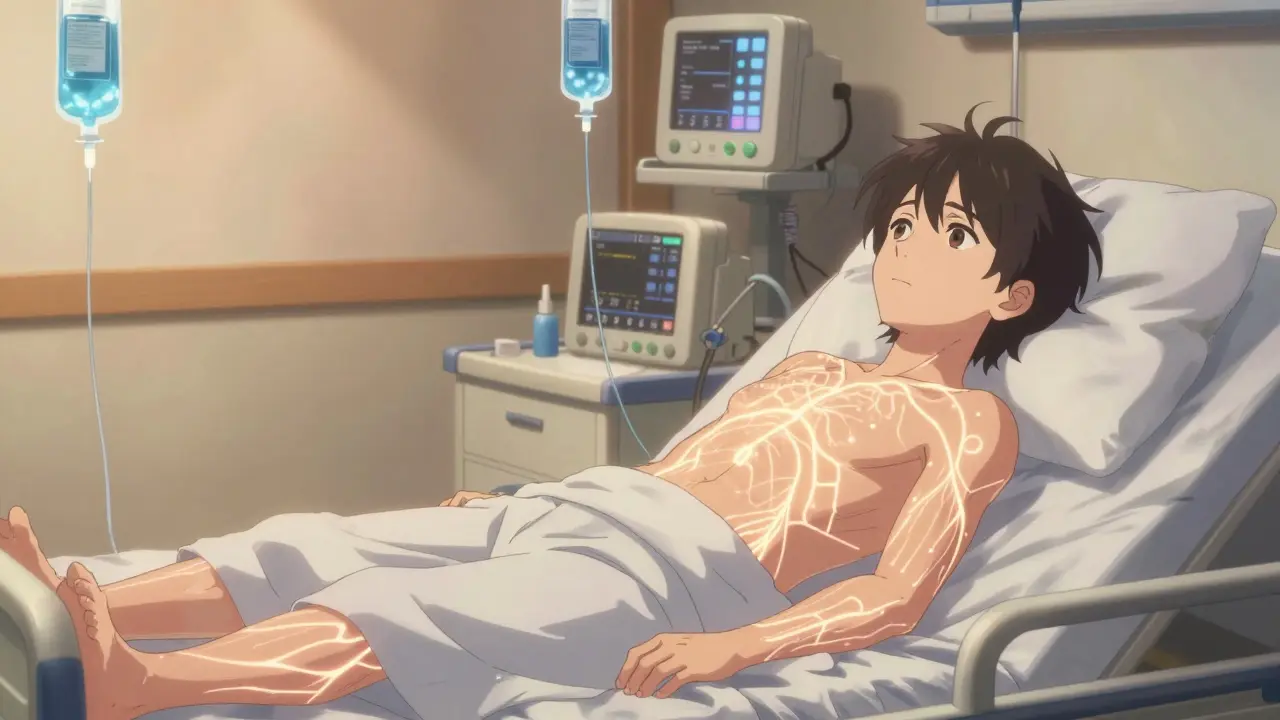
Guillain-Barré Syndrome (GBS) doesn’t announce itself with a fever or a cough. It creeps in quietly - maybe a tingling in your toes, a stumble on the stairs, or legs that feel heavier than usual. Within days, that mild discomfort can turn into full-body weakness so severe you can’t lift your head or breathe on your own. It’s rare - about 1 in 100,000 people get it each year - but when it hits, it demands immediate action. And the difference between recovery and permanent disability often comes down to one thing: IVIG treatment started within the first two weeks.
How GBS Attacks Your Nerves
GBS is not an infection. It’s your own immune system going rogue. After a stomach bug, flu, or even a vaccination, your body starts attacking the protective coating around your nerves - the myelin sheath. This is called demyelination. Without that insulation, electrical signals from your brain can’t reach your muscles properly. The result? Rapid, symmetrical weakness that climbs up from your feet to your arms, and sometimes your face and breathing muscles.
Most people (85-90%) start with weakness in their legs. Within days, it spreads. About half develop facial drooping, trouble swallowing, or blurred vision. Around 20-30% end up on a ventilator because their diaphragm gives out. The worst of it usually hits within three to four weeks. After that, things either plateau or begin to improve - if treatment has started.
The most common version in North America and Europe is called AIDP - Acute Inflammatory Demyelinating Polyradiculoneuropathy. It accounts for 90% of cases. Doctors confirm it with nerve conduction tests showing slowed signals and a spinal tap showing high protein levels with normal white blood cells - a telltale sign called albuminocytological dissociation.
Why IVIG Is the First-Line Treatment
For decades, the only hope was supportive care - monitoring, physical therapy, and waiting. Then came IVIG: intravenous immunoglobulin. It’s a purified solution of antibodies taken from thousands of healthy donors. When you get it, those antibodies flood your bloodstream and essentially confuse your immune system, stopping it from attacking your nerves.
The standard dose? 0.4 grams per kilogram of body weight, given daily for five days. That’s about 28 grams for a 70kg person. It’s administered through a regular IV line, usually in a hospital. No central lines. No needles in your neck. Just a simple drip over a few hours each day.
Studies show IVIG cuts recovery time by nearly half. People who get it within two weeks of symptoms start walking independently about three weeks sooner than those who don’t. In one trial, 60% of IVIG patients showed clear improvement within four weeks - compared to just 40% in the placebo group. That’s not just a statistical difference. It’s the difference between being home for Christmas or still in the ICU.
IVIG vs. Plasma Exchange: The Real Choice
Plasma exchange - or plasmapheresis - is the other first-line option. It works by pulling your blood out, removing the bad antibodies, and returning the cleaned plasma. It’s effective, too. In fact, multiple studies show it’s just as good as IVIG at improving strength at four weeks.
But here’s the catch: plasma exchange needs a central line. That’s a big needle inserted into your neck, chest, or groin. It’s invasive. It carries a 30% risk of complications - infection, bleeding, low blood pressure. IVIG? Only 15% complication rate. And you don’t need specialized equipment. Any hospital with an infusion suite can give it.
Cost-wise, IVIG runs $15,000-$25,000 per course. Plasma exchange costs more - $20,000-$30,000 - because of the equipment and staff time. Patient satisfaction scores? IVIG wins by a landslide. People report less pain, less stress, and more comfort. One patient on a GBS forum wrote: “IVIG started on day five. By day twelve, I could wiggle my toes. The headaches were awful, but I’d take them over a central line any day.”
There are exceptions. If someone is crashing - rapid breathing, unstable blood pressure - some neurologists still lean toward plasma exchange because it works faster in the first 48 hours. But even then, the long-term outcomes are nearly identical.
What Doesn’t Work
Corticosteroids - like prednisone - have been tried for decades. They’re cheap, widely available, and seem logical: reduce inflammation, right? But time and again, trials show they do nothing. A 2017 meta-analysis of over 1,000 patients found no difference in recovery time or strength between those on steroids and those on placebo. The American Academy of Neurology doesn’t recommend them. Not even as a backup.
Other experimental treatments - like complement inhibitors - are still in trials. One drug, eculizumab, showed faster recovery in a small 2022 study, but it’s not approved for GBS yet. And it costs over $500,000 per year. For now, IVIG remains the gold standard.
Side Effects and Risks
IVIG isn’t risk-free. About 25% of patients get a bad headache during or right after the infusion. Some feel feverish, chills, or nausea. These usually go away with rest and painkillers. But there are rarer, serious risks.
People with IgA deficiency can have life-threatening allergic reactions. That’s why hospitals check your blood before starting. Kidney problems? IVIG can cause acute kidney injury, especially in older patients or those with diabetes. One case report described a teenager who needed dialysis after his third dose. It’s rare - less than 0.5% - but it happens.
Thrombosis is another concern. IVIG thickens the blood. If you’re already at risk for clots - due to immobility, cancer, or dehydration - your chance of stroke or pulmonary embolism goes up. That’s why doctors hydrate patients before and after treatment and monitor blood pressure closely.
Autonomic instability affects 65% of severe GBS cases. Blood pressure can spike or crash without warning. Heart rate can go wild. That’s why patients in intensive care are hooked to monitors 24/7. A sudden drop in BP can kill. IVIG doesn’t cause this - but it doesn’t fix it either. Managing it requires expert nursing and constant vigilance.

Recovery: What to Expect
Recovery isn’t linear. Some people feel better within days. Others take months. About 60% recover fully within six to twelve months. That means walking without help, climbing stairs, driving again.
But 30% are left with lingering weakness - maybe a foot drop, numbness in fingers, or trouble with fine motor skills. They might need braces, canes, or ongoing physical therapy. And 10%? They’re severely disabled a year later. They may need a wheelchair. They may never regain full hand function.
One patient, posted on a GBS support group: “I got IVIG on day 7. I could walk again at 11 weeks. But my feet still burn at night. I can’t run. I can’t dance. But I can hold my daughter. That’s enough.”
Long-term outcomes depend on early treatment, age, and how fast weakness spread. Older patients and those with axonal damage (a rarer form of GBS) have worse prognoses. Anti-ganglioside antibodies - found in 65% of axonal cases - can help predict who’ll need more aggressive rehab.
When Time Is Everything
Every hour counts. Experts say each day’s delay in starting IVIG reduces its effectiveness by about 5%. That’s why neurologists stress: if you have ascending weakness after an infection, get to the hospital immediately. Don’t wait for an MRI. Don’t wait for a specialist referral. Get a spinal tap and nerve tests within 72 hours.
Many cases get misdiagnosed as a pinched nerve, multiple sclerosis, or even a stroke. A 2022 Johns Hopkins study found 5-10% of GBS cases were initially missed. That’s why emergency doctors need to know the signs: symmetric weakness, no reflexes, recent infection.
GBS doesn’t care if you’re young or old. It doesn’t care if you’re healthy. It strikes without warning. But with fast diagnosis and IVIG, most people don’t just survive - they rebuild their lives.
What’s Next for GBS Treatment?
The big news? The International GBS Outcome Study (IGOS) is tracking 1,500 patients across 30 countries. Early data suggests starting IVIG within 72 hours - not just 14 days - could improve six-month outcomes by 15%. That’s huge.
Researchers are also looking at personalized medicine. If you have certain antibodies, maybe you need a different dose. Maybe you need a combo of IVIG and a new drug. One trial is testing eculizumab, which blocks a key part of the immune attack. Early results are promising.
But for now, the answer is clear: recognize the symptoms. Get to the hospital. Start IVIG. Don’t wait. Because when your nerves are shutting down, time isn’t just money - it’s mobility, independence, and your future.
Can Guillain-Barré Syndrome come back after treatment?
Relapse is rare - less than 5% of patients experience a second episode. Most recover fully after one bout. But if weakness returns months or years later, doctors check for CIDP (Chronic Inflammatory Demyelinating Polyneuropathy), a related but long-term condition that mimics GBS. CIDP requires ongoing treatment, unlike GBS, which is usually a one-time event.
Is IVIG safe for children with GBS?
Yes. IVIG is the standard treatment for children with GBS and is just as effective as in adults. Dosing is based on weight, not age. Kids tend to recover faster than adults, and side effects like headaches or fever are usually milder. Hospitals follow the same protocols for pediatric patients, with extra monitoring for fluid balance and kidney function.
Can you get GBS from a vaccine?
Very rarely. The risk is about 1-2 cases per million flu shots - far lower than the risk from getting the flu itself. Other vaccines like HPV, tetanus, or COVID-19 have been linked to isolated cases, but no proven causal link exists. The CDC and WHO state that the benefits of vaccination vastly outweigh the tiny risk of GBS. Most cases are triggered by infections, not vaccines.
How long does IVIG stay in your system?
The infused antibodies last about 3-4 weeks in your bloodstream. But their effect on stopping the immune attack lasts longer - often weeks to months. That’s why one five-day course is enough. Your body gradually breaks down the antibodies, and your immune system resets. You don’t need repeat doses unless you have CIDP, not GBS.
Can you recover without IVIG?
Yes, but it’s slower and riskier. About 20% of untreated patients recover fully, but 30% end up with lasting disability. Without IVIG or plasma exchange, recovery can take 6-12 months longer. The risk of needing a ventilator is higher, and complications like blood clots or infections are more common. IVIG doesn’t cure GBS - it just speeds up your body’s natural recovery and reduces the chance of permanent damage.



Jonny Moran
December 15, 2025 AT 23:45Just had a cousin go through this last year. Started with tingling toes, thought it was a pinched nerve. By day 4, couldn’t stand. Got IVIG on day 6. Walked again at 8 weeks. Still gets foot numbness at night, but she’s back to teaching kindergarten. Don’t wait. If your legs feel like concrete after a bug, go to the ER. No exceptions.
Rulich Pretorius
December 16, 2025 AT 00:12It’s fascinating how the body turns against itself. The immune system, designed to protect, becomes the executioner. IVIG doesn’t cure-it interrupts. It’s like throwing a wrench into a machine that’s already running wild. The real tragedy isn’t the disease, but the delays caused by misdiagnosis. We treat symptoms, not the silent war inside the nerves.
Thomas Anderson
December 17, 2025 AT 12:47IVIG ain’t cheap, but it’s way better than getting stuck on a vent for months. My uncle got it after a bad flu. Headaches for a day, then boom-started moving toes by day 5. Docs said if he waited another 48 hours, he might’ve been stuck with permanent weakness. Don’t mess around with this stuff.
Sinéad Griffin
December 19, 2025 AT 05:01AMERICA STILL HAS THE BEST GBS CARE IN THE WORLD. 🇺🇸 No other country gives IVIG this fast. I saw a video from India where they waited 10 days because of ‘supply issues.’ That’s not healthcare, that’s a death sentence. If you’re reading this outside the US, get the hell here. IVIG saves lives. Period.
Dwayne hiers
December 19, 2025 AT 09:57While IVIG is standard-of-care for AIDP, it’s critical to differentiate axonal variants (AMAN/AMSAN) where efficacy may be attenuated. The 2023 EFNS guidelines emphasize neurophysiological stratification prior to treatment initiation. Elevated anti-GM1 antibodies correlate with poorer IVIG response in axonal subtypes-plasma exchange may still hold preferential advantage in these cases despite higher invasiveness.
jeremy carroll
December 19, 2025 AT 14:29my buddy got gbs after his covid booster. totally freaked out. doc said ‘it’s rare but real.’ got ivig on day 5. he could wiggle his fingers again in 72 hours. now he’s hiking again. don’t let fear stop you from getting help. sometimes the thing that’s supposed to protect you (vaccine) can trigger it-but the cure is right there. just don’t wait.
Daniel Thompson
December 20, 2025 AT 18:13I work in neurology. I’ve seen dozens of GBS cases. I’ve also seen families refuse IVIG because they ‘don’t trust big pharma.’ I’ve seen patients die because they waited for a second opinion. I don’t say this to scare you-I say it because I’ve held the hands of people who lost their ability to breathe because they listened to Reddit instead of their neurologist. Time is not a suggestion. It’s a countdown.
Daniel Wevik
December 20, 2025 AT 19:29IVIG is the gold standard for a reason. It’s not magic, but it’s science that works. The data is clear: earlier administration = better outcomes. Every hour you delay, you’re gambling with motor neurons that won’t regenerate. This isn’t a ‘maybe’ situation. It’s a ‘do it now’ emergency. If you’re reading this after a recent infection and your legs feel weak-don’t google it. Call 911. Go to the ER. Say ‘Guillain-Barré’ and demand nerve conduction studies. That’s all.
Rich Robertson
December 22, 2025 AT 03:38My dad’s from rural Arkansas. No neurologist for 80 miles. Got GBS after a stomach bug. Took 72 hours to get to a hospital. IVIG started on day 5. He’s 72 now, walks with a cane, still fixes his own truck. He says, ‘I didn’t know what IVIG was, but I knew I didn’t want to die in a bed.’ That’s the real story-people surviving because they refused to give up. Not because of fancy tech. Because they fought.
Natalie Koeber
December 22, 2025 AT 04:49IVIG? It’s just a cover-up. Big Pharma knows steroids work but they don’t make enough profit. That’s why they push IVIG-it’s expensive, it’s a 5-day drip, and they make billions. And don’t get me started on vaccines. They’re not safe. You think they care if you lose your legs? They care about stock prices. They’re hiding the truth. I know people who got better with acupuncture and turmeric. Why don’t you hear that on CNN?
Wade Mercer
December 22, 2025 AT 11:59People who delay treatment because they’re ‘waiting to see if it gets better’ are irresponsible. This isn’t a sprained ankle. It’s your nervous system being eaten alive. If you’re reading this and you’re a doctor, you know this. If you’re a patient, don’t be a hero. Go to the hospital. Your family needs you alive. Not paralyzed. Not on a ventilator. Alive.
Sarthak Jain
December 23, 2025 AT 15:21i got gbs in delhi last year. no ivig for weeks. had to pay out of pocket. finally got it on day 10. walked again after 5 months. still can’t feel my toes. but i’m alive. my sister’s friend in the usa got it same time-ivig on day 3. she’s back to yoga. i’m not jealous. just sad. why does it have to be this hard just to live?
Tim Bartik
December 25, 2025 AT 10:29IVIG? More like IV-Greed. $20k for a drip? That’s highway robbery. Meanwhile, my cousin in Mexico got treated with steroids and a prayer. He’s fine. Why do we pay this much for something that’s basically just donor blood? They’re milking the system. And don’t get me started on how they scare people into thinking they’ll die if they don’t pay up. It’s a scam wrapped in a lab coat.
Edward Stevens
December 25, 2025 AT 13:35So let me get this straight: the treatment that works best is also the most expensive, most accessible in the US, and the one that requires the least invasive procedure… and somehow people still think steroids are a viable alternative? Wow. Just… wow. The medical system is a masterpiece of irony.