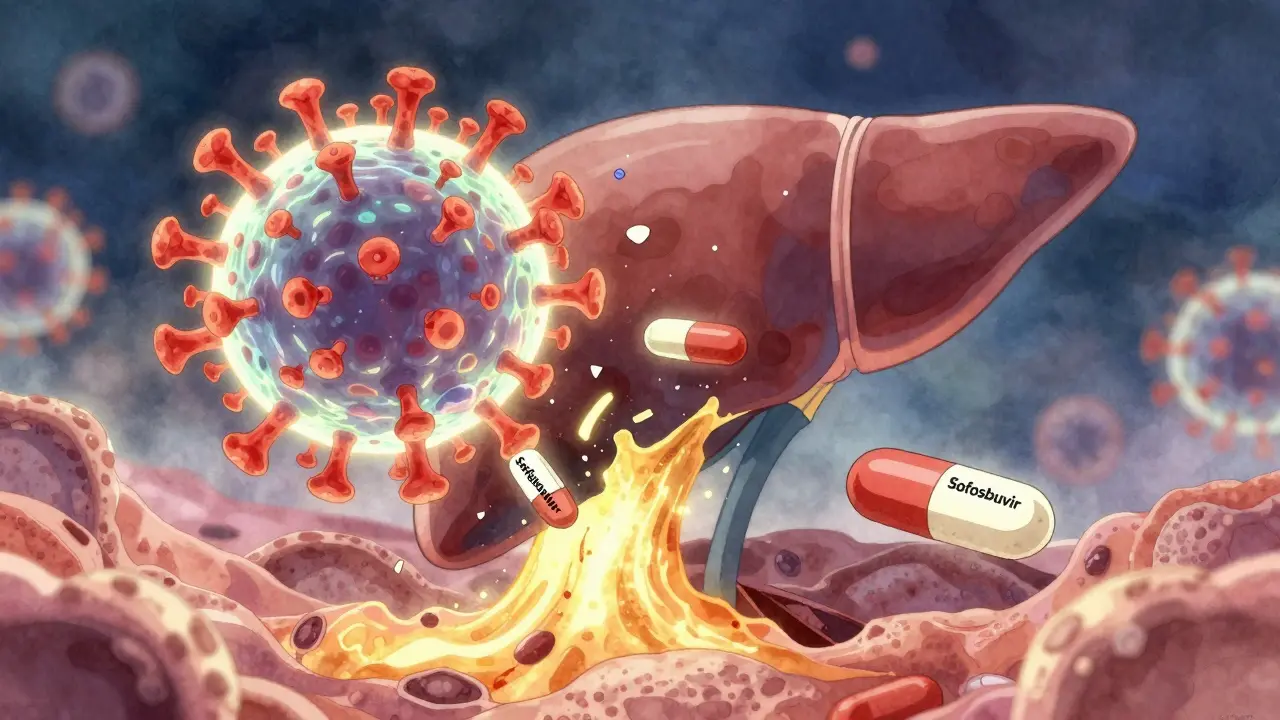
For decades, chronic hepatitis C was a silent killer. Many people carried the virus for years without symptoms, only to wake up one day with cirrhosis, liver failure, or cancer. The old treatments were brutal-weekly injections of interferon, constant nausea, depression, and a 50% chance of failure. But that chapter is over. Today, chronic hepatitis C is curable in most cases with a simple 8- to 12-week pill regimen. No shots. No hospital stays. Just a daily tablet that clears the virus from your body and lets your liver heal.
How Hepatitis C Damages the Liver
Hepatitis C is a virus that attacks liver cells. When it becomes chronic-meaning it lasts more than six months-it keeps reproducing, slowly destroying healthy tissue. Over time, the liver tries to repair itself by forming scar tissue. This scarring, called fibrosis, builds up like rust on a pipe. If it keeps going, the liver turns hard and lumpy-this is cirrhosis. At that stage, the organ can’t filter toxins, make proteins, or store energy properly. And the risk of liver cancer jumps dramatically. Before antivirals, doctors could only manage the damage. They monitored liver enzymes, advised no alcohol, and waited. Some patients ended up needing transplants. But now, the goal isn’t just to slow the damage-it’s to erase it.The Revolution: Direct-Acting Antivirals (DAAs)
The game-changer arrived in 2014. Direct-acting antivirals, or DAAs, are pills that target specific parts of the hepatitis C virus. Unlike old treatments that boosted your immune system (and made you feel awful), DAAs attack the virus directly. They’re like precision tools: one blocks the virus from cutting its proteins, another stops it from copying its RNA, and a third prevents it from assembling new virus particles. The most common combinations today are:- Sofosbuvir/velpatasvir (Epclusa)
- Glecaprevir/pibrentasvir (Mavyret)
- Sofosbuvir/velpatasvir/voxilaprevir (Vosevi) - used if prior treatment failed
Success Rates That Changed Everything
The numbers speak for themselves. Before DAAs, only about 40 to 80% of people cured the virus-and that depended on their genotype, age, and how much liver damage they already had. With DAAs, cure rates are 95 to 99%. That’s not an improvement. That’s a total overhaul. A 2024 study in Clinical Infectious Diseases found that after successful DAA treatment, the risk of liver failure dropped by 75%, the chance of liver cancer fell by 65%, and the risk of death decreased by 80%. These aren’t small gains. They’re life-saving. Even people with advanced cirrhosis or HIV co-infection now have high success rates. One study showed that 95% of HIV-positive patients cleared the virus with DAAs, compared to just 25% with interferon. Transplant patients, who used to face near-certain reinfection, now have a 94% cure rate after treatment.
How the Liver Heals After the Virus Is Gone
This is the part most people don’t realize: once the virus is gone, your liver doesn’t just stop getting worse-it starts getting better. Studies from the Mayo Clinic show that after successful DAA treatment, 95% of patients stop developing new scar tissue. In 70% of cases, the liver actually regenerates. Fibrosis reverses. Scar tissue breaks down. The liver regains function. Some patients with early cirrhosis see their liver stiffness return to normal levels within five years. One man in Sydney told his doctor he finally felt comfortable holding his newborn granddaughter. Before treatment, he was terrified of passing the virus to his family. After being cured, he started dating again. He got married. He stopped living in fear. That’s not just medical success-it’s human restoration.Side Effects? Almost None
Forget the old days of flu-like symptoms and depression. Today’s DAAs are gentle. Over 90% of patients report no side effects at all. The most common? Mild fatigue in the first week, or a headache. A small number feel nauseous, but it rarely lasts. Unlike interferon, DAAs don’t trigger autoimmune reactions or cause severe mood swings. You can keep working, driving, parenting, exercising. Most people don’t even notice they’re on medication. The only real challenge isn’t the pills-it’s getting them. In the U.S., a 12-week course cost nearly $75,000 in 2023. Insurance companies often deny coverage unless you have advanced liver damage. But patient assistance programs from drugmakers cover 70% of uninsured patients. In low-income countries, generic versions cost as little as $50 per course.
Who Can Be Treated Now?
The good news? Almost everyone. The World Health Organization updated its guidelines in 2022 to include children as young as three. There are no age limits. You don’t need to be sober to qualify. Even people with kidney disease, diabetes, or HIV can be treated safely. The only exceptions are rare cases where someone has failed multiple DAA regimens and has resistance mutations-these require specialized retreatment plans. Primary care doctors can now manage most cases. You don’t need a liver specialist. If your doctor knows you have hepatitis C, they can prescribe the right pill. Training programs show that clinicians become confident after just four hours of instruction.Why This Matters Beyond the Individual
Curing hepatitis C isn’t just about one person’s health. It’s about ending the epidemic. Since 2013, over 10 million people worldwide have been cured. Global prevalence has dropped from 1% to 0.5%. The World Health Organization’s goal is to eliminate hepatitis C as a public health threat by 2030. That means reducing new infections by 90% and curing 90% of those already infected. But progress is uneven. In high-income countries, 60% of diagnosed patients have been treated. In low-income regions, it’s only 15%. The biggest barrier isn’t the medicine-it’s screening. Only 20% of people with hepatitis C know they have it. Many don’t get tested because they feel fine. And reinfection is a risk, especially among people who inject drugs. About 5 to 10% get reinfected each year. That’s why treatment must be paired with harm reduction-clean needles, education, and support services.What Comes Next?
The future is about access and prevention. Generic versions are now available in over 100 countries. Gilead and other manufacturers are expanding low-cost programs to reach millions more. New research is looking at vaccines to prevent infection, and better tests to detect the virus in remote areas. For now, the message is clear: if you have chronic hepatitis C, you are not doomed. You are not stuck. You can be cured. Your liver can heal. Your life can change. You don’t need to wait for symptoms. You don’t need to be perfect. You just need to get tested-and if you’re positive, start treatment. The tools are here. The science is proven. The cure is simple.Can hepatitis C come back after treatment?
After achieving a sustained virologic response (SVR)-meaning no detectable virus 12 weeks after finishing treatment-the chance of the virus returning is less than 1%. This is considered a cure. However, if you’re exposed to the virus again (for example, through sharing needles), you can get infected a second time. That’s why ongoing prevention is important, especially for people who inject drugs.
Do I still need liver screenings after being cured?
Yes, if you had advanced fibrosis or cirrhosis before treatment. Even after the virus is gone, the risk of liver cancer remains higher than in people who never had hepatitis C. Doctors recommend ongoing ultrasound scans every six months for at least five years after cure. If your liver was healthy before treatment, routine screening may not be needed.
Are DAAs safe for people with other health conditions?
Yes. DAAs are safe for people with HIV, kidney disease, diabetes, and even those who’ve had liver transplants. The main concern is drug interactions. Some medications-like certain seizure drugs, statins, or HIV treatments-can interfere with DAAs. Your doctor will review all your medications before prescribing. In most cases, adjustments are simple and effective.
How long does it take to feel better after starting treatment?
Many people feel improvements in energy and mood within the first few weeks, even before the virus is cleared. That’s because the inflammation caused by the virus starts to drop quickly. But the real healing-liver repair-takes months to years. Don’t expect overnight results. The goal is long-term health, not short-term relief.
Can I drink alcohol after being cured?
It’s still best to avoid alcohol. Even after curing hepatitis C, your liver may still be recovering. Alcohol adds stress to the organ and increases the risk of scarring, even if the virus is gone. If you had cirrhosis, alcohol is strictly discouraged. For others, moderation may be okay-but zero alcohol is the safest choice for long-term liver health.
Is hepatitis C treatment covered by insurance?
In most high-income countries, yes. But insurers often require proof of liver damage before approving treatment. If you’re denied, you can appeal. Many drug manufacturers offer free or low-cost programs for uninsured patients. In Australia, the Pharmaceutical Benefits Scheme (PBS) covers DAAs for all eligible patients with no out-of-pocket cost. Check your local health authority for details.

Elizabeth Ganak
December 27, 2025 AT 15:24Just got tested last week and found out I’ve had it for 12 years. No symptoms, no idea. Now I’m on the waiting list for treatment-thank god it’s just pills now. I feel like I’ve been living under a shadow I didn’t even know was there.
Gerald Tardif
December 27, 2025 AT 17:12My uncle got cured last year. He was a mess before-fatigued, irritable, barely eating. After three months of pills? He started gardening again. Took up salsa. Told me he felt like he’d been given back his life. No drama. No miracles. Just science working the way it should.
Janice Holmes
December 28, 2025 AT 20:54Let’s be real-Big Pharma didn’t make these drugs to save lives. They made them because they realized they could charge $80K and people would pay. The ‘cure’ is a profit model wrapped in a lab coat. And don’t even get me started on how insurers gatekeep access like it’s a VIP club.
Alex Lopez
December 30, 2025 AT 02:16Oh, so now we’re pretending this is a humanitarian triumph? 🤡 The drugs work-yes. But the system still treats people like numbers. If you’re poor, uninsured, or in a rural county? Good luck getting your prescription. The science is brilliant. The bureaucracy? Still stuck in 1998.
Will Neitzer
December 30, 2025 AT 19:05It is indeed a remarkable paradigm shift in hepatology. The sustained virologic response rates, coupled with the unprecedented tolerability profile of pan-genotypic regimens, represent one of the most consequential advances in infectious disease therapeutics since the advent of antiretroviral therapy for HIV. The data from the 2024 Clinical Infectious Diseases meta-analysis are unequivocal and warrant immediate policy alignment across all healthcare systems.
Olivia Goolsby
January 1, 2026 AT 00:53Wait-so you’re telling me that after decades of ‘hepatitis C is incurable,’ suddenly, in 2014, these miracle pills appeared? No side effects? No catch? No hidden agenda? No government cover-up? No link to 5G? I’ve read about this before-this is the same ‘cure’ they tried to bury in the 90s with ‘Interferon 2.0’-now they just rebranded it with fancy names and charged $75K. I’ve got a cousin in Alabama who got denied because his liver enzymes were ‘not bad enough.’ That’s not medicine-that’s eugenics by insurance form.
James Bowers
January 3, 2026 AT 00:02While the clinical efficacy of DAAs is indisputable, one must exercise caution in extrapolating universal accessibility. The disparity in treatment uptake between high-income and low-income nations remains a glaring ethical failure of global health governance. To celebrate pharmacological innovation while ignoring systemic inequity is not progress-it is performative optimism.
Nicola George
January 3, 2026 AT 04:32Yeah, the science is cool. But let’s be honest-most people still don’t know they have it. I’ve got a friend who got tested because his dog licked his blood after he cut himself. He thought he was fine. Turns out, he had cirrhosis. So… congrats on the cure. Now go get tested. And tell your friends. Seriously.
Chris Garcia
January 4, 2026 AT 12:23There is a profound metaphysical shift here-not merely medical, but existential. The virus, once a silent specter haunting the body, has been reduced to a statistical footnote. We have turned a death sentence into a routine prescription. This is not just about liver enzymes or viral load; it is about reclaiming the dignity of uncertainty. For generations, we lived in the shadow of an invisible enemy, afraid to love, to touch, to be known. Now, we are not cured-we are liberated. The liver, that silent, tireless organ, no longer bears the burden of our ignorance. It breathes again. And so do we.
Monika Naumann
January 5, 2026 AT 13:42In my country, we have been treating hepatitis C since 2010 with generic drugs costing less than $20. Why are Western nations still making it so complicated? We don’t need $75,000 pills-we need common sense. Your pharmaceutical monopolies are not innovation-they are exploitation dressed in white coats. India has cured millions. You still argue over insurance forms. Shame.