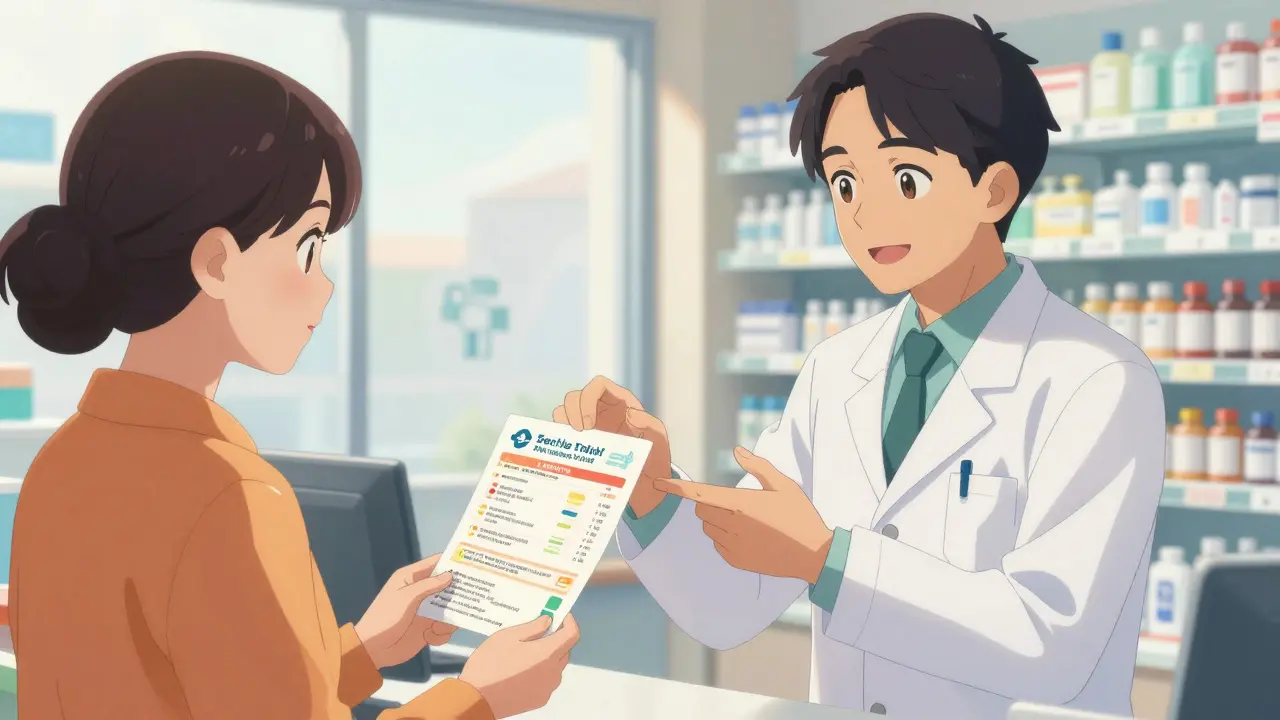
When you pick up a new prescription, your pharmacist has more to offer than just the pills. They’re trained to explain how to take your meds safely, what to watch out for, and how to make it fit into your life. But too often, patients leave without getting the full picture. You don’t have to wait for them to offer help-you can ask for it. Here’s exactly what to request to make sure you understand your meds and stay on track.
Ask for a Written Handout Specific to Your Medication
Don’t settle for generic drug pamphlets that came in the box. Ask your pharmacist for a medication-specific handout based on current clinical guidelines. These aren’t just marketing flyers-they’re evidence-based resources designed to answer your real questions. The American Society of Health-System Pharmacists (ASHP) recommends these handouts include: the name and purpose of the drug, exact dosage and timing, what to do if you miss a dose, common side effects, how to store it, and possible interactions with other meds or foods. Many pharmacies use systems like the Patient Education Reference Center (PERC), which offers over 15,000 customizable handouts in English and Spanish. If you’re taking insulin, blood thinners, or high-risk drugs like warfarin or lithium, this written guide is non-negotiable.
Request a Live Demonstration of How to Use It
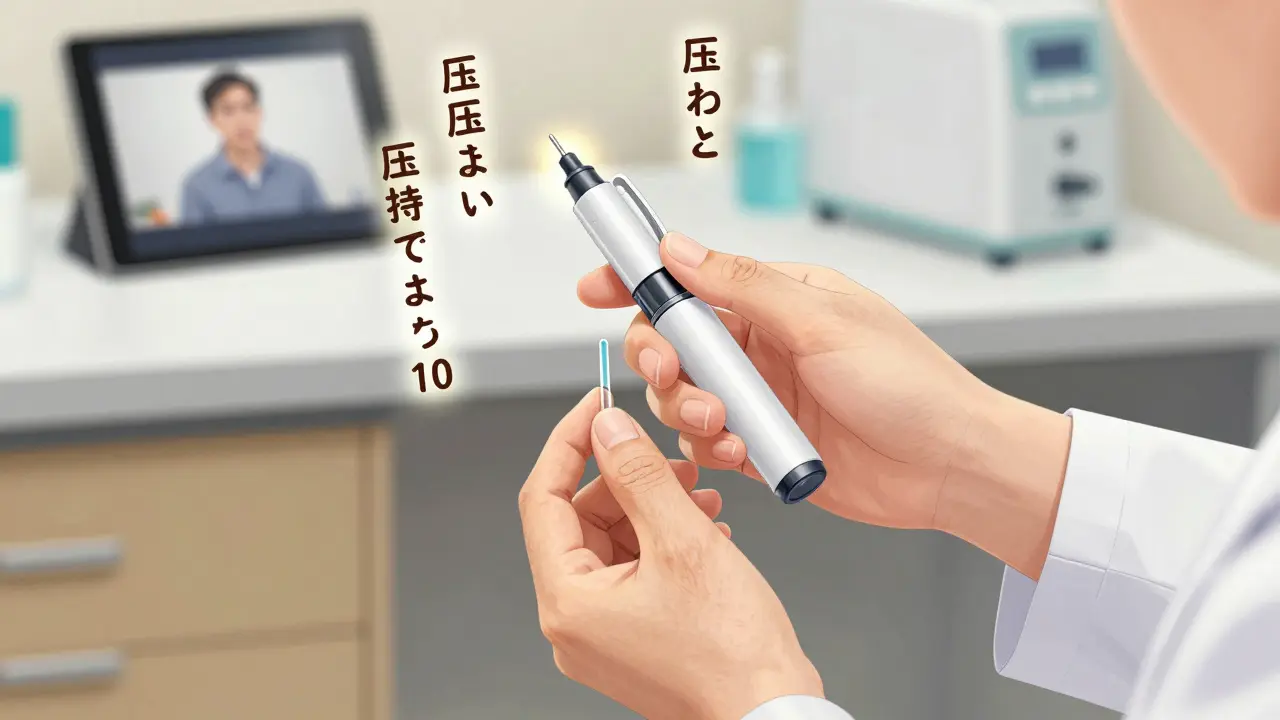
Reading about how to use an inhaler or insulin pen isn’t the same as seeing it done-and then doing it yourself. Ask your pharmacist to show you how to use your device. Then, ask them to watch you do it. This is called return demonstration, and it’s one of the most effective ways to catch mistakes before they cause harm. A 2023 study found that patients who demonstrated their technique after counseling had 87% better accuracy in using inhalers, nebulizers, and auto-injectors than those who only listened. For people with arthritis or shaky hands, this step is critical. Pharmacists can adjust how you hold the device, suggest adaptive tools, or even show you a video on their tablet. Don’t be shy: say, “Can you watch me do it so you know I got it right?”
Get Instructions in Your Preferred Language
If English isn’t your first language, or if you’re more comfortable with another language, ask for materials in that language. Most major pharmacy systems, including UpToDate and PERC, offer patient handouts in at least 18 languages. Spanish is widely available, but you can also find materials in Mandarin, Vietnamese, Arabic, and more. If your pharmacy doesn’t have it on hand, they can print it from a digital library in minutes. Don’t assume the pharmacist knows your language preference-speak up. Clear instructions reduce errors. The FDA’s 2024 draft guidance on Medication Guides now pushes for materials in multiple languages, especially for high-risk drugs. You’re not asking for a favor-you’re exercising your right to understand your treatment.
Ask for a Personalized Medication Schedule
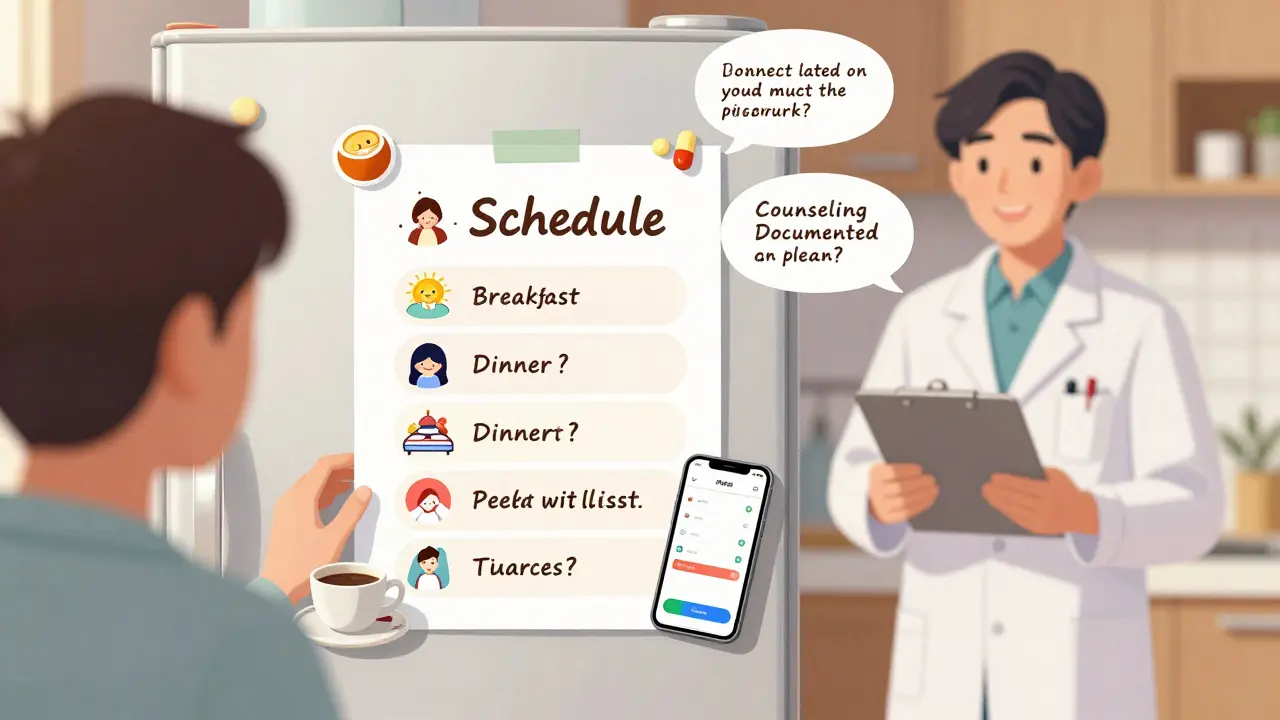
Most people don’t take meds exactly as prescribed-not because they’re careless, but because the schedule doesn’t match their life. Ask your pharmacist to build you a personalized daily schedule. Instead of just saying “take once daily,” they can write: “Take with breakfast, at 8 a.m., after your coffee.” If you work nights, they can adjust it. If you forget pills when you travel, they can suggest a pill organizer or a phone reminder setup. A 2023 study in the Annals of Pharmacotherapy showed that patients who received a custom schedule were 73% more likely to stick with their regimen. Write it down on paper or ask them to email it to you. Keep it on your fridge or phone wallpaper. This isn’t extra service-it’s core care.
Check if Your Counseling Is Documented
Pharmacists are required by law in 47 states to document patient counseling in your record. But many don’t unless you ask. Say: “Can you note in my file that we talked about my new blood pressure pill?” This matters because if you go to a different pharmacy or see a new doctor, they’ll know you’ve been properly counseled. It also helps if there’s ever a problem-like a side effect or a refill issue. The Joint Commission of Pharmacy Practitioners’ 2025 Pharmacists’ Patient Care Process (PPCP) now requires this documentation as part of person-centered care. If they say no, ask why. You have the right to have your care tracked.
Ask About Cost and Alternatives
One of the biggest reasons people skip doses is cost. But only 18% of patients report pharmacists ever discussing cheaper options-even though 62% say they’ve struggled to afford meds. Ask: “Is there a generic version?” or “Is there a lower-cost alternative that works just as well?” Pharmacists can check for manufacturer coupons, patient assistance programs, or even switch you to a different drug in the same class. Some pharmacies offer $4 generic lists for common meds like metformin, lisinopril, or atorvastatin. Don’t assume it’s too expensive-you won’t know unless you ask. A 2023 Health Affairs study found that every dollar spent on pharmacist-led cost counseling saved $4.30 in avoided hospital visits.
Use the 7 Essential Questions to Guide Your Conversation
It’s easy to walk out feeling confused. To avoid that, prepare these seven questions before your visit:
- What is this medication for?
- How and when should I take it?
- What should I do if I miss a dose?
- What side effects should I watch for?
- How will I know if it’s working?
- How should I store it?
- Is there anything else I need to know?
These are the same questions endorsed by ASHP and used in training programs across the U.S. Write them on your phone or carry a small card. If the pharmacist skips one, ask again. You’re not being difficult-you’re making sure you’re safe.
Why This Matters More Than You Think
Medication errors cause about 7,000 deaths in the U.S. every year, according to the Institute of Medicine. And half of all people with chronic conditions like diabetes or high blood pressure don’t take their meds as directed. That’s not because they’re lazy-it’s because they don’t fully understand them. Pharmacists are the most accessible health professionals-you see them every month, often more than your doctor. They have six years of clinical training focused solely on medications, compared to doctors who cover everything from bones to brains. Their job isn’t just to fill prescriptions. It’s to make sure you live well with them.
What to Do If They Don’t Offer Help
Not all pharmacists have time. Chain pharmacies average just 1.8 minutes per counseling session, according to a 2024 University of Illinois study. If you feel rushed, say: “I need a few extra minutes to make sure I get this right.” If they still don’t help, ask to speak to the pharmacy manager. Most pharmacies have patient education coordinators. If you’re still not getting support, switch to an independent pharmacy. A 2023 Pharmacy Times survey found that patients in independent pharmacies were twice as likely to receive detailed education than those at CVS, Walgreens, or Rite Aid. Your health is worth the extra trip.
What’s Changing in 2026
Starting January 2026, Medicare Part D plans must include pharmacist-led medication therapy management as a required benefit. That means over 52 million seniors will have access to structured education sessions-at no extra cost. This is a big shift. It’s no longer optional. Pharmacists will be expected to track your progress, adjust plans, and provide ongoing education. If you’re on Medicare, this is your cue to start asking for more. You’re not just a customer-you’re a partner in your care.

Robert Way
January 15, 2026 AT 20:24so i asked my pharmacist for a handout and she gave me a flyer for free gummy vitamins?? like bro i just need to know if my blood pressure pill makes me poop green
Vicky Zhang
January 17, 2026 AT 02:06OH MY GOODNESS THIS IS THE MOST IMPORTANT THING I’VE EVER READ IN MY LIFE. I USED TO JUST SWALLOW PILLS LIKE CANDY UNTIL MY DAD HAD A STROKE BECAUSE HE THOUGHT ‘ONCE A DAY’ MEANT ‘WHEN I REMEMBER’ AND NOW I CRY EVERY TIME I SEE A PHARMACIST BECAUSE THEY’RE THE ONLY ONES WHO ACTUALLY CARE. PLEASE TELL EVERYONE. I’M TELLING MY BOOK CLUB. I’M TELLING MY CHURCH. I’M TELLING MY DOG.
TooAfraid ToSay
January 17, 2026 AT 12:21you people act like pharmacists are saints. i’ve been to 3 different pharmacies and every single one tried to upsell me on probiotics and vitamin D. they don’t care if you live or die. they care about their commission. this whole post is corporate propaganda wrapped in a white coat.
Allison Deming
January 17, 2026 AT 22:16While I appreciate the sentiment behind this article, it is fundamentally flawed in its assumption that pharmacists are uniformly equipped or incentivized to provide comprehensive patient education. The systemic underfunding of community pharmacy services, coupled with the relentless pressure to maximize throughput, renders most of these recommendations idealistic at best and patronizing at worst. The notion that patients can simply ‘ask’ for personalized schedules or live demonstrations ignores the structural realities of retail healthcare capitalism.
Susie Deer
January 18, 2026 AT 11:29why are we paying these people to talk to us we already pay for the meds stop coddling people they should read the label like we did in the 80s
Henry Sy
January 20, 2026 AT 03:10my pharmacist once told me my antidepressant could make me horny and i asked if that was a feature or a bug. she laughed and said ‘depends on your ex’ and handed me a sticker that said ‘you’re not broken you’re just underdosed’ i frame that shit. this post is everything. also if you’re on warfarin and you eat kale without telling your pharmacist you’re basically playing russian roulette with your spleen
Jason Yan
January 21, 2026 AT 04:09it’s wild how much trust we put into pills without ever asking what they’re really doing in our bodies. we take them like they’re magic beans but ignore the people who actually know how the magic works. pharmacists aren’t just clerks with stethoscopes-they’re the quiet guardians of our daily survival. and yet we treat them like order-takers at a drive-thru. maybe the real problem isn’t patient ignorance-it’s how we’ve devalued the human connection in healthcare.
shiv singh
January 22, 2026 AT 03:38you think this is new? in india we have street pharmacists who write your meds on banana leaves and tell you to mix it with honey and chant to ganesh. you americans think you invented healthcare but you just invented bills. my cousin took his diabetes meds for 12 years without a single handout. he lived. you’re making a drama out of basic survival.
says haze
January 24, 2026 AT 03:27the entire premise of this post is a performative illusion of agency. asking for materials implies that the system is designed to accommodate your inquiry. in reality, the pharmacy’s workflow is optimized for speed, not understanding. the ‘7 essential questions’ are not empowerment-they’re cognitive labor dumped onto the patient to compensate for institutional failure. you’re not reclaiming your rights; you’re performing compliance with a broken architecture.
Alvin Bregman
January 24, 2026 AT 07:11just had my first real convo with my pharmacist and she showed me how to use my inhaler and i felt like a genius. no emojis no caps no drama just a human helping another human. i think we forget how rare that is. also she gave me a free pill organizer and i cried a little. not because i’m weak but because someone finally saw me as more than a barcode