Most headaches are just a nuisance - maybe from stress, lack of sleep, or too much caffeine. But some headaches are warning signs. Neurological red flags can mean something serious is happening in your brain, and waiting even an hour could cost you your life.
What Makes a Headache Dangerous?
Not all headaches are created equal. The difference between a bad migraine and a life-threatening condition often comes down to how fast it comes on, what else is happening in your body, and whether you’ve ever felt anything like it before. The medical community uses a checklist called SNNOOP10 to spot danger signs. It’s not perfect, but it’s been proven in thousands of cases. The most critical red flags include sudden, explosive pain, new neurological symptoms, and headaches that start after age 50. If you’ve had headaches your whole life and this one feels familiar, you’re probably fine. But if this headache is unlike anything you’ve ever experienced - especially if it hits like a lightning bolt - you need to act now.Thunderclap Headache: The #1 Emergency Signal
A thunderclap headache hits harder than anything else. It peaks in less than 60 seconds. Not five minutes. Not ten. One minute. That’s the definition. This isn’t just a really bad migraine. It’s the classic sign of a ruptured brain aneurysm - a weak spot in a blood vessel that bursts, causing bleeding into the space around the brain. About 85% of these cases show up this way, according to a 2021 study in Neurology. People often describe it as "the worst headache of my life." Some say it felt like being hit in the head with a sledgehammer. Others say it was like a gunshot going off inside their skull. If you’ve had one, don’t wait. Don’t take painkillers and hope it goes away. Don’t call your doctor tomorrow. Go to the ER right now. Delaying treatment increases your risk of another bleed by up to 40%.Headaches With Neurological Symptoms: Don’t Wait for the Pain to Worsen
If your headache comes with weakness, numbness, trouble speaking, double vision, or sudden confusion - you’re not having a migraine. You could be having a stroke. Migraines with aura usually build slowly over 5 to 20 minutes. Stroke symptoms hit fast and get worse fast. One side of your face droops. Your arm drops. You can’t find the right words. These aren’t "bad vibes." They’re brain signals screaming for help. A 2022 study from the American Heart Association found that 63% of patients with stroke-related headaches had focal neurological symptoms like these. The average time from symptom start to hospital arrival? Over three hours. That’s too long. Every minute counts. If you or someone else has a headache plus any of these symptoms:- One-sided weakness or numbness
- Slurred speech or trouble understanding others
- Loss of vision in one or both eyes
- Dizziness with loss of coordination
Headaches After Age 50: It’s Not Just Aging
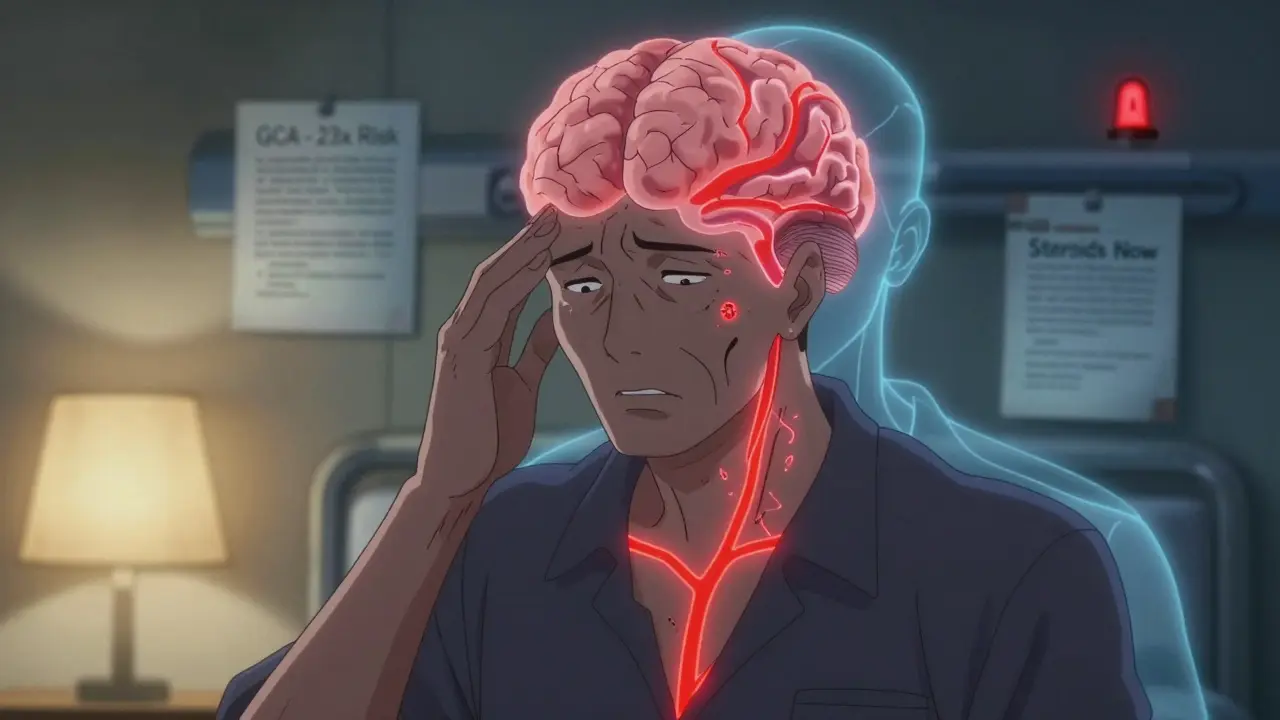
If you’re over 50 and you’ve never had serious headaches before - and now you’re getting them - that’s not normal. It’s a red flag. One of the most dangerous causes in this group is giant cell arteritis (GCA). It’s inflammation of the arteries in your head, especially near your temples. Left untreated, it can cause permanent blindness in days. Signs to watch for:- New, constant headache on one or both sides of the head
- Tenderness when touching your temples
- Jaw pain when chewing (called jaw claudication)
- Fever, fatigue, or unexplained weight loss
Headache With Fever and Stiff Neck: Meningitis Doesn’t Wait
If your headache is paired with fever, neck stiffness, and sensitivity to light, don’t assume it’s the flu. Bacterial meningitis is rare - but deadly. It kills 1 in 10 people even with treatment. Each hour of delay in antibiotics increases the risk of death by over 5%. The classic sign? Neck stiffness that makes it hard to touch your chin to your chest. Not just soreness - real resistance. Add a high fever and you’re looking at a medical emergency. The CDC reports that 78% of meningitis cases involve altered mental status. That means confusion, drowsiness, or trouble staying awake. If someone with a headache can’t answer simple questions, they need to be in the ER now. A 2022 IDSA guideline says antibiotics must be given within 45 minutes of triage. That’s why ERs have protocols: get the blood tests, start the IV, and get the CT scan - all before the neurologist even walks in.Headaches After Head Injury: When to Worry
You hit your head. You got a headache. Should you be scared? It depends. If you lost consciousness for more than five minutes, threw up more than twice, or feel worse now than you did right after the injury - that’s not normal. The PECARN guidelines (used in hospitals across the U.S. and Australia) say these are key triggers for a CT scan:- Loss of consciousness longer than 5 minutes
- Vomiting more than two times
- Severe headache that keeps getting worse
- Confusion or trouble remembering what happened
Papilledema: Swelling in the Eye That Means Swelling in the Brain
This one is less common but terrifying when it shows up. Papilledema is swelling of the optic nerve, visible only with an eye exam. It happens when pressure builds up inside the skull - from a tumor, infection, or fluid buildup. It’s not something you feel. You won’t notice it yourself. But if your doctor sees it during an exam, they’ll order an MRI immediately. The 2023 American College of Radiology guidelines now recommend MRI over CT for papilledema because it’s 22% more sensitive at spotting the cause. If you’ve had vision changes, blurred vision, or double vision along with a persistent headache - insist on a full neurological workup. Don’t let it be written off as "eye strain."What About Migraines? Can They Be Dangerous Too?
Migraines are common. They’re painful. But they’re not usually dangerous. The key is knowing what’s normal for you. Migraines with aura typically develop slowly - over 5 to 20 minutes - and fade within an hour. They don’t cause weakness or confusion that lasts. But if you’ve never had aura before and suddenly get it after age 40, that’s a red flag. So is a migraine that doesn’t respond to your usual meds. Or if you start having them more often, or they’re worse than ever. The International Classification of Headache Disorders (ICHD-3) says new or changing patterns in migraine should be evaluated - especially if you have risk factors like high blood pressure, smoking, or a history of stroke.
What Should You Do If You Spot a Red Flag?
Here’s the simple rule:- If your headache comes on suddenly - like a thunderclap - go to the ER.
- If it comes with weakness, slurred speech, vision loss, or confusion - call 911.
- If you’re over 50 and this is your first bad headache - see a doctor within 24 hours.
- If you have a fever, stiff neck, and headache - don’t wait until morning.
- If you had a head injury and now feel worse - get scanned.
Why Do People Ignore These Signs?
A 2023 survey by the National Headache Foundation found that 63% of people who had a thunderclap headache initially thought it was just a bad migraine. Nearly 30% waited over six hours before seeking help. Some think they’re overreacting. Others are scared of hospitals. Some don’t have access to care. In rural areas, delays can be over three hours because there’s no neurologist on call. But the cost of waiting? It’s not just pain. It’s permanent brain damage. Blindness. Paralysis. Death. One patient on Reddit shared: "I ignored my thunderclap headache for four hours. My neurosurgeon said that delay increased my risk of rebleeding by 40%. I’m lucky I’m alive. Don’t make my mistake."What Happens in the ER?
When you arrive with a red flag headache, the clock starts ticking. First, they’ll do a non-contrast CT scan - fast. It’s the best tool to spot bleeding in the first 6 hours. If it’s normal but they still suspect a bleed (like in thunderclap cases), they’ll do a lumbar puncture - a spinal tap - to check for blood in the fluid around your spine. If meningitis is suspected, antibiotics go in within 45 minutes. If stroke is possible, they’ll do a CT angiogram and prepare for clot-busting drugs. In hospitals with advanced care, MRI may follow within four hours if the CT was inconclusive. AI tools like the FDA-cleared HeadacheAI platform are now helping triage nurses spot red flags with 89% accuracy - better than most general practitioners. The goal isn’t to scare you. It’s to make sure you get the right care at the right time.Final Thought: Your Body Knows
You know your body better than anyone. If something feels off - really off - trust that feeling. Headaches are common. But the ones that come with warning signs? They’re not. And they don’t wait. Don’t gamble with your brain. If you see a red flag - act fast. It’s not an overreaction. It’s survival.Is a thunderclap headache always a brain aneurysm?
No, but it’s the most common sign of one. About 85% of subarachnoid hemorrhages present as thunderclap headaches. Other causes include reversible cerebral vasoconstriction syndrome (RCVS), pituitary apoplexy, or spinal fluid leaks. But because the risk of rupture is so high, every thunderclap headache is treated as an emergency until proven otherwise.
Can a migraine cause stroke-like symptoms?
Yes - but only in rare cases. Migraine with aura can mimic stroke symptoms like weakness or speech trouble. This is called a migrainous infarction. However, these symptoms usually develop slowly over 5-20 minutes and last less than an hour. Stroke symptoms come on suddenly and get worse quickly. If in doubt, assume it’s a stroke and call 911.
What if I’m over 50 and get a headache for the first time?
That’s a red flag. New-onset headaches after age 50 can signal giant cell arteritis, brain tumors, or other serious conditions. The risk of brain tumor increases 200-fold in this group compared to younger adults. See a doctor within 24 hours. Don’t wait for it to get worse.
Do I need a CT scan for every bad headache?
No. Most headaches don’t need imaging. But if you have any neurological red flags - sudden onset, fever, weakness, vision changes, or onset after age 50 - a CT scan is usually the first step. The AAN’s Red Flag Headache Decision Tree helps doctors avoid unnecessary scans while catching 94% of dangerous cases.
Can stress cause a dangerous headache?
Stress can trigger migraines or tension headaches, but it doesn’t cause thunderclap headaches, brain bleeds, or meningitis. If you think stress caused your headache, ask yourself: Is this different from any headache I’ve had before? If yes - get checked. Stress is a trigger, not a diagnosis.
Should I go to the ER if I have a headache after a vaccine?
Most post-vaccine headaches are mild and go away in a day or two. But if you develop a severe headache with fever, confusion, vision changes, or neck stiffness within days of vaccination - go to the ER. While extremely rare (0.8 cases per 100,000 doses), vaccine-related neurological complications can occur.
What if I have a headache and I’m immunocompromised?
Any headache in someone with cancer, HIV, or on immunosuppressants needs immediate evaluation. Fungal meningitis can develop silently and has a 35% mortality rate even with treatment. Don’t wait for fever or neck stiffness - act fast.
How do I know if my child’s headache is serious?
In children, watch for: persistent vomiting, extreme sleepiness, confusion, seizures, or a headache that wakes them from sleep. If they’ve had a head injury and now seem worse - get them checked. Kids don’t always say "my head hurts" - they may just cry, refuse to eat, or act unusually quiet.




Mike Rengifo
December 18, 2025 AT 18:28Ashley Bliss
December 20, 2025 AT 02:14Dev Sawner
December 21, 2025 AT 19:03Meenakshi Jaiswal
December 23, 2025 AT 09:30bhushan telavane
December 23, 2025 AT 23:33Mahammad Muradov
December 24, 2025 AT 05:28Connie Zehner
December 25, 2025 AT 16:54holly Sinclair
December 26, 2025 AT 03:59Monte Pareek
December 27, 2025 AT 11:34mark shortus
December 27, 2025 AT 17:46Elaine Douglass
December 28, 2025 AT 21:49Allison Pannabekcer
December 30, 2025 AT 20:48