
When you start coughing and struggle to catch your breath, it’s easy to blame a cold, allergies, or even a new medication. But if these symptoms stick around and don’t improve with typical treatments, there’s a rare but serious lung condition that could be the real culprit - one that has nothing to do with pills or injections. It’s called hypersensitivity pneumonitis, and it’s triggered not by what you swallow, but by what you breathe.
What Exactly Is Hypersensitivity Pneumonitis?
Hypersensitivity pneumonitis (HP), sometimes called extrinsic allergic alveolitis, is an immune reaction in the lungs caused by breathing in tiny airborne particles from the environment. These aren’t chemicals you’re exposed to at work - they’re biological substances like mold spores, bird proteins, or bacteria from humidifiers. When someone who’s sensitized inhales them, their immune system overreacts, causing inflammation deep in the lungs, specifically in the air sacs (alveoli).
This isn’t asthma. Asthma tightens the airways. HP damages the lung tissue itself. And unlike a drug allergy, which can cause a rash or swelling, HP only happens when you repeatedly breathe in the trigger. The body doesn’t react to the substance in your bloodstream - it reacts to it in your lungs.
Think of it like this: your lungs are designed to filter air, not fight off allergens. But if you’re exposed to the same irritant over and over - say, cleaning a bird cage every day or working in a damp grain silo - your immune system starts treating those particles like invaders. The result? Inflammation, scarring, and eventually, permanent lung damage if you don’t stop the exposure.
Why Medications Don’t Cause True Hypersensitivity Pneumonitis
You might have heard of people developing lung problems from drugs like amiodarone or nitrofurantoin. And yes, those medications can cause lung injury. But it’s not the same as hypersensitivity pneumonitis.
Drug-induced lung damage is called drug-induced interstitial lung disease (DILD). It looks different under the microscope. Instead of the hallmark poorly formed granulomas and lymphocyte-rich inflammation seen in HP, drug reactions often show patterns like organizing pneumonia or direct cell death. The immune response is systemic, not localized to the airways.
Major medical references - including the Merck Manual, the Pulmonary Fibrosis Foundation, and the American Thoracic Society - don’t list medications as causes of true HP. They all point to environmental and occupational triggers. If a doctor says you have HP and you’re on a new medication, they’re likely mislabeling the condition. You probably have DILD, not HP.
The confusion matters because treatment is different. HP is cured by removing the trigger. DILD might require stopping the drug and using steroids. Mixing them up can delay the right care.
Common Triggers You Might Not Realize Are Dangerous
Most people think of HP as something that affects farmers or bird owners. But the list of triggers is longer - and more surprising - than you’d expect:
- Bird fancier’s lung: Proteins in bird droppings, feathers, or serum. Common in pigeon breeders, parrot owners, or even people who clean bird cages weekly.
- Farmer’s lung: Moldy hay, grain, or straw. Fungi like Thermophilic actinomycetes release spores that trigger reactions.
- Mushroom picker’s disease: Fungi in mushroom-growing environments, especially in poorly ventilated greenhouses.
- Humidifier lung: Bacteria or mold growing in home humidifiers, air conditioners, or spa systems. This one’s rising as more people use humidifiers in dry climates.
- Hot tub lung: Mycobacteria from warm, stagnant water in spas. Symptoms often appear after regular use.
These aren’t rare. In Australia, humidifier lung and hot tub lung are increasingly reported in Sydney’s suburbs, especially during winter months when indoor air is dry and heating systems run constantly. A 2022 study in Queensland found a 37% increase in HP cases linked to home humidifiers over five years.

How Do You Know It’s HP and Not Just a Cold or Asthma?
HP symptoms can mimic other lung conditions. But there are key clues:
- Timing: Symptoms start 4 to 8 hours after exposure and often improve within a day or two if you leave the environment. If you feel fine at work but get sick every weekend when you clean the attic or handle your pet bird, that’s a red flag.
- Pattern: Acute HP brings fever, chills, and body aches along with cough and shortness of breath. Subacute HP creeps in over weeks - fatigue, worsening breathlessness during simple tasks. Chronic HP leads to progressive shortness of breath, weight loss, and a dry cough that won’t quit.
- Physical signs: Doctors may hear crackling sounds in the lungs. In advanced cases, fingers may become clubbed - rounded and enlarged.
One of the most telling signs? Your symptoms vanish when you go on vacation. If you stop coughing and breathing easier during a weekend away, then it comes back when you return - that’s HP trying to tell you something.
How Is It Diagnosed?
There’s no single test for HP. Diagnosis is like solving a puzzle. Doctors look at five pieces:
- Exposure history: Did you recently start handling birds? Clean your HVAC system? Use a new humidifier?
- Imaging: A high-resolution CT scan shows ground-glass opacities, mosaic patterns, and air trapping - signs of inflammation in the lung tissue.
- Blood tests: Antibodies to specific antigens (like bird proteins or mold) are found in 60-90% of cases.
- Bronchoalveolar lavage: A procedure where fluid is washed from the lungs. In HP, lymphocytes (a type of white blood cell) make up more than 40% of the sample.
- Lung biopsy: If the diagnosis is unclear, a small tissue sample may show the telltale poorly formed granulomas.
It’s rare to find all five pieces, but even three or four can point strongly to HP - especially if exposure history matches the imaging.
What Happens If You Don’t Stop the Exposure?
This is the most critical point: HP is reversible - if caught early.
In acute cases, simply avoiding the trigger leads to full recovery in most people. No drugs needed. But if exposure continues, inflammation turns to scarring. That’s fibrosis. And once fibrosis sets in, it’s permanent.
Chronic HP with fibrosis has a 5-year survival rate of only 50-80%. Some patients need oxygen therapy. Others end up on transplant lists. The good news? If you stop the exposure before fibrosis develops, over 70% of people recover completely.
Studies show that people who continue exposure - even at low levels - are 5 times more likely to develop irreversible lung damage. That’s why removing the trigger isn’t optional. It’s the treatment.
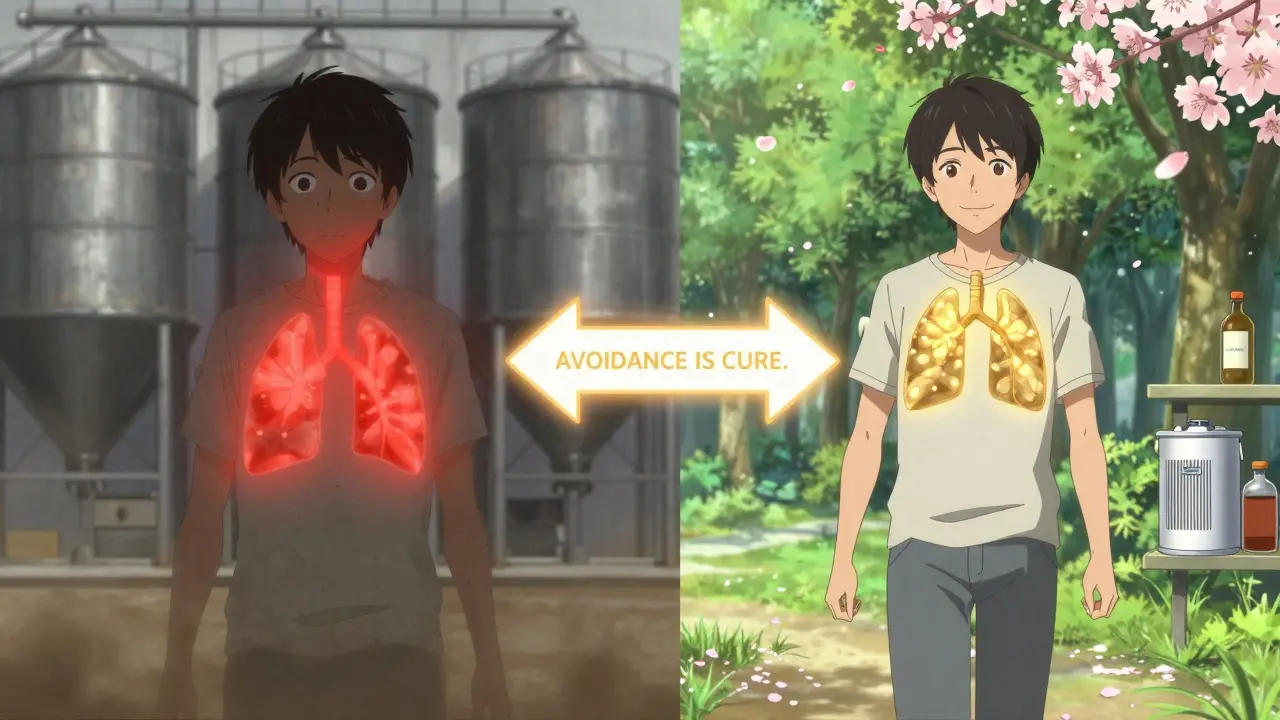
Treatment: Avoidance Is the Only Cure
Medication has a limited role. Steroids like prednisone may help reduce inflammation in the short term, especially if symptoms are severe. But they don’t fix the root problem. If you keep breathing in the trigger, the inflammation comes back.
For chronic cases with scarring, doctors may add antifibrotic drugs like nintedanib - the same drug used for idiopathic pulmonary fibrosis. Clinical trials show it slows lung function decline by about 56% over a year.
But the real treatment? Removing the source. That means:
- Stopping bird ownership or using HEPA filters and masks when cleaning cages.
- Replacing humidifiers with cool-mist models and cleaning them daily with vinegar.
- Improving ventilation in workspaces where mold or dust is present.
- Draining and cleaning hot tubs weekly to prevent bacterial growth.
Simple changes. But they’re life-changing.
Who’s at Risk?
Anyone can get HP - but some groups are more vulnerable:
- People with repeated exposure to birds, mold, or damp environments.
- Those working in agriculture, poultry farming, or mushroom cultivation.
- Homeowners using humidifiers, air conditioners, or hot tubs without proper maintenance.
- People with a family history of autoimmune or allergic conditions.
Interestingly, smokers are less likely to develop HP. Studies suggest cigarette smoke may suppress the immune response that triggers the disease - though smoking causes plenty of other lung problems, so it’s not a recommendation.
What Should You Do If You Suspect HP?
If you’ve had a persistent cough and breathlessness for more than a few weeks - especially if it gets worse after certain activities - see a pulmonologist. Don’t wait for it to get worse.
Keep a symptom diary. Note:
- When symptoms start and stop.
- What you were doing before they began.
- Whether they improve when you’re away from home or work.
Bring this to your doctor. It’s the best tool they have to spot HP.
And if you’ve been told you have HP because of a medication - get a second opinion. True hypersensitivity pneumonitis isn’t caused by pills. It’s caused by what’s in the air.
Can medications like amiodarone cause hypersensitivity pneumonitis?
No. Medications like amiodarone, nitrofurantoin, or bleomycin can cause drug-induced interstitial lung disease (DILD), which has similar symptoms - cough and breathlessness - but different causes and pathology. True hypersensitivity pneumonitis is triggered only by inhaled environmental antigens, not by drugs taken orally or intravenously. The lung tissue damage looks different under the microscope, and the immune response is localized to the airways, not systemic.
Is hypersensitivity pneumonitis the same as asthma?
No. Asthma involves tightening of the airways (bronchoconstriction) and is often triggered by allergens like pollen or pet dander. Hypersensitivity pneumonitis affects the lung tissue itself - the tiny air sacs called alveoli. It causes inflammation and scarring deep in the lungs, not wheezing or reversible airway narrowing. Symptoms like fever and fatigue are common in HP but rare in asthma.
How long does it take for symptoms to improve after removing the trigger?
In acute cases, symptoms often clear up within 24 to 48 hours after stopping exposure. For subacute cases, improvement may take weeks to months. Chronic cases with scarring may not fully recover, even after removing the trigger. That’s why early diagnosis and avoidance are so critical - the sooner you stop the exposure, the better your chances of full recovery.
Can you develop hypersensitivity pneumonitis from a one-time exposure?
No. HP requires repeated exposure over time to develop. A single exposure might cause temporary flu-like symptoms, but true hypersensitivity pneumonitis only occurs after sensitization - meaning your immune system has been exposed multiple times and now reacts strongly. This is why it’s often linked to hobbies or jobs done regularly, not one-off events.
Are there any tests to confirm what’s causing my HP?
Yes. Blood tests can detect antibodies to specific antigens - like bird proteins or mold spores - in 60-90% of cases. Bronchoalveolar lavage can show high lymphocyte counts, and lung biopsy can confirm granulomas. But the most important test is your exposure history. If your symptoms disappear when you’re away from your home or workplace, that’s often the clearest clue.




Aileen Nasywa Shabira
March 17, 2026 AT 14:01Kendrick Heyward
March 18, 2026 AT 02:06lawanna major
March 19, 2026 AT 17:13Ryan Voeltner
March 21, 2026 AT 05:09Lauren Volpi
March 22, 2026 AT 15:44Shameer Ahammad
March 24, 2026 AT 02:01Alexander Pitt
March 25, 2026 AT 06:22Manish Singh
March 25, 2026 AT 16:35Nilesh Khedekar
March 27, 2026 AT 11:36jared baker
March 27, 2026 AT 19:09Michelle Jackson
March 28, 2026 AT 21:23Paul Ratliff
March 29, 2026 AT 05:45SNEHA GUPTA
March 30, 2026 AT 22:44