
When you prescribe a medication, you want it to work - not just on paper, but in real patients. That’s why clinical outcomes data matters more than marketing claims or price tags. For years, doctors have wondered: do generic drugs really do the same job as their brand-name cousins? The answer isn’t opinion. It’s in the numbers. And the numbers are clear.
Let’s cut through the noise. A 2019 study in PLOS Medicine looked at over 1.3 million patient pairs, comparing outcomes between those taking generic drugs and those taking brand-name versions. Across 16 different clinical endpoints - things like heart attacks, hospitalizations, and medication adherence - 12 showed no meaningful difference. The rest? Either showed no difference or, surprisingly, generics performed better. For example, patients on generic amlodipine had fewer heart-related hospital visits than those on the brand version. The hazard ratio? 0.91. That’s not a fluke. That’s evidence.
It’s easy to assume generics are cheaper because they’re weaker. They’re not. The FDA requires them to deliver the same active ingredient, in the same amount, with the same release profile. The standard? Bioequivalence. That means the generic must absorb into the bloodstream at a rate and level that falls between 80% and 125% of the brand-name drug. For most drugs, that’s plenty. For narrow therapeutic index drugs - like warfarin, levothyroxine, or tacrolimus - the bar is even higher. Studies using intra-individual switching over 42 days in transplant patients showed no loss of effectiveness when switching from brand to generic. The FDA’s own 2017 review found no consistent pattern of worse outcomes across cardiovascular, psychiatric, or metabolic drugs.
Here’s what providers need to know: 97% of all generic drugs are rated "A" in the FDA’s Orange Book - meaning they’re therapeutically equivalent. The remaining 3%? Those are the tricky ones. Maybe the drug has an unusual delivery system - like an inhaler or a topical gel - where tiny differences in formulation could matter. That’s why you don’t just swap any generic for any brand. You check the rating. You know the drug. And you pay attention to patients who say, "This doesn’t feel the same."
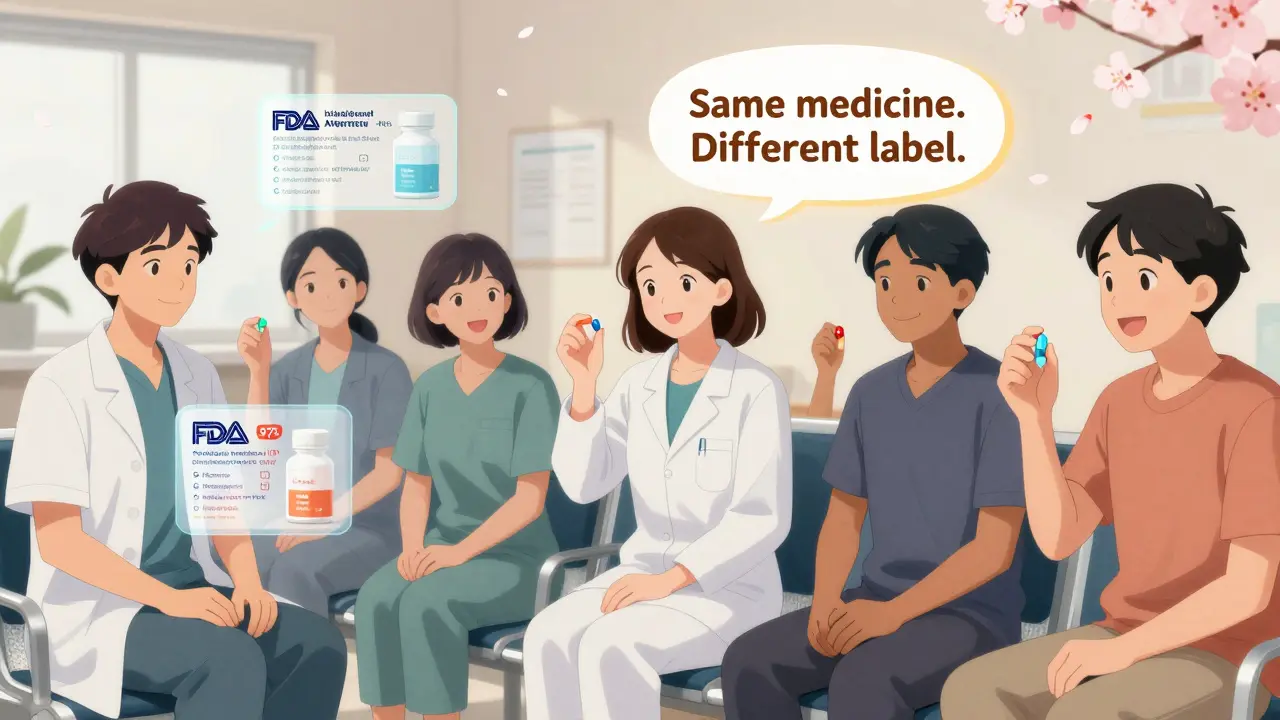
But here’s the twist: sometimes, it’s not the drug. It’s the pill. A generic might look different - different color, different shape, different imprint. Patients notice. And if they’ve been on the brand for years, they might think the change means it’s not working. A 2019 FDA study confirmed: appearance changes cause anxiety, not clinical problems. The fix? Talk to your patient. Say: "This is the same medicine. The FDA made sure of it. It’s just made by a different company." That simple conversation reduces discontinuation rates.
What about psychiatric drugs? Some studies showed slightly higher hospitalization rates with generics for escitalopram and sertraline. But here’s the catch: the same pattern showed up when comparing authorized generics (made by the brand company) to the original brand. That suggests it’s not the drug - it’s the perception. Patients who switch from a familiar brand to a new-looking generic may feel uneasy. That unease can show up as side effects - real or imagined. One study found authorized generics had lower emergency room visit rates than traditional generics. Why? Because they looked more like the brand. The medicine didn’t change. The patient’s trust did.
Real-world data from Medicare beneficiaries tells another story. In an unadjusted analysis, people taking generics had higher five-year survival rates than those on brand-name drugs. At first glance, that sounds like generics are better. But when researchers adjusted for health status - using inverse probability weighting - the gap vanished. Turns out, healthier patients were more likely to be prescribed generics. The drug wasn’t the reason for better outcomes. The patient’s overall health was.
Cost savings? They’re massive. Generics make up 90% of prescriptions in the U.S., but only 23% of drug spending. From 2008 to 2017, they saved the system $1.68 trillion. In 2021 alone, they saved $377 billion. That’s not just money. That’s access. A patient who can’t afford $400 for a brand-name statin can get the same active ingredient for $12. That’s not a trade-off. That’s a lifeline.
And here’s what no one talks about enough: generics aren’t just safe. They’re monitored. The FDA’s Adverse Event Reporting System shows only 0.02% of all adverse drug reports between 2015 and 2020 were linked to generic-specific concerns. Brand-name drugs? 3.2%. That’s 160 times more. If generics were dangerous, we’d see it. We don’t.
So what should you do as a provider? Start with this: if a generic is available and rated "A," prescribe it. Don’t wait for the patient to ask. Don’t assume they’ll refuse. Most don’t. The American College of Physicians says it plainly: "Prescribe generics when equivalent options exist." It’s not just cost-effective. It’s evidence-based.
When a patient pushes back - "I’ve always taken the brand" - don’t dismiss them. Ask why. Maybe they had a bad experience years ago. Maybe they heard a story. Listen. Then share the data. Tell them about the FDA’s 10-month review process. Tell them about the 24-36 healthy volunteers in bioequivalence trials. Tell them about the 1.3 million patient pairs studied. Tell them the drug is the same. The pill just looks different.
And if you’re still unsure? Look up the drug in the Orange Book. Check the rating. Talk to a pharmacist. Read the latest meta-analysis. The science isn’t hiding. It’s published. It’s peer-reviewed. It’s been replicated across continents.
Here’s the bottom line: for the vast majority of patients, generics are not a compromise. They’re the standard. And the data doesn’t just support that. It demands it.
What Does "Therapeutic Equivalence" Really Mean?
When the FDA says a generic is "therapeutically equivalent," it doesn’t mean "close enough." It means: same active ingredient, same dose, same strength, same route of administration, and same bioavailability. The drug must perform the same way in the body. That’s not opinion. It’s measured. In clinical trials. With blood samples. With pharmacokinetic curves.
For most drugs, the test is simple: compare the area under the curve (AUC) and peak concentration (Cmax) of the generic to the brand. The 90% confidence interval must fall between 80% and 125%. That’s a wide range - but it’s based on real variability in how people absorb drugs. Even brand-name drugs vary between batches. The system accounts for that.
For drugs like tacrolimus - where a 10% change in blood level can mean rejection or toxicity - the standard tightens. The FDA uses Scaled Average Bioequivalence (SCABE), which adjusts the range based on how much the drug varies naturally in the body. That’s not a loophole. It’s precision.
Why Do Some Patients Report Differences?
Patients report differences - more side effects, less effectiveness - when switching to generics. But studies show those reports are often tied to the act of switching, not the drug itself. A 2020 study of 3.5 million Medicare patients found that switching from brand to generic triggered a temporary spike in ER visits - but only in the first 30 days. After that? No difference. It’s like the body is adjusting to a new label, not a new medicine.
Also, inactive ingredients matter. A generic might use a different dye, filler, or coating. For 99% of people, that’s harmless. For the 1% with allergies or sensitivities - say, to lactose or a specific dye - it can cause issues. That’s why pharmacists check for allergies. That’s why you ask: "Any reactions to pills before?"
Are Authorized Generics Different?
Authorized generics are made by the brand-name company under a different label. They’re identical in every way - same factory, same formula, same pill. The only difference? Price. They’re cheaper because there’s no marketing cost.
Studies show patients are more likely to stick with authorized generics than traditional generics. Why? Because they look and feel like the brand. That’s not science. That’s psychology. But it’s real. If a patient has a history of switching back and forth, consider an authorized generic first. It’s the same drug. Just less expensive.
What About Complex Drugs?
Not all drugs are created equal. Inhalers, topical creams, injectables, and long-acting formulations are harder to replicate. The FDA’s 2023 draft guidance on complex generics acknowledges this. For these, bioequivalence isn’t just about blood levels. It’s about how the drug behaves in the lung, the skin, or the joint. That’s why some complex generics are rated "B" - not because they’re bad, but because the science is still catching up.
For these, don’t guess. Check the Orange Book. If it’s "B," stay with the brand - unless a newer study shows equivalence. And if you’re unsure? Ask a specialist. Or refer to the FDA’s guidance documents. They’re public. They’re updated. They’re there to help.
How to Talk to Patients About Generics
Patients aren’t resistant because they’re ignorant. They’re resistant because they’ve been sold a story: "Brand is better." Your job isn’t to argue. It’s to reframe.
- "This generic has the same active ingredient as your old pill. The FDA required proof it works the same way."
- "The only difference is the price. You’ll save over $300 this year."
- "I’ve prescribed this generic to dozens of patients. No one had a problem."
- "If you notice any changes, let me know. We can always switch back."
Don’t say: "It’s the same." Say: "It’s been tested. It’s approved. It’s cheaper. And it works."
Are generic drugs as safe as brand-name drugs?
Yes. The FDA requires generics to meet the same strict standards for quality, purity, and potency as brand-name drugs. Adverse event reports show only 0.02% of all drug-related incidents involve generics, compared to 3.2% for brand-name drugs. That’s 160 times fewer reports. The science doesn’t support safety concerns.
Why do some patients say generics don’t work for them?
Most often, it’s not the drug - it’s the switch. Changing pill shape, color, or size can trigger anxiety. Some patients also confuse the placebo effect with drug failure. Studies show these concerns drop sharply after the first few weeks. If a patient insists, consider an authorized generic - it looks identical to the brand - or give them time to adjust. Never assume a patient is wrong just because they feel different.
Can I trust generics for chronic conditions like hypertension or diabetes?
Absolutely. Large studies on amlodipine, metformin, and lisinopril show identical outcomes between generics and brands. A 2023 study of 2.1 million diabetics found no difference in HbA1c control. The FDA’s 2017 review found no consistent evidence of worse outcomes for generics in cardiovascular or metabolic diseases. For these conditions, generics are the standard of care.
What’s the difference between generic and authorized generic drugs?
An authorized generic is made by the original brand-name manufacturer but sold under a generic label. It’s identical in every way - same factory, same formula, same inactive ingredients. A traditional generic is made by a different company. Authorized generics often have higher patient acceptance because they look and feel like the brand. Both are equally effective.
Should I avoid generics for narrow therapeutic index drugs?
No - but be cautious. Drugs like warfarin, levothyroxine, and tacrolimus require tight blood level control. The FDA uses stricter bioequivalence standards for these. Most generics are approved and safe. But if a patient has had instability after switching, consider sticking with the brand or switching to an authorized generic. Always monitor levels closely after any switch.
What Comes Next?
The future of generics isn’t about more approvals. It’s about better communication. More providers need to know the data. More patients need to hear the truth. And more systems need to make generics the default - not the fallback.
Start with your next prescription. Choose the generic. Explain why. Document the conversation. Watch the outcomes. You’ll see what the studies already show: the medicine works. The patient gets better. And the system saves billions.


Angie Datuin
February 8, 2026 AT 17:06I’ve had patients tell me their generics 'don’t feel right'-and honestly, I used to worry too. But after reading this, I realize it’s not the drug. It’s the pill. Different shape, different color, different imprint. One guy swore his blood pressure meds stopped working after switching, but when I showed him the FDA bioequivalence charts and told him the manufacturer just changed the dye, he laughed and said, 'So I was mad at a color?' Yeah. That’s the whole thing.
Camille Hall
February 10, 2026 AT 14:37This is the kind of post that makes me proud to be a clinician. We’re not just prescribing pills-we’re fighting misinformation. I’ve started including a one-liner in my notes: 'Patient educated on generic equivalence per FDA Orange Book.' It’s not just for documentation-it’s for the patient who might Google this later and find a scammy blog saying generics are 'cut-rate poison.' We need to be louder than those blogs.
Also, love the point about authorized generics. I’ve started prescribing those first for patients with anxiety around switching. Same drug. Same factory. Just cheaper label. Works like magic.
Ritteka Goyal
February 10, 2026 AT 20:43OMG this is so true!! I live in India and we have so many generics here and people think they are fake or weak but NOOOO they are 100% same!! I had my cousin who was on generic atorvastatin and she was panicking because the pill was blue not white like before but when i showed her the FDA data and the bioequivalence % she cried like 'all this stress for a color??' LMAO!!
Also in India we have like 80% generics and no one dies!! We have more people on meds than USA and our outcomes are better!! So stop the stigma!! Generic is not cheap it is smart!!
PS: Why do Americans think brand = better? Is it ads? I think you guys are brainwashed by pharma commercials!!
PPS: I love how u said 'the pill looks different' - that’s the whole thing!! My grandma switched and thought she was getting a different medicine but it was same!! Just different shape!!
Ashlyn Ellison
February 11, 2026 AT 16:39My favorite part? The 0.02% vs 3.2% adverse event stats. That’s not even close. It’s like saying your car is safer if you drive a Tesla instead of a Toyota. Except the Toyota is 10x cheaper and gets you there just as fast.
Karianne Jackson
February 12, 2026 AT 06:54Wait. Are you telling me I’ve been paying $400 for a pill that’s exactly the same as the $12 one? And my doctor knew this? And never told me? I’m not mad. I’m not upset. I’m just… emotionally devastated.
Tom Forwood
February 13, 2026 AT 14:47Had a patient last week who refused generic metformin because 'it made me feel weird.' Turned out the new generic had a different coating-made it taste metallic. He’d been on brand for 8 years. Swapped him to an authorized generic (same pill, different label) and he said, 'This feels like the old one.' No change in meds. Just the packaging. Psychology is wild.
Also, side note: I always tell patients, 'If it works, it’s the same.' And if they say, 'But what if it’s not?' I say, 'Then let’s check your labs. If your HbA1c is the same, the pill’s doing its job.' Works every time.
John McDonald
February 15, 2026 AT 05:01Let’s be real: if generics were dangerous, the FDA wouldn’t let them fly. They’re not some shady loophole. They’re a rigorously tested, legally binding standard. The fact that 97% are rated 'A' isn’t luck-it’s science. And the 3% that aren’t? They’re usually complex delivery systems-like inhalers or topical gels-not your everyday blood pressure or diabetes med.
Here’s what I tell residents: if you’re unsure, check the Orange Book. If it says 'A,' prescribe it. If it says 'B,' ask a pharmacist. If it says 'A' and the patient freaks out? Use an authorized generic. No judgment. Just pragmatism.
And yeah, the cost savings? $377 billion in 2021 alone. That’s not a number. That’s 377 million reasons to stop treating generics like a second choice.
Chelsea Cook
February 16, 2026 AT 03:03So let me get this straight: we’ve spent decades convincing people brand-name drugs are superior… and the data says the opposite? And we’re still surprised? Wow. I mean, who else do we lie to like this? 'Oh, this organic kale is 3x better than conventional kale'-nope, same nutrients. 'This luxury toilet paper is softer'-nope, same cellulose. But somehow, pills are magic? Please. We’re living in a marketing dystopia.
Joseph Charles Colin
February 16, 2026 AT 12:21The bioequivalence threshold of 80–125% AUC and Cmax is rooted in pharmacokinetic variability across populations-this isn’t arbitrary. The 90% CI must fall within that range to establish therapeutic interchangeability. For narrow TI drugs, SCABE methodology adjusts the interval dynamically based on intra-individual variance, ensuring safety margins are maintained even under physiological heterogeneity. The FDA’s 2017 review of 15,000+ bioequivalence studies confirmed no clinically significant differences across CV, endocrine, or psychotropic agents. The outlier reports in psychiatric drugs are confounded by nocebo effects, not pharmacodynamic divergence. In short: the data isn’t just consistent-it’s overwhelming.