
GI Side Effect Management Calculator
Start Your Personalized Plan
Your Personalized Plan
Important Tips for Success
- Start slowly - your gut needs time to adjust
- Take medication with your first bite of carbs
- Consider taking with only your largest meal (usually dinner) if needed
- Avoid high-fiber foods during initial weeks (beans, broccoli, Brussels sprouts)
When you're managing type 2 diabetes, the last thing you want is to spend your day avoiding social situations because of constant gas, bloating, or cramps. Yet for many people taking acarbose or miglitol, that’s exactly what happens. These drugs work by slowing down how fast your body breaks down carbs, which helps keep blood sugar from spiking after meals. But that same mechanism leaves undigested sugar in your gut - and your gut bacteria turn it into gas. A lot of it.
Studies show up to 70% of people starting acarbose or miglitol experience noticeable flatulence within the first week. About 1 in 3 patients quit the medication within 12 weeks because the side effects feel worse than the diabetes itself. But here’s the truth: you don’t have to live with it. With the right approach, most people can get through the rough patch and keep using these drugs long-term - without the embarrassment.
Why These Drugs Cause So Much Gas
Acarbose and miglitol belong to a class called alpha-glucosidase inhibitors. They block enzymes in your small intestine that normally break down complex carbs like bread, pasta, and rice into simple sugars your body can absorb. Instead of being digested, those carbs move into your colon, where bacteria feast on them. The result? Lots of hydrogen, methane, and carbon dioxide - aka, gas.
The difference between acarbose and miglitol isn’t just in price - it’s in how your body handles them. Acarbose stays mostly in your gut. It doesn’t get absorbed into your bloodstream. That means it’s working right where the carbs are, but also dumping more undigested food into your lower intestine. Miglitol, on the other hand, gets absorbed about half as much. That means less of it stays behind to feed gut bacteria, which is why people on miglitol report fewer and less intense gas episodes.
A 2010 study comparing the two directly found that acarbose users had nearly 50% more flatulence than miglitol users in the first week. Bloating was worse too - 2.5 out of 4 on the discomfort scale versus 1.7 for miglitol. That’s not just a small difference. It’s the reason why doctors in Japan, where these drugs are used more often, tend to pick miglitol when GI tolerance matters.
How Bad Are the Side Effects Really?
Let’s be real - the numbers are rough. On Drugs.com, acarbose has a 5.2 out of 10 rating from nearly 200 users. Over half of those reviews call it “negative,” and 73% of those people say the main reason is excessive gas. Miglitol does a bit better - 6.1 out of 10 - but still, 61% of negative reviews point to the same problem.
It’s not just gas. People report bloating, stomach cramps, diarrhea, and even nausea. These symptoms usually hit hardest between days 3 and 7 after starting the drug. That’s when your gut bacteria are scrambling to adjust to the sudden influx of undigested carbs. But here’s the good news: they adapt.
Doctors who specialize in diabetes say most patients see major improvement by week 2 to 4. By week 6, many say the gas is manageable - not gone, but no longer life-disrupting. One Reddit user, u/DiabeticDave1982, shared that after starting with just 25mg of acarbose once a day and slowly increasing over six weeks, his gas dropped from “unbearable” to “barely noticeable” after month two.
The Dose That Saves Your Social Life
The biggest mistake people make? Starting at the full dose. Many are told to take 50mg or 100mg of acarbose with every meal right away. That’s like throwing a bucket of sugar into your colon on day one. No wonder it explodes.
Instead, start low. The American Diabetes Association recommends beginning with just 25mg of acarbose or miglitol with your first bite of each meal. Wait two to four weeks. If you’re tolerating it okay - even if you still have some gas - then bump up to 50mg. After another few weeks, go to 100mg if needed. This slow ramp-up cuts the chance of quitting the drug by more than half.
Some patients even do better taking the drug only with their largest meal of the day - usually dinner - instead of all three. That reduces the total amount of undigested carbs hitting the colon at once. It’s not perfect for blood sugar control, but if you’re choosing between stable glucose and being stuck at home, it’s a trade-off worth considering.
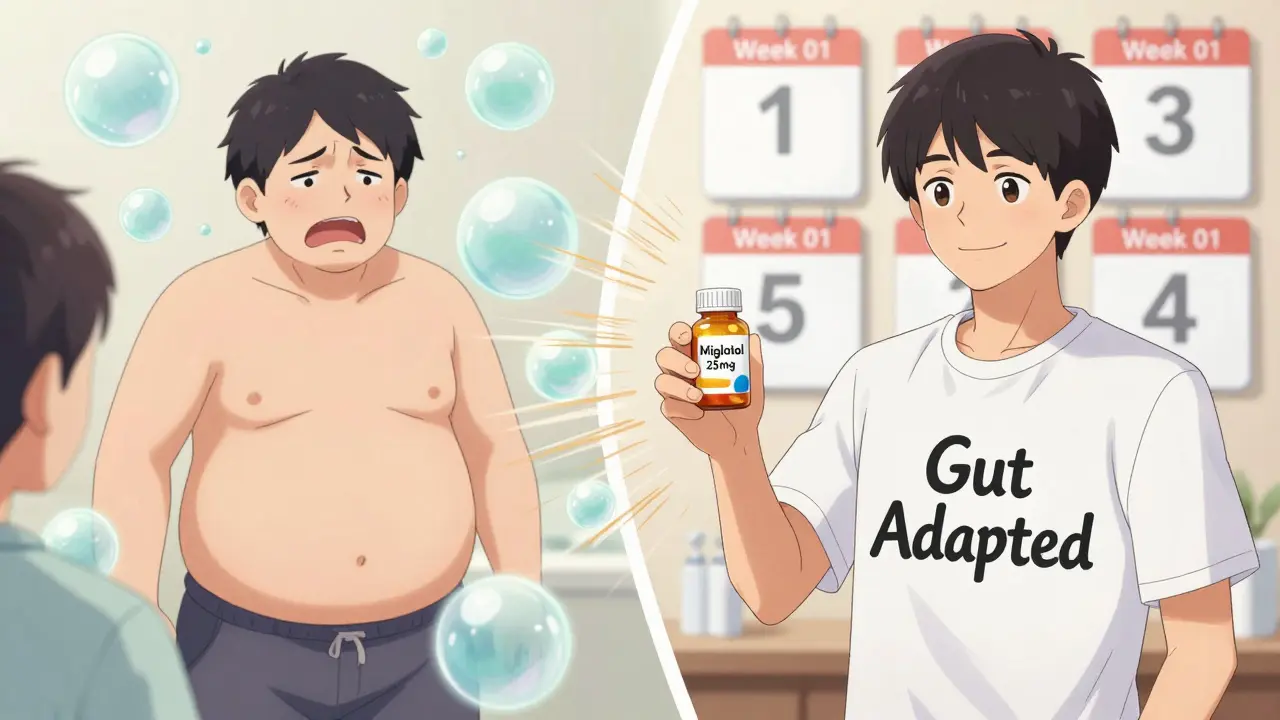
Diet Tweaks That Cut Gas in Half
What you eat matters just as much as how much you take. Carbs aren’t all the same. Simple sugars like candy, soda, and fruit juice get broken down quickly - even with these drugs. That means they still cause spikes in blood sugar and also feed bacteria fast, leading to more gas.
Focus on complex carbs: whole grains, legumes, starchy vegetables. These are digested slower, so your gut has more time to adjust. Avoid high-fiber foods like beans, broccoli, and Brussels sprouts during the first 3-4 weeks. Fiber adds fuel to the fire. Once your gut settles, you can slowly reintroduce them.
Also, spread your carbs out. Don’t save all 90 grams for dinner. Aim for 45-60 grams per meal. That keeps the bacterial feast manageable. And don’t skip meals. Taking the drug without carbs means it’s sitting there doing nothing - and still causing irritation.
What Actually Works to Reduce Gas
There are a few proven tricks that don’t involve quitting the drug.
- Activated charcoal: Taking 500-1,000 mg 30 minutes before meals can reduce flatus volume by up to 32%. It absorbs gas in the gut before it builds up.
- Simethicone: Found in Gas-X or Mylanta, this breaks up gas bubbles. Taking 120mg three times a day reduces bloating severity by 40%, according to a 2019 study in Diabetes Care.
- Probiotics: Not all probiotics help - but specific strains do. Lactobacillus GG (10 billion CFU daily) cut flatulence frequency by 37% in a 12-week trial. Another study showed Bifidobacterium longum BB536 reduced gas from miglitol by 42%.
Don’t waste money on random “gut health” supplements. Stick to the ones with research behind them. And give them at least 4 weeks to work. Your gut microbiome doesn’t change overnight.

When to Consider Switching
If after 8 weeks of slow dosing, dietary changes, and gas-reducing aids you’re still miserable, it’s time to talk to your doctor about alternatives. Miglitol is generally better tolerated than acarbose. If you’re on acarbose, switching to miglitol might be the easiest fix.
But if even miglitol is too much, other options exist. GLP-1 agonists like semaglutide reduce blood sugar without causing gas - though they can cause nausea. SGLT2 inhibitors like empagliflozin are weight-neutral and don’t cause GI issues. Metformin is still first-line, but if you can’t take it because of diarrhea, these drugs fill the gap.
The key is not to suffer in silence. Many patients feel guilty for quitting because they think they’re “giving up.” But if a drug makes you avoid family dinners, skip work events, or dread going out, it’s not helping - it’s hurting.
Why These Drugs Still Matter
Despite the side effects, acarbose and miglitol have unique advantages. They don’t cause weight gain. They don’t cause low blood sugar. And they lower HbA1c by 0.5% to 1.0% - similar to metformin, but without the diarrhea. In Japan, where people eat more rice and carbs, these drugs are first-line. That’s not because they’re perfect - it’s because they work well for the diet people actually eat.
Even in the U.S., they’re still useful. If you’re obese, if you can’t take metformin, or if you need a drug that won’t make you gain weight, these are among the few options that fit. And now, with newer combo pills like Acbeta-M (acarbose + metformin in one controlled-release tablet), side effects are dropping by 28% in early trials.
There’s also new research showing that genetic testing might soon tell you if you’re likely to have bad reactions to these drugs - before you even start. That could make personalized dosing the norm, not the exception.
For now, the message is simple: don’t give up too soon. The worst of it lasts less than a month. With the right dose, the right diet, and a few simple aids, most people find their way back to normal life - and better blood sugar control - without giving up on these drugs.




Nancy Kou
December 20, 2025 AT 13:30This is the most practical guide I've ever read on acarbose side effects. I started at 25mg with dinner only and within three weeks, my gas went from 'emergency evacuation mode' to 'mild inconvenience.' No magic pills, just patience and carb management.
Matt Davies
December 22, 2025 AT 00:41Man, I wish I’d read this before I bailed on acarbose after a week. I thought I was broken-turns out I just went full turbo mode on day one. Now I’m back on 25mg with lunch and dinner, using simethicone like a champ. My wife says I’m finally human again. Thanks for the real talk.
Hussien SLeiman
December 23, 2025 AT 13:24Let’s be honest-this whole ‘slow titration’ advice is just sugar-coated capitulation. If your body can’t handle a full dose of acarbose, it’s not the drug that’s the problem, it’s your gut being a fragile, carb-addicted mess. People treat these medications like they’re tea, not pharmaceuticals designed to disrupt digestion. You want to eat rice and pasta without consequences? That’s not how biology works. Either take the hit or switch to something that doesn’t pretend to be a carb cop. The fact that people need probiotics and charcoal just to tolerate a diabetes drug speaks volumes about how broken this approach is.
Meenakshi Jaiswal
December 24, 2025 AT 11:06As a diabetes educator, I’ve seen this play out a hundred times. The biggest myth is that side effects mean the drug isn’t working. It’s the opposite-it’s working too well. The key is not to quit, but to coach the gut through the transition. I always tell patients: think of it like training for a marathon. You don’t run 26 miles on day one. Start slow, hydrate, listen to your body. And yes-activated charcoal really works. I’ve had patients go from 10+ episodes a day to 2-3 after two weeks. It’s not glamorous, but it’s science.
Anna Sedervay
December 25, 2025 AT 21:47While the article presents a superficially coherent framework, it conspicuously omits the potential influence of glyphosate residues in modern carbohydrate sources, which may synergistically exacerbate gut dysbiosis when combined with alpha-glucosidase inhibitors. Furthermore, the recommendation to use Lactobacillus GG is statistically dubious given the heterogeneity of microbiome responses across ethnic populations-particularly in individuals of East Asian descent, where baseline Bifidobacterium levels are significantly elevated. One must question the generalizability of Western clinical trials in populations consuming traditional, unrefined diets.
bhushan telavane
December 27, 2025 AT 03:18Bro, in India we’ve been using acarbose for ages with rice-heavy meals. The trick? Eat your dal and roti together, not rice alone. And never skip the yogurt after dinner. It’s not rocket science. Also, avoid mangoes for the first month. Sweet, but deadly with this med.
Mahammad Muradov
December 28, 2025 AT 11:42Anyone who needs charcoal or simethicone to tolerate a diabetes drug shouldn’t be on it at all. This is just pharmaceutical band-aiding a lifestyle failure. If you’re eating enough carbs to generate this much gas, you’re not managing diabetes-you’re enabling it. The real solution is keto. End of story.
mark shortus
December 29, 2025 AT 22:25MY GUT WAS IN A WAR ZONE FOR 3 WEEKS. I THOUGHT I WAS DYING. I WASN’T. I WAS JUST BEING REBUILT. AND THEN-ONE DAY-I ATE A BURGER AND DIDN’T TURN INTO A HUMAN BALLOON. I CRIED. NOT FROM PAIN. FROM FREEDOM. THIS DRUG SAVED MY LIFE. NOT BECAUSE IT’S PERFECT. BECAUSE I WAS STRONG ENOUGH TO STICK WITH IT. TO THE PEOPLE WHO QUIT: YOU DIDN’T LOSE TO THE DRUG. YOU LOST TO YOUR OWN FEAR.
Mike Rengifo
December 30, 2025 AT 05:42Just wanted to say thanks for the miglitol tip. Switched from acarbose last month and the difference is like going from a jackhammer to a whisper. Still get a little gurgle after pasta, but now I can go to brunch without planning an escape route.